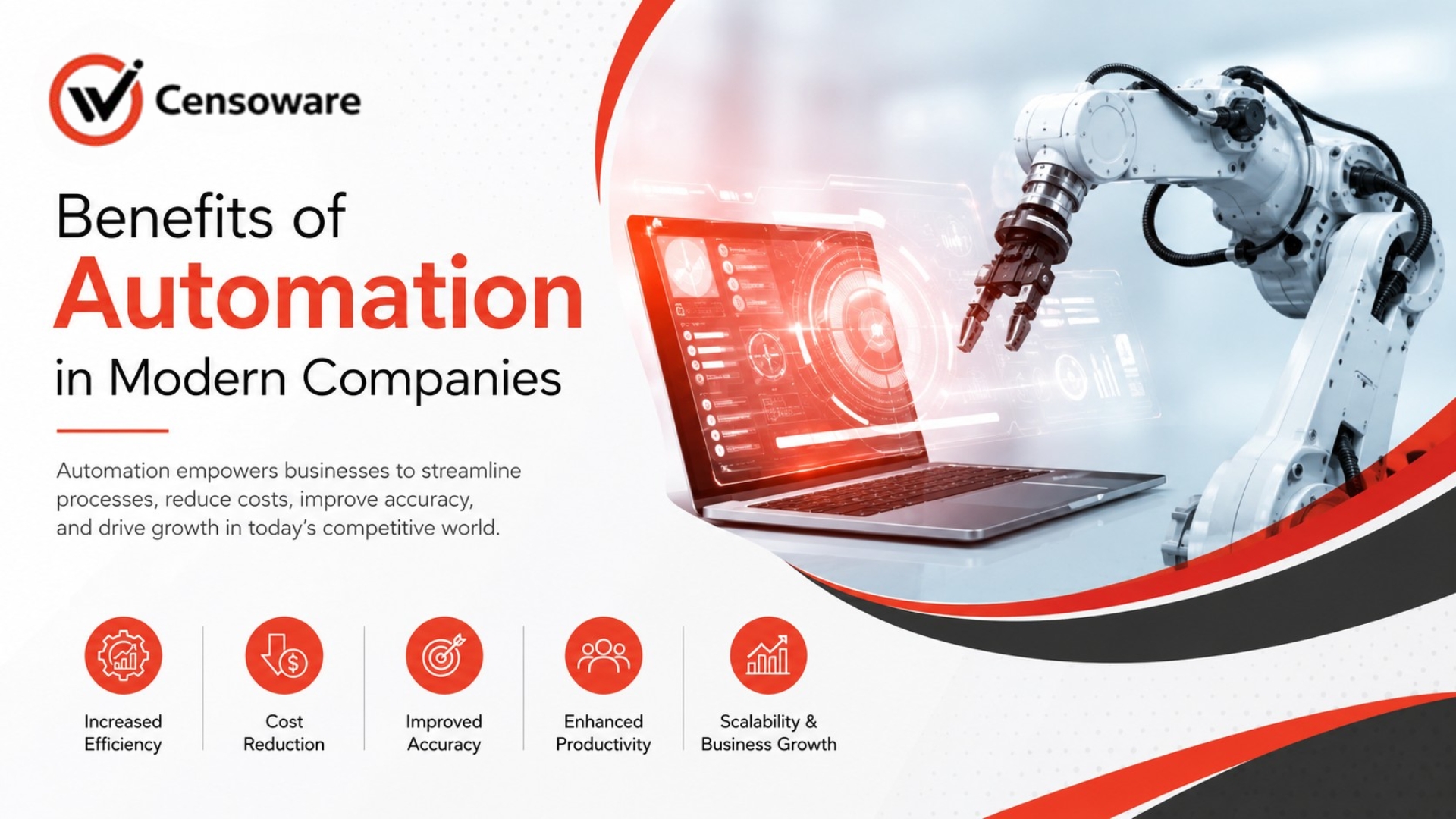
Benefits of Automation in Modern Companies
Repetitive tasks are expensive. Not just in the wages paid to perform them, but in the time, errors, and missed opportunities they create when handled manually. Automation addresses this directly, and the companies applying it well are pulling ahead.
- Introduction
- What Business Automation Means
- Reducing Costs and Improving Efficiency
- Eliminating Errors and Ensuring Quality
- Empowering Employees
- Scaling Without Proportional Cost
- Where to Start
- Frequently Asked Questions
In every department of a modern business, from finance and operations to marketing and customer service, large amounts of productive time are spent on work that follows predictable rules and does not require human judgment. Repetitive tasks are expensive. Not just in the wages paid to perform them, but in the time, errors, and missed opportunities they create when handled manually.
What This Guide Covers
- What business automation means in practice.
- How automation reduces costs and improves efficiency.
- The role of automation in reducing errors and ensuring quality.
- How automation frees employees for higher-value work.
- Scaling operations without proportional cost increases.
- Frequently asked questions.
This guide explains what business automation is, why it matters, and how modern companies are using it to build operations that scale without friction.
What Business Automation Means
Business automation is the use of technology to complete tasks that would otherwise require manual human effort. The tasks most suited to automation are those that are repetitive, rule-based, and high-volume, where the process follows the same steps each time and the inputs and outputs are clearly defined.
Automation exists across a wide spectrum. At the simpler end, you have scheduled email campaigns and automatic invoice generation. Further along the spectrum, Robotic Process Automation, or RPA, uses software bots to replicate complex workflows across multiple systems without human involvement at any step.
Advanced artificial intelligence is being integrated into automation platforms to handle tasks that require pattern recognition, decision-making, or natural language processing. These systems learn from data and improve their performance over time.
Reducing Costs and Improving Efficiency
The most measurable benefit of automation for most businesses is cost reduction. When software handles work that previously required staff hours, those hours become available for activities that create more value. In many cases, automation also eliminates the need for headcount growth as the business scales.
Automated processes run faster than manual ones, often completing in minutes what previously took hours or days. Faster processes mean faster cash flow, stronger vendor relationships, and better customer experiences.
Measurable Productivity Gains
An automation tool can complete tasks continuously, in seconds, without breaks and without errors. The productivity gain is permanent once the automation is in place, allowing revenue to increase without a proportional rise in labor costs.
Eliminating Errors and Ensuring Quality
Manual processes produce errors. Automation eliminates error at its source. Once a process is correctly configured, the software follows it identically every time, regardless of volume, time pressure, or fatigue.
In regulated industries such as financial services and healthcare, consistency is not optional. Automation helps businesses maintain compliance by processing transactions according to defined rules and creating audit trails automatically.
Quality Across Functions
Automated testing in software development catches bugs before release. Automated data validation prevents incorrect information from reaching decision-makers. Automated quality checks in production identify defects faster and more reliably.
Empowering Employees
When automation handles repetitive work, employees are free to focus on what they were actually hired to do. A marketing analyst spends more time on strategy, while a finance professional focuses on planning rather than reconciliation.
Employee satisfaction improves when work becomes more meaningful. People are less likely to leave roles that challenge and develop them. Recruitment becomes easier when the organization can offer work that is substantive rather than administrative.
Scaling Without Proportional Cost
Traditional business growth requires more customers, more orders, and more administrative work. Without automation, meeting this increased demand requires hiring more people and expanding management layers.
Automation breaks this pattern. Software can handle dramatically higher volumes without additional cost per unit of work. The business scales its revenue without scaling its operational costs at the same rate. This is particularly valuable during growth phases and periods of seasonal demand.
Where to Start
The question for most business leaders is not whether to automate but where to begin. The strongest starting points are processes that are high-volume, rule-based, and currently producing errors or delays.
1. Map current workflows
Identify the processes that consume the most manual time and have the clearest inputs and outputs.
2. Prioritize by impact
Focus first on processes that affect revenue, customer experience, or compliance for the most visible results.
3. Start with a pilot
Automate one process, measure results, and use that evidence to build confidence before a broader rollout.
Frequently Asked Questions
Does automation mean replacing employees with software?
Not typically. Most businesses use automation to remove repetitive tasks from existing roles rather than eliminate positions. The goal is to redirect human effort toward higher-value work.
What types of tasks are easiest to automate?
Tasks that are rule-based, repetitive, and high-volume, such as data entry, report generation, and scheduling, are the best candidates.
How much does business automation cost?
Costs vary widely. Simple workflow tools cost very little, while sophisticated RPA solutions require a larger investment but typically deliver returns that justify the spend.
How long does it take to see results from automation?
Simple automations can deliver measurable results within days. More complex projects take longer but produce larger and more durable improvements once in place.
Can automation work for small businesses?
Yes. Many automation tools are specifically designed for small businesses and priced accordingly. Even simple automations can save significant time for a small team.
Conclusion
Automation is one of the most reliable ways for a modern business to improve its operations without proportionally increasing its costs. The benefits compound over time: fewer errors, faster processes, and employees who are focused on the work that moves the business forward.
The businesses that invest in automation today are building an operational foundation that will support stronger margins and more consistent growth.
Ready to build an operational foundation for consistent growth? Talk to our experts at Censoware today.