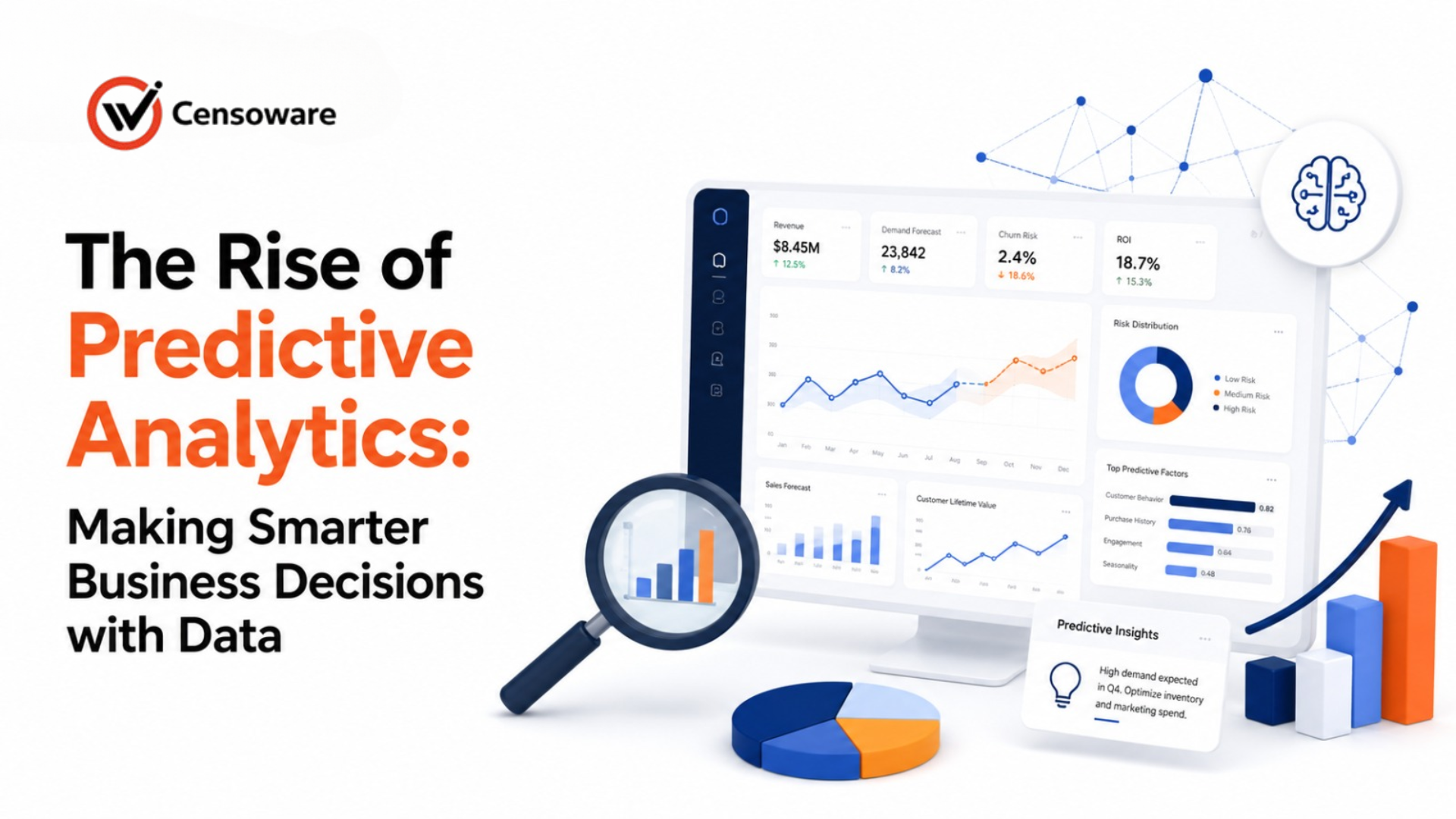
The Rise of Predictive Analytics: Making Smarter Business Decisions with Data
A guide to understanding what predictive analytics is, why it has become essential, and how organizations use it to make faster decisions.
- Introduction
- Understanding Predictive Analytics
- Why This Capability Has Become Essential
- Where Predictive Analytics Is Delivering Value
- Building the Capability
- Common Challenges
- Frequently Asked Questions
In today's data-saturated business environment, simply collecting information is no longer enough to stay competitive. Organizations across every industry are shifting from reactive decision-making, analyzing what already happened, to proactive strategies powered by predictive analytics.
This guide explains what predictive analytics actually is, why it has become a critical business capability, and how organizations are using it to make faster, more confident decisions.
What This Guide Covers
- What predictive analytics is and how it differs from traditional reporting.
- The industries and functions where predictive models are delivering the most value.
- The building blocks businesses need to develop this capability.
- Common challenges businesses face when adopting predictive analytics.
Understanding Predictive Analytics
Predictive analytics uses historical data, statistical algorithms, and machine learning to identify patterns and forecast future outcomes. Unlike traditional business intelligence, which mainly describes what already happened, predictive analytics answers a forward-looking question: what is likely to happen next, and how should we prepare?
This relies on analyzing large volumes of data, from sales records to IoT sensor readings, to build models that surface patterns invisible to the human eye.
Why This Capability Has Become Essential
Businesses now generate more data than ever, from transactions to website interactions, but that data only creates value for organizations equipped to analyze it meaningfully. Markets have also grown more volatile, and businesses that can anticipate shifts in demand or pricing gain a real advantage over those reacting after the fact.
As more competitors adopt predictive analytics successfully, businesses relying solely on intuition find themselves increasingly outpaced.
Where Predictive Analytics Is Delivering Value
Predictive analytics is reshaping how organizations operate across key sectors.
Retail and Financial Services
Retailers use it for demand forecasting and personalized recommendations that lift conversion rates. Financial institutions rely on it for credit risk assessment and fraud detection, flagging suspicious transactions far faster than manual review.
Healthcare and Manufacturing
In healthcare, predictive models identify patients at risk of developing certain conditions, enabling earlier intervention. Manufacturers use it primarily for predictive maintenance, forecasting equipment failure before it happens.
HR and Marketing
HR teams use it to flag flight-risk employees before they resign, while marketing teams use it to target campaigns toward the customers most likely to convert.
Building the Capability
A solid data infrastructure capable of collecting and processing information from multiple sources is the essential starting point. Skilled analysts who understand both the technical modeling and the business context are equally important, though increasingly accessible platforms are letting non-technical users work with predictive insights directly.
The Role of Culture
Perhaps most critical is organizational culture: even the most accurate model provides little value if leaders continue relying primarily on gut instinct rather than incorporating data into decisions.
Common Challenges
Data quality remains a persistent obstacle, since predictive models are only as reliable as the data feeding them. Model interpretability can also create hesitation, as complex models sometimes function as "black boxes" that are hard to explain.
Predictive models also require ongoing retraining, since accuracy can degrade as market conditions and customer behavior shift over time.
Frequently Asked Questions
1. How is predictive analytics different from regular reporting?
Regular reporting describes what already happened. Predictive analytics uses that historical data to forecast what is likely to happen next, allowing for proactive rather than reactive decisions.
2. Do small businesses have access to predictive analytics tools?
Increasingly, yes. Cloud-based platforms have significantly lowered the cost and technical expertise once required, making these capabilities accessible beyond large enterprises.
3. What kind of data is needed to get started?
Any structured historical data related to the business, such as sales records, customer interactions, or operational logs, can serve as a starting point for basic predictive models.
4. How accurate are predictive models typically?
Accuracy varies by use case and data quality. Models generally improve over time as more data becomes available and as they are retrained regularly.
5. What's the most common mistake businesses make with predictive analytics?
Treating it as a one-time project rather than an ongoing process. Models need continuous monitoring and retraining to stay accurate as conditions change.
Final Thoughts
Predictive analytics has fundamentally changed how successful businesses approach decision-making, shifting the focus from understanding the past to anticipating the future.
Organizations that invest in the right data infrastructure, talent, and culture are positioning themselves to make smarter, faster decisions in an increasingly competitive marketplace.
Censoware helps organizations implement and leverage predictive analytics. Ready to turn your historical data into a forward-looking advantage?
Consult our analytics and data team.