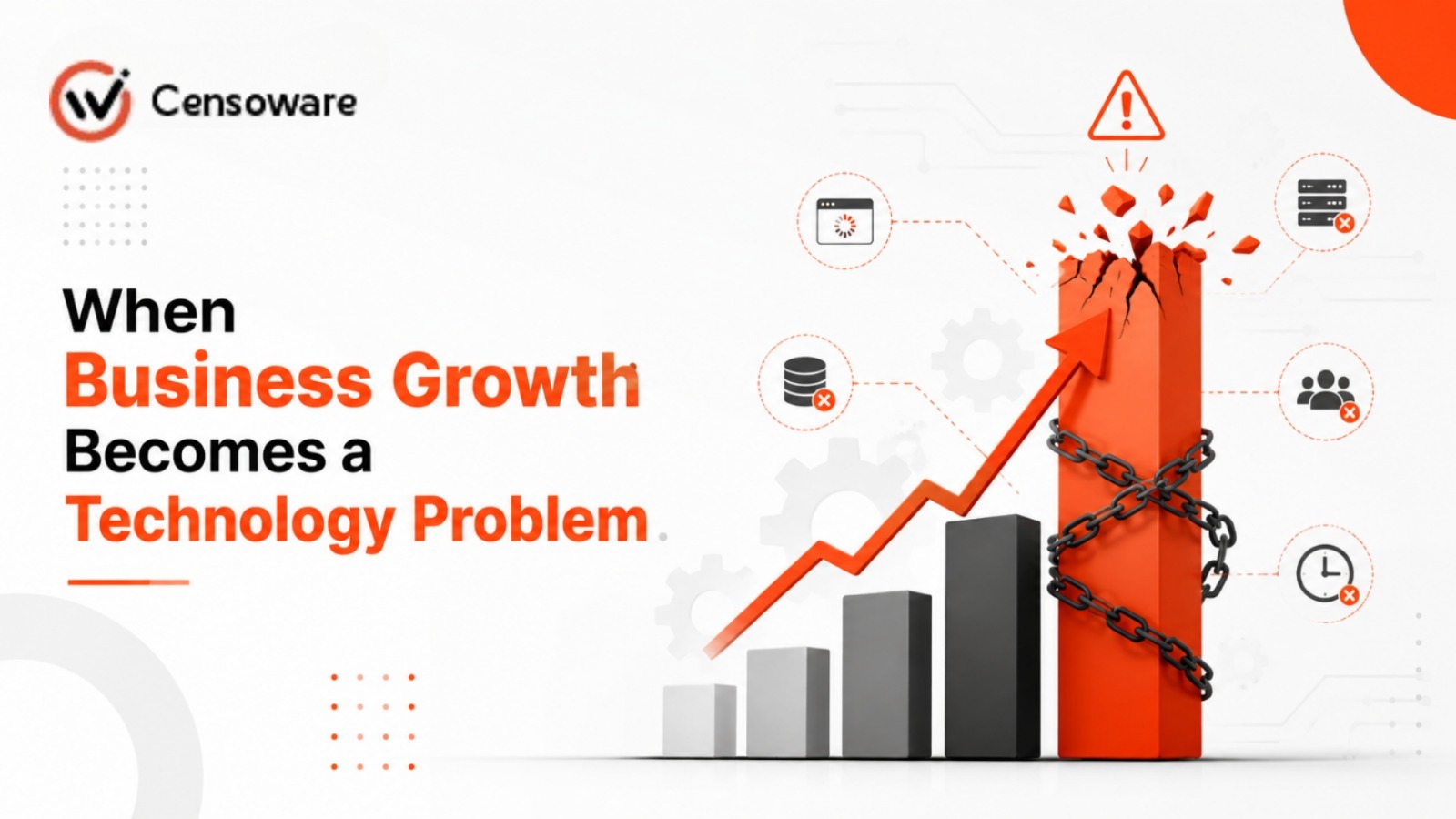
When Business Growth Becomes a Technology Problem
A strategic guide to identifying when legacy systems, disconnected tools, and fragmented processes begin to restrict business growth, and how to plan a phased digital transformation.
- Introduction
- Growth Reveals Problems That Were Always There
- How Legacy Systems Quietly Become Obstacles
- The Compounding Cost of Disconnected Processes
- What Digital Transformation Actually Involves
- Approaching Transformation Without Disrupting Daily Operations
- Frequently Asked Questions
Business growth is usually described in positive terms: more customers, more revenue, more opportunity. What gets discussed far less often is how growth exposes the limits of the technology a business has relied on for years. Systems that were perfectly adequate when a business was smaller can become genuine obstacles once the business scales, not because the technology failed, but because it was never designed to support the business the company has since become.
This creates a specific kind of challenge: a business problem that is, at its root, a technology problem. Leadership may sense that operations feel slower, more error-prone, or harder to coordinate than they should be, without immediately recognizing that outdated or disconnected systems are the underlying cause. This guide looks at how legacy systems and disconnected processes create this friction, and what digital transformation actually involves when it comes to resolving it.
What This Guide Covers
- Why legacy systems that once worked well quietly become growth obstacles.
- How disconnected processes and tools compound as a business scales.
- What digital transformation actually involves beyond the buzzword.
- How to approach integration and transformation without disrupting daily operations.
Growth Reveals Problems That Were Always There
It is tempting to think of technology problems as something a business develops as it grows, but in most cases, the underlying weaknesses were present from the start. A legacy system with limited capacity, or two tools that were never properly connected, are problems that exist regardless of a business's size. What growth actually does is increase the frequency and the visibility of those problems, turning something that was a minor, occasional inconvenience into a constant, unavoidable source of friction.
This distinction matters because it changes how a business should think about fixing the problem. The goal is not simply to accommodate a larger version of the same flawed process. It is to address the underlying weakness directly, since that weakness will continue to resurface, in new and increasingly costly forms, as the business continues to grow.
How Legacy Systems Quietly Become Obstacles
Legacy systems rarely fail all at once. They tend to become obstacles gradually, as the gap between what the system was designed for and what the business actually needs grows wider over time. A system built to manage a few hundred customer records can technically continue running as that number grows into the tens of thousands, but performance degrades, workarounds accumulate, and the system becomes progressively harder to maintain or extend.
The risk with legacy systems is that this decline is often invisible until it becomes a serious constraint. Businesses frequently do not recognize how much a legacy system is costing them, in staff time, in errors, in missed opportunities, because the cost is spread out gradually rather than appearing as a single, obvious expense. By the time leadership fully recognizes the problem, the system is often deeply embedded in daily operations, making it harder and more disruptive to replace.
The Compounding Cost of Disconnected Processes
As businesses grow, they tend to accumulate more tools—a system for sales, a separate system for inventory, another for accounting, another for customer support—often adopted at different times to solve specific, immediate problems. Individually, each tool may work reasonably well. Collectively, when these systems do not communicate with each other, they create a fragmented operational environment where information has to be manually transferred, reconciled, and double-checked between systems.
This fragmentation compounds as a business scales. What was a minor inconvenience when a business had ten customers becomes a significant operational drag at a thousand customers, since every disconnected handoff between systems now happens far more frequently, multiplying both the time cost and the risk of error. Departments that should have a shared, unified view of the business instead work from different, sometimes contradictory versions of the same information.
What Digital Transformation Actually Involves
Digital transformation is often discussed in abstract, aspirational terms, but at its core, it involves a specific and practical goal: replacing outdated or disconnected systems with integrated technology that reflects how the business actually operates today, rather than how it operated years ago when the original systems were first put in place.
This does not necessarily mean replacing every system at once. Effective digital transformation is usually approached in phases, starting with the systems or integrations causing the most operational friction, and expanding from there. A business might begin by connecting its sales and inventory systems, eliminating a specific, painful manual reconciliation process, before moving on to address other disconnected areas.
The goal throughout is not technology for its own sake. It is building a technology foundation that can actually support the business's current scale and its future growth, rather than continuing to patch around the limitations of systems that were designed for a smaller, simpler version of the company.
Approaching Transformation Without Disrupting Daily Operations
One of the biggest concerns businesses have about digital transformation is disruption, the fear that replacing core systems will create chaos during the transition. This concern is reasonable, but it is usually addressed through careful, phased planning rather than by avoiding transformation altogether. Running new and legacy systems in parallel during a transition period, migrating data carefully, and training staff before a full cutover all reduce the risk of significant disruption.
It also helps to prioritize based on impact rather than attempting a complete transformation all at once. Addressing the single most painful, disconnected process first delivers a clear, visible win, builds internal confidence in the transformation process, and provides a template for how subsequent phases should be approached.
Frequently Asked Questions
1. How do I know if my business's technology problems are actually a growth issue?
If operational friction, errors, delays, disconnected data, has increased noticeably as your business has grown, even though your team and processes have not fundamentally changed, that pattern usually points to a technology limitation rather than a people problem.
2. Does digital transformation mean replacing all our current systems?
Not necessarily. Many successful transformations focus on integrating and connecting existing systems rather than replacing everything, particularly in the early phases.
3. Is digital transformation only relevant for large enterprises?
No. Small and mid-sized businesses frequently face the same disconnected-systems problems as larger companies, often with fewer internal resources to absorb the resulting inefficiency, making transformation just as relevant, if not more so.
4. How long does a typical digital transformation take?
Timelines vary widely depending on scope, but phased approaches allow businesses to see meaningful improvements within the first phase, rather than waiting for a single, lengthy project to conclude.
5. What is the biggest risk of postponing digital transformation?
The main risk is that legacy systems become more deeply embedded in daily operations over time, making them progressively harder, more disruptive, and more expensive to replace the longer a business waits.
Final Thoughts
Growth exposes limitations that were invisible at a smaller scale, and technology is frequently where those limitations show up first. Legacy systems and disconnected processes rarely cause a single, obvious crisis; instead, they create a steady accumulation of friction that makes a growing business feel slower and more fragile than it should be.
Digital transformation, approached deliberately and in phases, addresses this friction at its source rather than continuing to work around it. Businesses that recognize this pattern early, and act before legacy systems become too deeply embedded to change easily, tend to scale far more smoothly than those that wait until the technology problem becomes impossible to ignore.
Censoware helps growing businesses navigate digital transformation by integrating disconnected systems and engineering custom solutions built to scale. Ready to modernize your technology foundation?