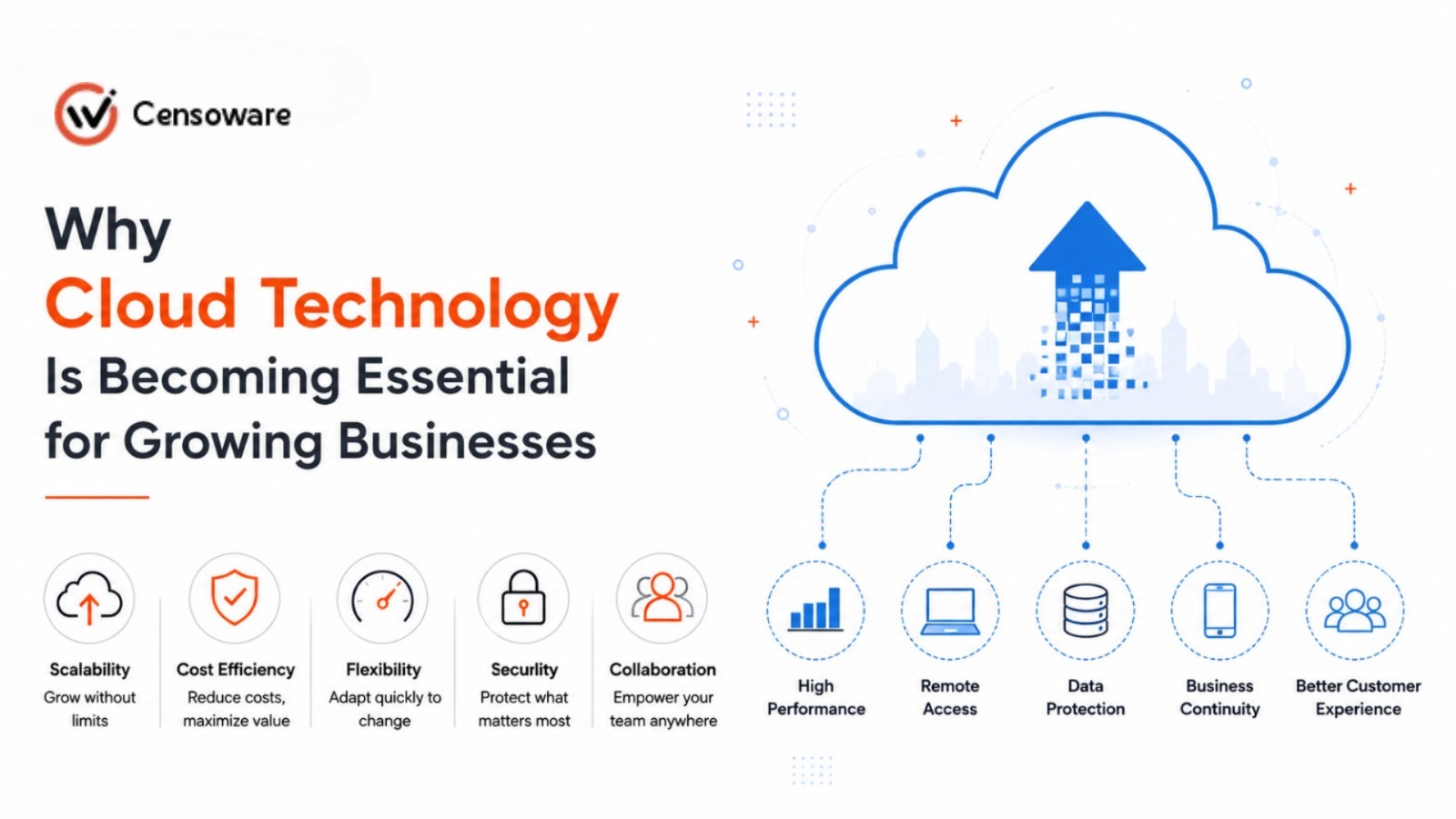
Why Cloud Technology Is Becoming Essential for Growing Businesses
An overview of how cloud infrastructure shifts technology from a fixed constraint to a scalable utility, enabling modern businesses to control costs, work flexibly, and secure operations.
- Introduction
- Reliability and Business Continuity
- What Cloud Technology Means in Practical Terms
- Scalability Without Heavy Upfront Investment
- Accessibility and Collaboration Across Locations
- Cost Efficiency Over the Long Term
- Frequently Asked Questions
For much of the last two decades, businesses treated cloud technology as an optional upgrade, something to consider once the budget allowed for it. That assumption has largely reversed. Today, cloud infrastructure is closer to a baseline requirement than an optional enhancement, particularly for any business that expects to grow, hire remotely, or serve customers across multiple locations.
This shift is not driven by hype. It reflects a practical reality: businesses running on-premise, locally hosted systems increasingly find themselves at a disadvantage when it comes to scaling operations, enabling collaboration, and controlling long-term costs. This guide explains what cloud technology actually offers a growing business, and why so many companies are treating it as essential rather than optional.
What This Guide Covers
- What cloud technology actually means for day-to-day business operations.
- How the cloud improves scalability without large upfront infrastructure costs.
- Why remote accessibility and collaboration increasingly depend on cloud systems.
- How moving to the cloud affects long-term cost efficiency for growing businesses.
Reliability and Business Continuity
One benefit of cloud technology that often gets less attention than cost or scalability is reliability. On-premise systems are vulnerable to local disruptions—a hardware failure, a power outage, a damaged server—that can bring an entire business's operations to a halt until the physical problem is fixed. Recovering from these disruptions can take hours or days, during which a business may be unable to process orders, access customer records, or communicate internally.
Cloud providers typically maintain redundant infrastructure across multiple locations, which means a single hardware failure or local outage is far less likely to take an entire system offline. Data is also backed up automatically as a standard part of most cloud services, reducing the risk of permanent data loss that has historically been one of the most damaging outcomes of relying on a single, local server. For a growing business, this kind of resilience becomes increasingly important, since the cost of downtime tends to rise as more people and processes depend on the system staying available.
What Cloud Technology Means in Practical Terms
At its core, cloud technology means running software, storing data, and processing information on remote servers accessed over the internet, rather than on physical hardware owned and maintained by the business itself. Instead of purchasing servers, installing software locally, and managing updates manually, a business relies on a cloud provider to handle the underlying infrastructure, while accessing the actual tools and data through a browser or app.
This shift changes more than where data physically lives. It changes how a business relates to its own technology. Instead of treating software as a fixed asset that requires ongoing physical maintenance, cloud technology treats software as an evolving service that updates automatically, scales on demand, and can be accessed from virtually anywhere with an internet connection.
Scalability Without Heavy Upfront Investment
Traditional, on-premise infrastructure requires businesses to predict their future needs and invest accordingly, purchasing enough server capacity to handle growth that may or may not materialize on schedule. Overestimate, and the business wastes money on unused capacity. Underestimate, and systems slow down or fail exactly when the business needs them most, often during periods of rapid growth or high demand.
Cloud infrastructure removes much of this guesswork. Businesses can scale their storage, processing power, and software capacity up or down based on actual, current demand, rather than committing to a fixed level of infrastructure years in advance. A retail business preparing for a seasonal sales spike, for example, can temporarily scale up cloud resources to handle increased traffic, then scale back down once the spike passes, paying only for what it actually uses. This kind of flexibility is simply not available with fixed, on-premise infrastructure, where capacity stays locked in place until new hardware is purchased and installed, regardless of whether that extra capacity is actually needed.
Accessibility and Collaboration Across Locations
As businesses increasingly rely on remote and hybrid teams, or simply operate across multiple physical locations, the ability to access systems and data from anywhere has become a basic operational requirement rather than a convenience. Cloud-based systems allow employees to access the same files, tools, and dashboards regardless of where they are physically working, without depending on a local server that only functions within one office.
This accessibility also transforms collaboration. Multiple team members can work on the same document, dataset, or project simultaneously, with changes reflected in real time, rather than emailing files back and forth and manually reconciling different versions. For businesses with teams spread across cities or even countries, this shift alone can meaningfully reduce the delays and miscommunication that come from working on outdated or duplicated files.
Cost Efficiency Over the Long Term
While cloud services involve ongoing subscription costs, they typically eliminate much larger expenses associated with maintaining physical infrastructure—hardware purchases, server maintenance, dedicated IT staff for infrastructure management, and the cost of downtime when on-premise systems fail. Over time, this shift from large upfront capital expenses to predictable, usage-based operating expenses tends to be significantly more cost-efficient for growing businesses.
Cloud providers also handle security updates, system maintenance, and infrastructure reliability as part of their service, work that would otherwise require dedicated internal resources. For most growing businesses, particularly those without a large in-house IT department, this represents a meaningful reduction in both cost and operational risk. Over several years, the combined savings from avoided hardware refreshes, reduced downtime, and lower staffing overhead typically outweigh the ongoing subscription costs of cloud services by a wide margin, especially for businesses whose needs are still changing year to year.
Frequently Asked Questions
1. Is cloud technology secure enough for sensitive business data?
Reputable cloud providers generally invest far more in security infrastructure than an individual business could on its own, including encryption, regular security updates, and dedicated monitoring, making the cloud a secure option when paired with proper access controls.
2. Will moving to the cloud disrupt my current operations?
Migrations can typically be planned in phases, allowing a business to move systems gradually rather than all at once, minimizing disruption to day-to-day operations.
3. Is cloud technology only useful for businesses with remote teams?
No. Even businesses operating from a single physical location benefit from the scalability, automatic updates, and reduced infrastructure costs that cloud systems provide.
4. How does the cloud actually save money compared to on-premise systems?
It shifts costs from large upfront hardware investments to predictable, usage-based operating expenses, while also reducing the need for dedicated infrastructure maintenance staff.
5. What is the first step for a business considering a move to the cloud?
Identifying which current systems create the most friction, whether due to accessibility limits, scaling issues, or maintenance costs, is usually the best starting point for planning a cloud migration.
Final Thoughts
Cloud technology is no longer a forward-looking upgrade reserved for large, well-funded companies. It has become a practical foundation that growing businesses of nearly any size rely on to scale efficiently, support distributed teams, and control long-term technology costs.
Businesses that delay the shift to cloud infrastructure often find themselves managing the same limitations repeatedly—fixed capacity, limited accessibility, rising maintenance costs—as their operations continue to expand. Moving to the cloud does not have to happen all at once, but treating it as essential rather than optional is quickly becoming the standard for businesses that intend to keep growing.
Censoware builds custom cloud-based software solutions, custom migrations, and integrations tailored to support your business's scale and operations. Ready to optimize your infrastructure in the cloud?