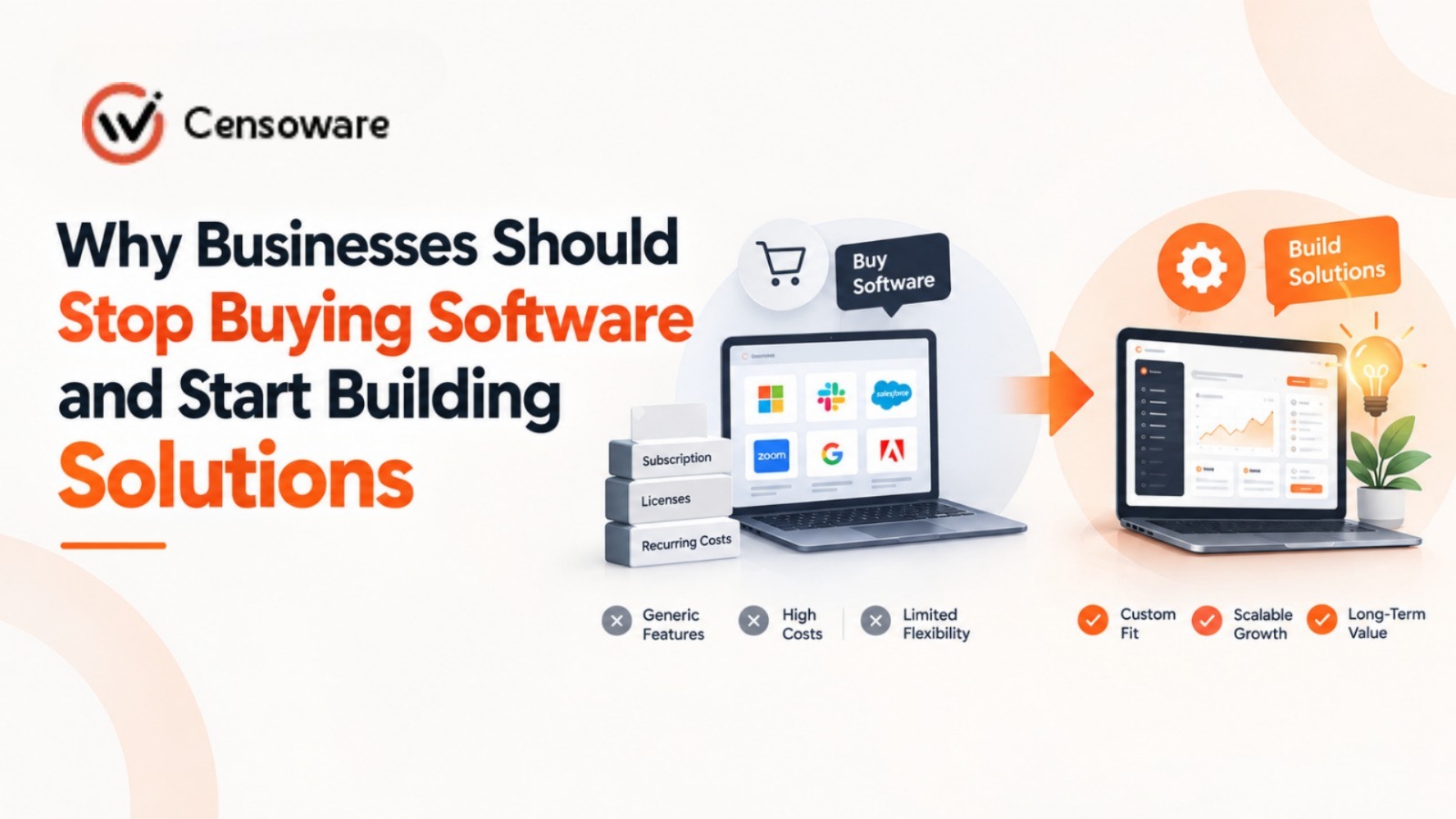
Why Businesses Should Stop Buying Software and Start Building Solutions
A strategic guide to understanding when off-the-shelf software limits growth, the hidden costs of ready-made tools, and how to transition to custom-built business solutions.
- Introduction
- What "Buying vs. Building" Actually Means
- The Hidden Cost of Off-the-Shelf Software
- Where Ready-Made Tools Fall Short
- What It Looks Like to Build a Business-Specific Solution
- Making the Right Call for Your Business
- Frequently Asked Questions
Almost every business starts the same way when it comes to software: it buys what already exists. A CRM off the shelf, an accounting package everyone uses, a project management tool a competitor recommended. This is a sensible starting point. Ready-made software is fast to set up, well documented, and cheap relative to building something from scratch. For a long time, it works well enough that no one questions it.
The trouble is that "well enough" quietly becomes the ceiling on how a business operates. Ready-made software is designed to serve thousands of businesses at once, which means it is built around the average case, not any one company's actual workflow. As a business grows and its processes become more specific, the gap between what the software does and what the business actually needs starts to show up in the form of workarounds, manual patches, and features that almost fit but never quite do. This guide looks at why that gap exists, what it costs a business over time, and when it makes sense to stop buying and start building.
What This Guide Covers
- The real difference between buying ready-made software and building a business-specific solution.
- Why off-the-shelf tools quietly cost more than they appear to over time.
- What "building a solution" actually looks like in practice, beyond expensive custom development.
- How to decide whether your business should keep buying or start building.
What "Buying vs. Building" Actually Means
Buying software means adopting a tool that was designed for a broad market and adapting your business to fit its assumptions. Building a solution means designing something around how your business actually operates, so the software fits the process instead of the other way around. Neither approach is inherently right or wrong; the question is which one matches where a business currently is.
In the early stages of a business, buying almost always makes sense. Processes are still simple and changing frequently, so the flexibility of a generic tool outweighs the benefit of something custom-built. The calculation shifts as a business matures and its processes become distinct, repeatable, and central to how it competes. At that point, forcing those processes to conform to a generic tool starts to cost more than it saves.
The Hidden Cost of Off-the-Shelf Software
The subscription fee for ready-made software is rarely the real cost. The real cost shows up in the workarounds a team builds to compensate for what the software cannot do: an extra spreadsheet to track something the tool does not support, a manual step to move data from one system to another, a report that has to be assembled by hand every week because the built-in reporting does not answer the actual question leadership is asking.
These workarounds tend to accumulate quietly. No single one looks expensive on its own, but collectively they consume a significant amount of employee time and introduce a steady stream of small errors. Over months and years, a business can end up spending more in staff hours compensating for a tool's limitations than it would have spent building something that fit from the start.
Where Ready-Made Tools Fall Short
Generic software is built to be broadly useful, which means it is rarely built to be precisely useful for any one business. It typically covers the 80 percent of functionality that most businesses in a category need, and leaves the remaining 20 percent, the part that often reflects what actually makes a business distinctive, to be handled manually or not at all.
This becomes a real constraint when that missing 20 percent is exactly where a business creates value. A logistics company with a unique routing process, a service business with a non-standard pricing model, or a manufacturer with a specific quality control workflow will often find that no combination of off-the-shelf tools quite captures how the work actually gets done. The business ends up managing its most important processes outside the software it pays for, rather than through it.
What It Looks Like to Build a Business-Specific Solution
Building a solution does not necessarily mean writing an entire platform from scratch. In practice, it often means building targeted software around the specific process that generic tools do not handle well, while continuing to use off-the-shelf tools for everything that is already standard, such as email, basic accounting, or general communication.
A business might, for example, keep its existing accounting software but build a custom system to manage a complex order fulfillment process that no generic tool captures correctly. This selective approach delivers most of the benefit of custom software, a workflow that matches how the business actually operates, without the cost of replacing every system the business already relies on.
Making the Right Call for Your Business
The decision to build rather than buy should be driven by a specific, recurring problem, not a general feeling that things could be better. A useful test is to ask whether a process is core to how the business competes, and whether that process is currently being managed through workarounds rather than through the software meant to support it. If both are true, building a targeted solution is usually worth serious consideration.
It also helps to be realistic about scope. Businesses that succeed with custom-built solutions tend to start narrow, solving one clearly defined problem well, rather than attempting to replace every tool at once. That narrower approach reduces risk, delivers value faster, and gives the business a clear basis for deciding where to build next.
Frequently Asked Questions
1. Isn't building custom software always more expensive than buying?
Not necessarily over time. The upfront cost of custom development is usually higher, but ongoing subscription fees, workaround costs, and lost productivity from a poor-fitting tool can add up to more over several years, particularly for a core, high-volume process.
2. How do I know if my business has actually outgrown off-the-shelf software?
A strong signal is when your team relies on manual workarounds, extra spreadsheets, or duplicate data entry to compensate for what the software cannot do, especially for a process that is central to your business.
3. Do I need to replace all my software at once to build a solution?
No. Most businesses benefit from a selective approach, keeping standard tools for standard functions and building custom software only for the specific processes that generic tools do not handle well.
4. Is building a solution only realistic for larger businesses?
No. Smaller businesses can build targeted solutions scoped to a single high-impact process, which keeps cost and complexity manageable while still solving the problem that matters most.
5. What is the biggest risk when moving from buying to building?
The biggest risk is scope creep, trying to build a solution that replicates everything a generic tool already does well instead of focusing narrowly on the process that actually needs it.
Final Thoughts
Buying software will always be the right starting point for most businesses, and it remains the right choice for a large share of what a business needs to run day to day. The mistake is assuming that ready-made tools should handle everything indefinitely, even as a business's processes become more specific and more central to how it competes.
Knowing when to stop buying and start building is less about technology and more about recognizing which processes define your business and refusing to let a generic tool flatten them into something average. Businesses that make that distinction early tend to build a genuine operational advantage, rather than spending years managing around the limits of software that was never built for them.
Censoware helps growing businesses transition from off-the-shelf software to targeted, custom-built solutions designed around your unique workflows. Ready to build software built for your business?