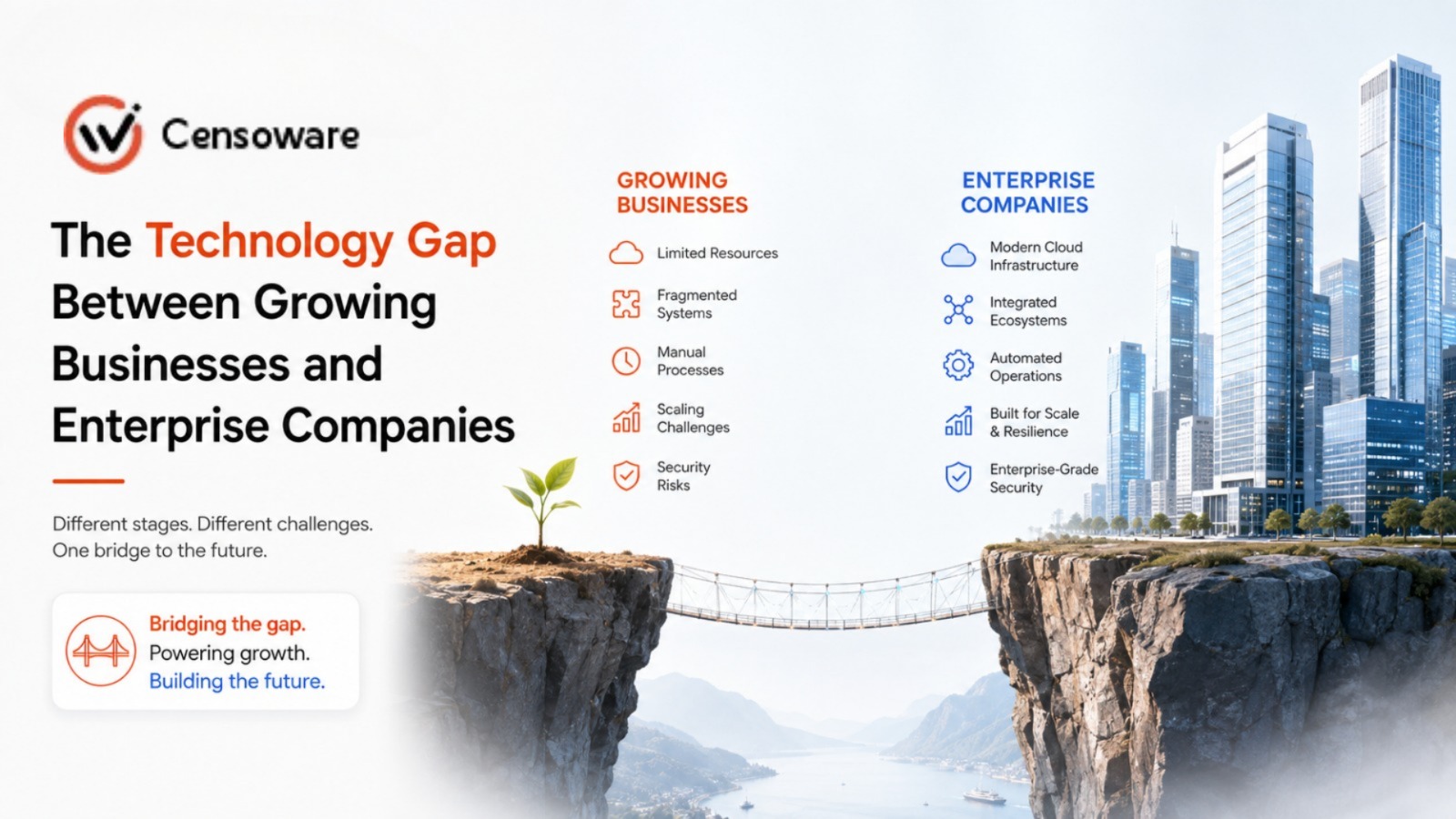
The Technology Gap Between Growing Businesses and Enterprise Companies
A strategic guide to understanding the technology maturity gap between small/mid-sized businesses and enterprise companies, and how growing businesses can close it without an enterprise budget.
- Introduction
- What the Technology Maturity Gap Actually Looks Like
- Why the Gap Widens as Small Businesses Grow
- What Enterprises Do Differently
- Closing the Gap Without an Enterprise Budget
- Signs Your Business Is Falling Behind
- Frequently Asked Questions
Large enterprises and small or mid-sized businesses rarely compete on the same technological footing, even when they operate in the same industry and serve similar customers. Enterprise companies typically run on integrated systems, dedicated IT teams, and mature data practices built up over years of deliberate investment. Growing businesses, by contrast, often run on a patchwork of tools adopted at different times to solve immediate problems, with no one responsible for how those tools fit together.
This difference is not simply a matter of enterprises having more money to spend. It reflects a genuine maturity gap in how technology is planned, integrated, and maintained, one that widens as a business grows unless it is deliberately addressed. This guide looks at what that gap actually consists of, why it tends to widen rather than close on its own, and what a growing business can realistically do to close it.
What This Guide Covers
- Why a technology maturity gap opens up between small and mid-sized businesses and large enterprises.
- What enterprise companies typically do differently with data, systems, and infrastructure.
- The specific ways this gap holds growing businesses back, beyond just "having less software."
- Practical ways to close the gap without an enterprise-sized budget.
What the Technology Maturity Gap Actually Looks Like
The gap between growing businesses and enterprise companies is rarely about access to any single tool. Most software categories, from CRM to accounting to analytics, have affordable options available to businesses of any size. The real gap is in how those tools are connected, governed, and maintained over time.
Enterprise companies typically treat technology as a coordinated system: data flows between platforms with minimal manual intervention, access and security policies are consistently enforced, and someone is explicitly responsible for how new tools get evaluated and integrated. Growing businesses more often accumulate tools individually, each adopted to solve a specific problem at the time, with little planning for how they will work together as the business scales.
Why the Gap Widens as Small Businesses Grow
In the earliest stages of a business, the maturity gap barely matters. A small team with a handful of disconnected tools can still coordinate easily because there simply are not that many moving parts to manage. The problems caused by disconnected systems are minor and easily absorbed.
As the business grows, however, the number of tools tends to increase faster than the coordination between them. Each new department or function often brings its own preferred software, and without a deliberate integration strategy, the business ends up with more disconnected systems rather than fewer. The gap does not appear suddenly; it widens gradually, in step with the business's own growth, until the accumulated friction becomes hard to ignore.
What Enterprises Do Differently
Enterprise companies generally treat data as a shared asset rather than something that belongs to whichever department happens to generate it. Customer, sales, and operational data are typically centralized or connected in ways that let different teams work from the same underlying information, rather than maintaining separate, sometimes contradictory versions.
Enterprises also tend to plan technology decisions with scale in mind from the outset, rather than solving only for the immediate problem in front of them. A new system is evaluated not just on whether it solves today's issue, but on whether it will still make sense once the business, and the volume of data it produces, is significantly larger. Growing businesses rarely have the luxury of this kind of long-range planning, which is part of why the gap tends to persist.
Closing the Gap Without an Enterprise Budget
Closing the technology maturity gap does not require enterprise-level spending. It requires enterprise-level intentionality applied at a smaller scale. This starts with treating integration as a deliberate priority rather than an afterthought, evaluating new tools not just on their individual features but on how well they will connect with systems the business already relies on.
It also helps to designate clear ownership over the business's technology stack, even if that responsibility sits with one person rather than an entire department. Someone needs to be accountable for noticing when tools have started to duplicate effort, when data has become fragmented across systems, or when a manual workaround has quietly become a permanent part of how the business operates.
Signs Your Business Is Falling Behind
A few patterns tend to indicate that the maturity gap is widening. Reporting takes longer than it should because data has to be manually pulled from several disconnected systems. Different teams occasionally disagree about basic numbers because they are working from different sources of truth. New employees take longer than expected to get comfortable with the business's tools because there is no consistent system connecting them.
None of these signs are dramatic on their own, which is exactly why they tend to go unaddressed for so long. Recognizing them early, and addressing the underlying integration and planning gaps rather than adding yet another disconnected tool, is what allows a growing business to narrow the distance between itself and far larger competitors.
It also helps to periodically step back and audit the technology stack as a whole rather than evaluating each tool in isolation. A business that reviews, every so often, which systems actually talk to each other, which ones duplicate effort, and which ones no longer serve a clear purpose, tends to catch small inefficiencies before they compound into the kind of large, expensive gap that becomes genuinely difficult to close.
Frequently Asked Questions
1. Is the technology gap mainly about budget?
Not primarily. It is more about how deliberately technology decisions are planned, integrated, and maintained over time, which a growing business can improve without enterprise-level spending.
2. How can a small business tell if it has fallen behind on technology maturity?
Common signs include manually compiling reports from multiple systems, teams working from inconsistent data, and new tools being adopted without any consideration of how they connect to existing ones.
3. Do we need a dedicated IT department to close this gap?
Not necessarily at first. What matters more is that someone is clearly responsible for how the business's tools fit together, even if that role is part of a broader position rather than a full department.
4. Should we replace our current tools to close the gap?
Usually not immediately. Closing the gap more often starts with better integration and governance of existing tools rather than wholesale replacement.
5. Is this gap only relevant to businesses planning to grow significantly?
No. Even businesses with modest growth ambitions benefit from closing the gap, since disconnected systems create ongoing inefficiency regardless of how large the business eventually becomes.
Final Thoughts
The technology gap between growing businesses and enterprise companies is real, but it is not fixed. It exists because enterprises have had the time, resources, and organizational discipline to treat technology as a coordinated system, while growing businesses often accumulate tools reactively, one urgent problem at a time.
Closing that gap does not require matching an enterprise budget. It requires applying the same intentionality, deliberate integration, clear ownership, and planning with future scale in mind, at whatever size a business currently operates. Businesses that start doing this early tend to find the gap narrows steadily, rather than continuing to widen as they grow.
Censoware helps growing businesses bridge the technology gap with enterprise-grade software architecture, system integration, and custom digital solutions. Ready to modernize your technology foundation?