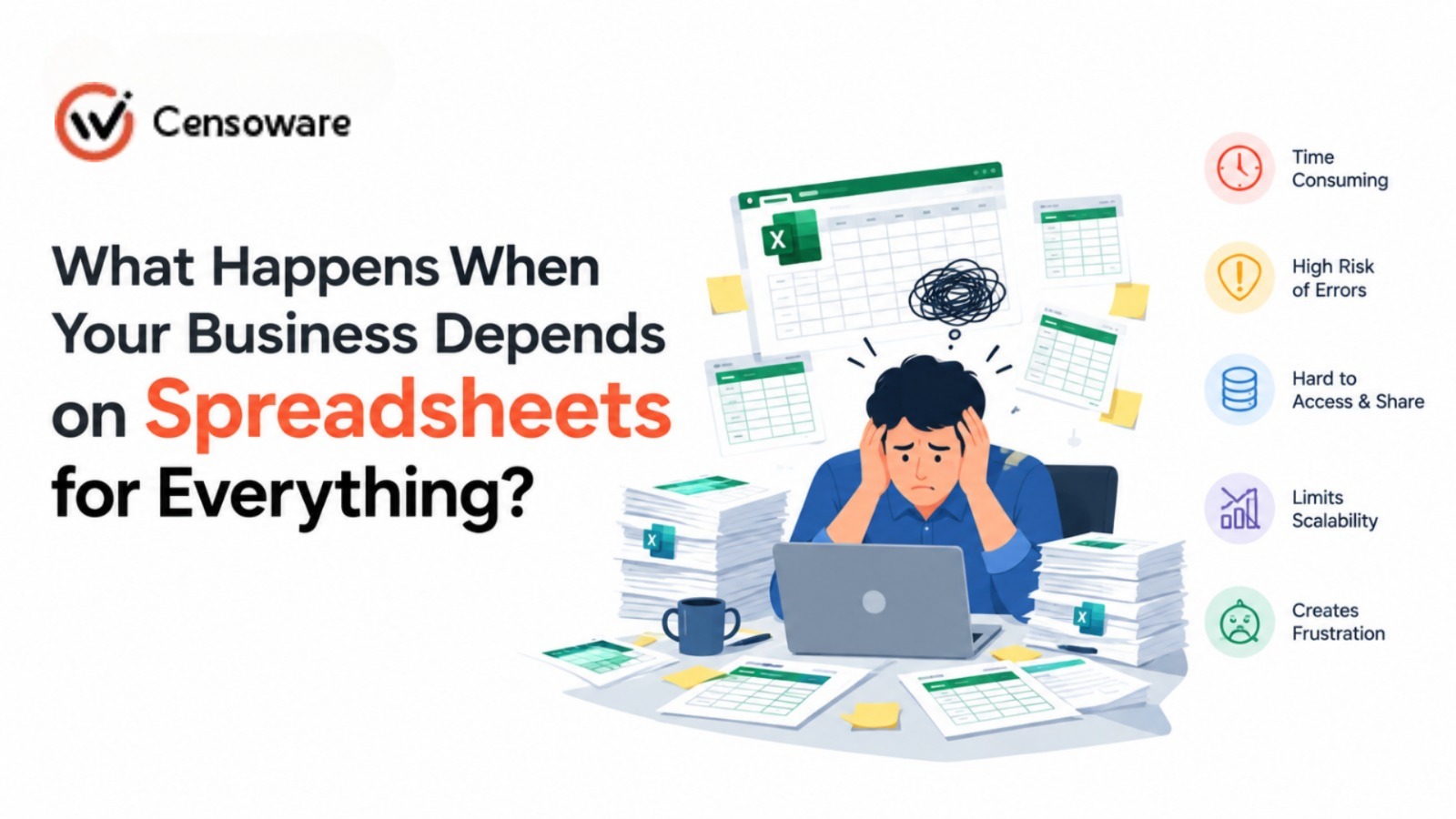
What Happens When Your Business Depends on Spreadsheets for Everything?
A strategic guide to identifying the risks of spreadsheet dependence in growing operations, and how to transition core processes to dedicated business software.
- Introduction
- Why Spreadsheets Are Every Business's First Tool
- The Hidden Risks of Spreadsheet Dependence
- Errors, Duplication, and the Cost of "Good Enough"
- The Visibility Problem
- When to Move Beyond Spreadsheets
- Frequently Asked Questions
Spreadsheets are, in many ways, the perfect starting tool for a business. They are flexible, familiar, and require no special setup to start tracking orders, customers, or expenses. It is entirely normal for a business to run most of its early operations out of a handful of spreadsheets, and for a long time, this works fine.
The problem is that spreadsheets were never designed to be a business's system of record. They lack the structure, validation, and connectivity that operational software provides, which means the risks they introduce tend to stay hidden until the volume of data or the number of people relying on them grows large enough to expose the cracks. This guide looks at what actually happens when a business becomes dependent on spreadsheets for core operations, and how to recognize when it is time to move beyond them.
What This Guide Covers
- Why spreadsheets become the default tool for nearly every growing business.
- The specific risks spreadsheet dependence introduces as volume increases.
- How errors and duplicated data quietly accumulate in spreadsheet-based operations.
- The visibility problem spreadsheets create for leadership, and when it is time to move beyond them.
Why Spreadsheets Are Every Business's First Tool
Spreadsheets require no procurement process, no onboarding, and almost no learning curve for most employees. A new business can start tracking customers, orders, or inventory in a spreadsheet within minutes, which makes it the natural default when a business is small and its needs are still simple.
This flexibility is also why spreadsheets are so hard to move away from. They can be adapted to nearly any purpose, which means a business can keep extending a spreadsheet's use for years, adding new columns and tabs to handle new needs, long after a dedicated system would have served the business better.
The Hidden Risks of Spreadsheet Dependence
A spreadsheet has no built-in way to prevent someone from entering the wrong type of data, overwriting a formula, or accidentally deleting a row that other calculations depend on. These are not hypothetical risks; they are common, everyday mistakes that become more likely, not less, as more people rely on the same file.
The risk compounds when multiple versions of the same spreadsheet start circulating, one person's local copy, an emailed attachment, a version saved to a shared drive with slightly different numbers. Without a single, reliable source of truth, it becomes genuinely difficult to know which version of the data is actually correct at any given moment.
Errors, Duplication, and the Cost of "Good Enough"
Manual data entry is one of the most common sources of error in a spreadsheet-based operation. A misplaced decimal, a transposed number, or a row copied into the wrong place can go unnoticed for weeks, quietly affecting decisions before anyone realizes the underlying data was wrong.
Duplication is an equally common problem. Because spreadsheets are easy to copy, businesses frequently end up with several versions of essentially the same information, a sales list here, a slightly different customer list there, each maintained by a different person. Reconciling these duplicates consumes real time and introduces further opportunities for error, even when everyone involved is being careful.
The Visibility Problem
Perhaps the least discussed cost of spreadsheet dependence is what it does to leadership's visibility into the business. When operational data lives in dozens of individual spreadsheets scattered across different employees' computers and shared drives, no one has a complete, real-time picture of what is actually happening across the business.
This forces leadership to make decisions based on periodic manual summaries rather than current, reliable data. By the time a spreadsheet-based report reaches a decision-maker, it often reflects information that is already days or weeks old, and assembling that report has typically consumed hours of someone's time that could have been spent on more valuable work.
When to Move Beyond Spreadsheets
There is no fixed size at which a business must abandon spreadsheets entirely, and for many simple, low-stakes tasks, spreadsheets remain a perfectly reasonable tool. The signal to move on is not company size but a pattern: recurring errors in the same type of data, multiple people maintaining conflicting versions of the same information, or leadership regularly waiting on manually compiled reports to understand basic performance.
When these patterns appear consistently around a specific process, such as order tracking, inventory management, or customer records, that is usually the process worth moving into dedicated software first, rather than attempting to replace every spreadsheet in the business at once.
It is also worth remembering that the goal is not to eliminate spreadsheets entirely. Even businesses running mature, dedicated systems continue to use spreadsheets for ad hoc analysis, quick calculations, and one-off reporting. The distinction that matters is between using a spreadsheet as a flexible, secondary tool and depending on one as the permanent system of record for a process the business can no longer afford to get wrong.
Frequently Asked Questions
1. Are spreadsheets always a problem for a growing business?
No. Spreadsheets remain useful for simple, low-volume tasks. The risk grows specifically around core, high-volume, or multi-person processes where errors and version conflicts are more likely and more costly.
2. How do I know if spreadsheet errors are actually costing my business money?
Look for recurring mistakes tied to a specific process, such as pricing errors, missed follow-ups, or inventory mismatches. If the same type of error keeps happening, it is usually a sign the underlying tool, not the person, is the problem.
3. What is usually the first process worth moving out of spreadsheets?
Whichever process is highest in volume, involves multiple people, and has the most direct impact on customers or revenue, such as order tracking, inventory, or customer records.
4. Can better spreadsheet practices solve these problems instead of switching tools?
Better practices can reduce some risk, but they do not fully solve the structural limitations of spreadsheets, such as lack of real-time visibility and no built-in data validation, especially as volume grows.
5. Is moving away from spreadsheets expensive?
Not necessarily. Many affordable, purpose-built tools exist for common processes like order management or customer tracking, and starting with one high-impact process keeps the transition manageable.
Final Thoughts
Spreadsheets are not the enemy of a growing business; they are simply a tool that was never designed to scale with one. The flexibility that makes them so useful early on is the same quality that allows them to quietly become a liability once a business depends on them for processes that involve significant volume, multiple people, or real financial stakes.
Recognizing the specific signs of spreadsheet dependence, recurring errors, version conflicts, and slow, manually assembled reporting, gives a business a clear, practical starting point for change. Moving even one core process into dedicated software often delivers a noticeable improvement in accuracy and visibility, without requiring a business to overhaul everything at once.
Censoware helps growing businesses transition from spreadsheet dependency to custom software and automated workflows designed to scale. Ready to modernize your core business operations?