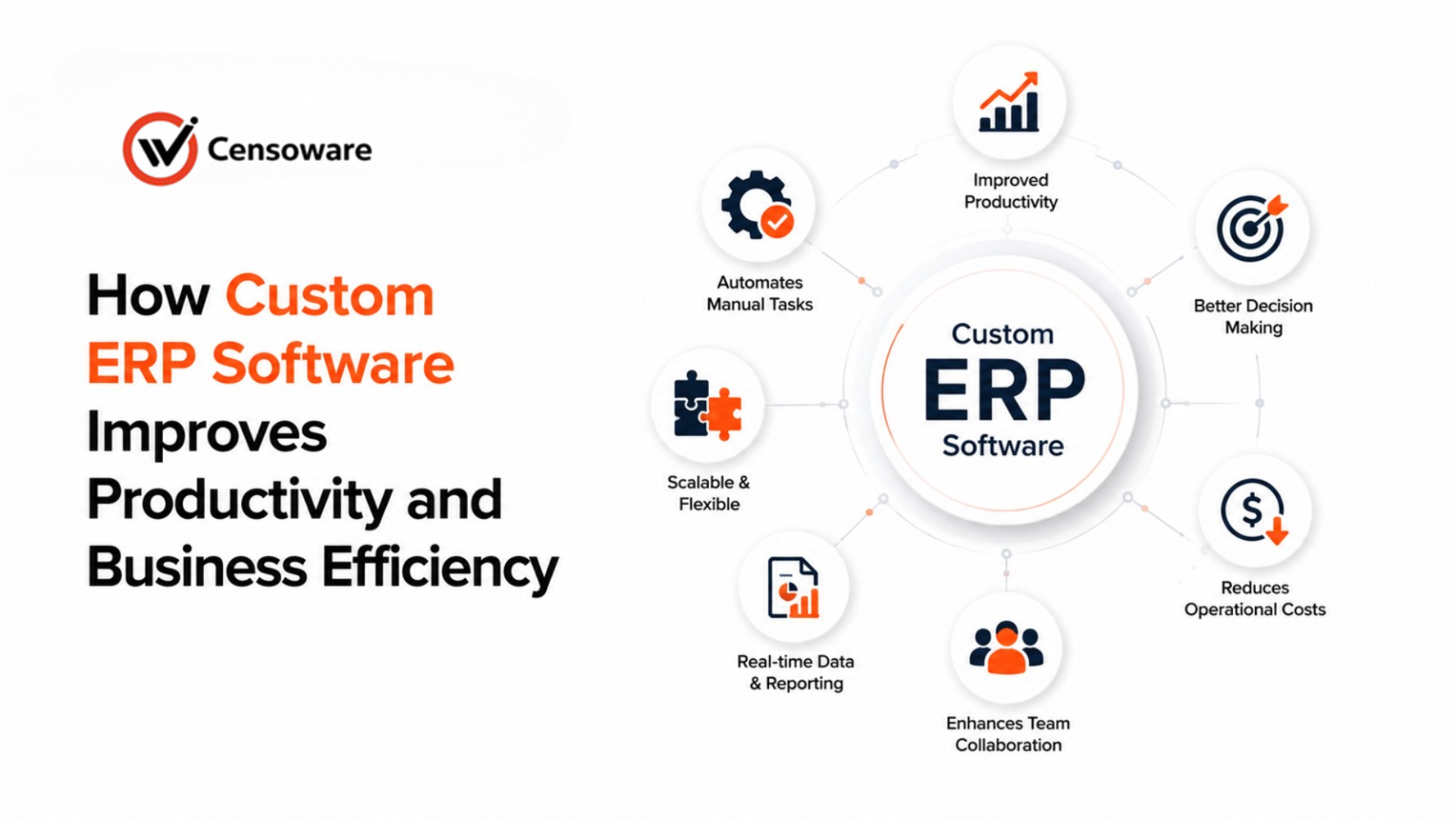
How Custom ERP Software Improves Productivity and Business Efficiency
A guide to understanding how tailored ERP drives measurable productivity gains and what businesses should consider before making the investment.
- Introduction
- What Sets Custom ERP Apart
- How Custom ERP Improves Productivity
- Industry-Specific Advantages
- Weighing Cost Against Long-Term Value
- Frequently Asked Questions
Enterprise Resource Planning systems have long been the backbone of organized business operations, connecting finance, inventory, sales, and HR into a single platform. But as businesses grow more complex, many are discovering that generic, off-the-shelf ERP fails to match their actual workflows. Custom ERP software solves this by being built around how a business genuinely operates, rather than forcing the business to adapt to a rigid system.
This guide explains how custom ERP drives measurable productivity gains and what businesses should consider before making the investment.
What This Guide Covers
- How custom ERP software differs from generic, off-the-shelf systems.
- The specific ways tailored ERP boosts daily productivity.
- Industry-specific advantages across manufacturing, healthcare, and retail.
- What to weigh before investing in a custom-built system.
What Sets Custom ERP Apart
Off-the-shelf ERP systems serve a broad range of industries, which means they include features many businesses never use while lacking capabilities others genuinely need. Custom ERP is built, or heavily tailored, around a company's exact workflows, terminology, and reporting needs, eliminating the common frustration of forcing unique processes into a generic framework.
How Custom ERP Improves Productivity
Because the software mirrors how the business actually functions, unnecessary steps disappear and confusion drops sharply. A single unified database eliminates redundant data entry across departments, reducing both wasted time and human error.
Real-time dashboards are tailored to the specific metrics that matter to that particular business, rather than burying decision-makers in generic reports. Custom systems can also automate tasks specific to a company's own processes, such as routing approvals according to its exact organizational hierarchy, and scale as the business grows without the licensing limitations common to off-the-shelf platforms.
Industry-Specific Advantages
Custom ERP enables workflows that generic systems often struggle to support properly across different industries.
Manufacturing and Healthcare
Manufacturers benefit from modules built for production scheduling, bill-of-materials tracking, and equipment maintenance that generic ERP often handles poorly. Healthcare organizations gain systems that manage patient data and regulatory compliance while meeting strict privacy standards.
Retail and Construction
Retailers benefit from seamless integration between point-of-sale systems, e-commerce platforms, and multi-location inventory. Construction and project-based businesses gain accurate project cost tracking and billing structures tied to milestones, functionality most generic systems struggle to support.
Weighing Cost Against Long-Term Value
Custom ERP typically requires a higher upfront investment than off-the-shelf alternatives, but off-the-shelf systems often carry ongoing licensing fees and costs for add-on modules that weren't included originally.
The Long-Term View
Custom ERP, built precisely for the business from the start, frequently results in lower long-term costs tied to inefficiency and unnecessary features, along with stronger employee adoption since the system feels intuitive rather than foreign.
Frequently Asked Questions
1. Is custom ERP only suitable for large businesses?
No. Mid-sized and even smaller businesses with specific operational needs often benefit, particularly when off-the-shelf systems require expensive workarounds to function properly.
2. How long does a custom ERP build typically take?
Timelines vary based on scope and complexity, but custom builds generally take longer than off-the-shelf implementation, which is why phased rollouts are common.
3. What's the biggest risk with custom ERP projects?
Choosing a development partner unfamiliar with the specific industry is the most common risk, since it often results in a system that doesn't truly reflect how work gets done.
4. Can a custom ERP system integrate with tools we already use?
Yes, custom ERP is typically designed with integration in mind from the outset, connecting with existing tools like CRMs, e-commerce platforms, or accounting software.
5. Do employees need extensive retraining to use custom ERP?
Usually less than with generic systems, since custom ERP is designed around existing workflows employees are already familiar with.
Final Thoughts
Custom ERP software gives businesses the chance to move beyond the limitations of generic systems and build something precisely matched to how they operate. By streamlining workflows, eliminating redundant processes, and offering real-time visibility, it delivers productivity gains that compound over time, making it a compelling choice for organizations serious about long-term efficiency.
Censoware builds custom ERP solutions tailored to your unique operational workflows. Ready to eliminate inefficiencies and consolidate your operations into a single platform?
Consult our ERP development team.