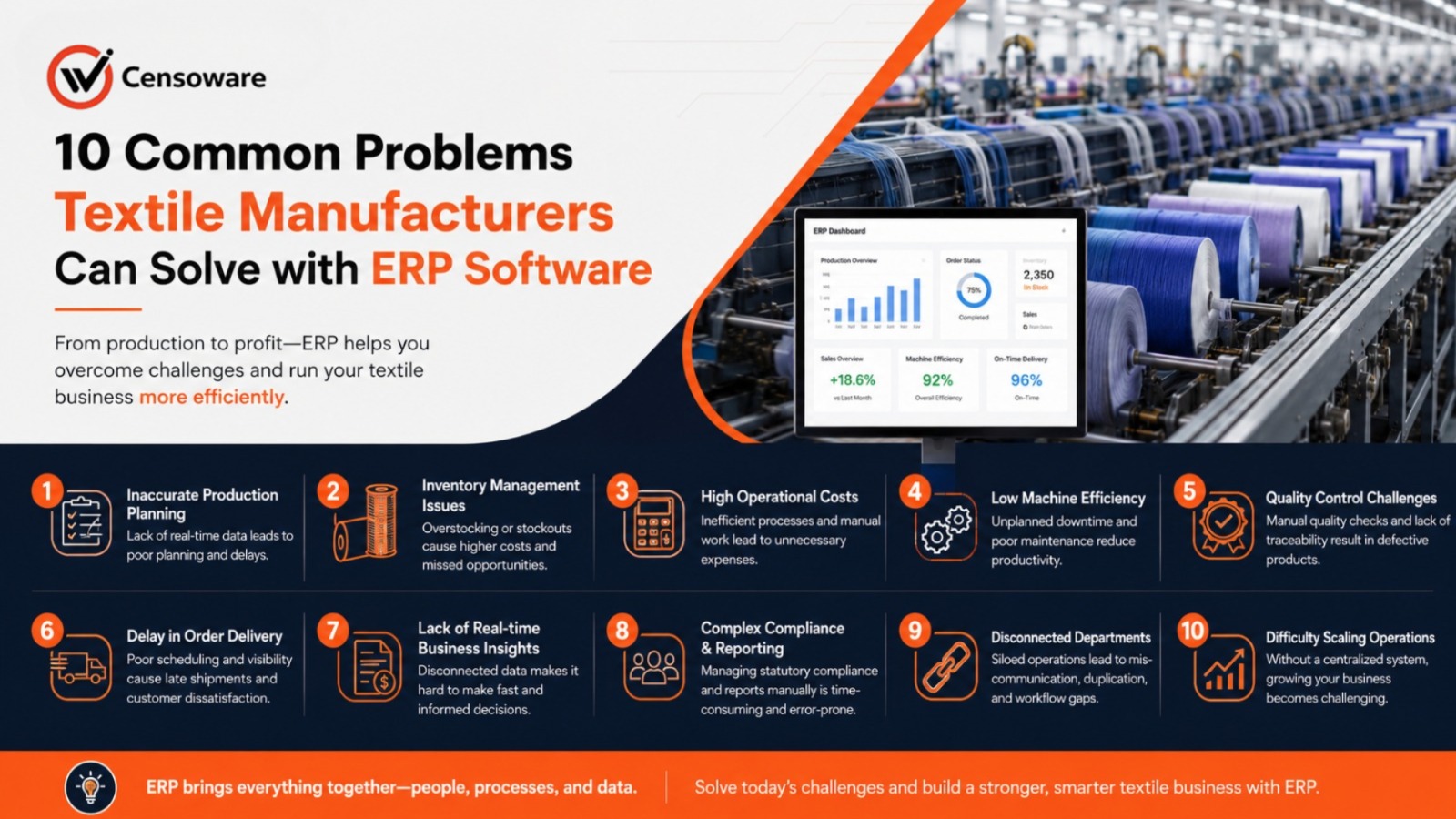
10 Common Problems Textile Manufacturers Can Solve with ERP Software
Discover how specialized Manufacturing ERP and Textile ERP Solutions eliminate inventory mismatches, order tracking bottlenecks, fabric wastage, and reporting delays.
- Introduction
- 1. Inventory Mismatch Between Store and Records
- 2. Production Delays Discovered Too Late
- 3. Order Tracking Depending on Memory
- 4. Fabric and Raw Material Wastage
- 5. Manual Reporting That Takes Hours
- 6. Customer Management Spread Across Files
- 7. Duplicate Purchase Orders
- 8. Machine Downtime That Goes Unnoticed
- 9. Billing Errors from Manual GST Calculation
- 10. Compliance Reports Assembled Under Pressure
- Frequently Asked Questions
Ask any textile manufacturer to list their daily frustrations, and the same problems come up again and again: stock that does not match the register, orders that slip past their delivery date, fabric that gets wasted somewhere between cutting and stitching, and reports that take a full day to put together before anyone can even make a decision. These are not isolated incidents. They are symptoms of running a complex, multi-stage production process on tools that were never designed to keep up with it.
This guide walks through ten of the most common problems textile manufacturers face and explains how Manufacturing ERP built for the textile industry solves each one, turning daily firefighting into a manageable, predictable operation.
What This Guide Covers
- The recurring operational problems that slow down textile manufacturers every day.
- How Textile ERP Solutions address each of these problems directly.
- Why manual reporting and customer management break down as a business scales.
- What manufacturers should expect once these problems are resolved.
1. Inventory Mismatch Between Store and Records
Manual stock registers rarely match what is physically present in the store, because entries are delayed, handwriting is misread, or a transaction is simply forgotten during a busy shift. Textile ERP Solutions solve this by recording every stock movement, whether it is a purchase, an issue to production, or a return, at the exact moment it happens, so the system total always reflects the physical count.
This matters most during peak season, when the store is handling many transactions in a short window and even a small delay in recording an entry can snowball into a mismatch that takes days to trace and correct.
2. Production Delays That Are Discovered Too Late
In manual setups, a delay at one stage, such as dyeing running behind schedule, is often only discovered when the next stage is ready to start and finds nothing to work with. Textile Industry Software gives managers a live view of every stage, so a slowdown is visible immediately and can be addressed before it pushes back the entire order.
Catching a delay early also gives planners options, such as reprioritizing another order or reallocating a machine, that simply are not available once the delay has already pushed the delivery date past the point of recovery.
3. Order Tracking That Depends on One Person's Memory
When order status lives in a notebook or in a single employee's head, customer service suffers the moment that person is on leave or busy elsewhere. An ERP system logs every order's stage automatically, so any authorized staff member can answer a customer's question accurately without needing to track someone down.
This consistency also protects the business during staff transitions. When an experienced employee leaves, their knowledge of pending orders and customer preferences does not leave with them, because it is already recorded in the system rather than existing only in their head.
4. Fabric and Raw Material Wastage
Wastage is difficult to control when no one is comparing how much raw material went in against how much finished product came out. Manufacturing ERP tracks consumption against standard usage norms for each order, flagging unusual wastage so it can be investigated while the batch is still fresh in everyone's memory, rather than at the end of the month.
Over time, this data also reveals which machines, shifts, or operators consistently produce more wastage than others, giving management a factual basis for training or maintenance decisions instead of relying on guesswork.
5. Manual Reporting That Takes Hours to Prepare
Building a production, sales, or stock report by hand from multiple registers is slow and prone to error, and the report is often outdated by the time it reaches the owner. Textile Industry Software generates these reports automatically from live data, cutting a process that once took hours down to a few clicks.
This also frees up the staff who previously spent a large part of their week compiling these reports, allowing them to focus on tasks that actually move the business forward rather than repeating the same manual summary every month.
6. Customer Management Spread Across Notebooks and WhatsApp
Many textile manufacturers manage customer orders, pricing history, and follow-ups across notebooks, phone calls, and messaging apps, which makes it easy to lose track of a pending order or an unpaid invoice. Textile ERP Solutions centralize customer history, order records, and payment status in one place, so nothing falls through the cracks.
A centralized customer record also makes it easier to spot repeat buying patterns, which can inform everything from stock planning to which customers deserve priority attention during a busy season.
7. Duplicate Purchase Orders
Without a shared record of what has already been ordered, it is common for two people in the same business to raise separate purchase orders for the same material, tying up cash in stock that was not actually needed yet. An ERP system shows current and pending purchase orders to everyone involved, preventing this kind of costly duplication.
8. Machine Downtime That Goes Unnoticed
Idle machine time is easy to overlook when there is no system tracking it, since a machine sitting unused for an hour does not generate an obvious record the way a missed delivery does. Manufacturing ERP logs machine status, making idle patterns visible so they can be addressed through better scheduling or maintenance.
9. Billing Errors from Manual GST Calculation
Calculating GST manually across different fabric categories and rates increases the risk of invoicing errors, which can lead to disputes with customers or issues during tax filing. An ERP system applies the correct rate automatically based on the item and generates compliant invoices directly from the sales record.
10. Compliance Reports Assembled Under Pressure
When compliance documentation is scattered across departments, preparing it for an audit or filing deadline becomes a last-minute scramble. Textile ERP Solutions keep purchase, production, and sales records in a consistent, exportable format throughout the year, so compliance reporting is a matter of generating a report rather than reconstructing one from scratch.
Frequently Asked Questions
1. Which of these problems should a manufacturer prioritize first?
Inventory mismatch and order tracking usually cause the most day-to-day disruption, so most manufacturers see the fastest impact by addressing these two areas first.
2. Can ERP software be introduced gradually rather than all at once?
Yes. Most Textile ERP Solutions are modular, allowing a manufacturer to start with inventory or production and add sales, accounts, or CRM modules over time.
3. Will ERP work for a manufacturer with multiple small units?
Yes. Cloud-based Manufacturing ERP is designed to bring multiple units under one shared system, so leadership can view combined or unit-wise data at any time.
4. Does fixing wastage really require an ERP system?
Not strictly, but tracking wastage manually across many orders is extremely time-consuming, and it is easy for patterns to go unnoticed without a system that flags deviations automatically.
5. How quickly will these problems reduce after implementation?
Most manufacturers notice a visible reduction in reporting time and order confusion within the first month, with inventory accuracy improving steadily as staff adjust to logging transactions in real time.
Final Thoughts
None of these ten problems are unique to one factory; they are common across the textile manufacturing industry because they stem from the same root cause: information that is scattered, delayed, or dependent on memory. Textile ERP Solutions solve this at the source by giving every department a shared, accurate, real-time record to work from.
Manufacturers who address these problems early free up time and resources that were previously spent firefighting, and redirect that energy toward growing the business instead of just keeping it running.
Censoware builds custom Textile ERP solutions designed to solve shop floor inefficiencies, inventory leaks, and order bottlenecks. Ready to eliminate operational friction?