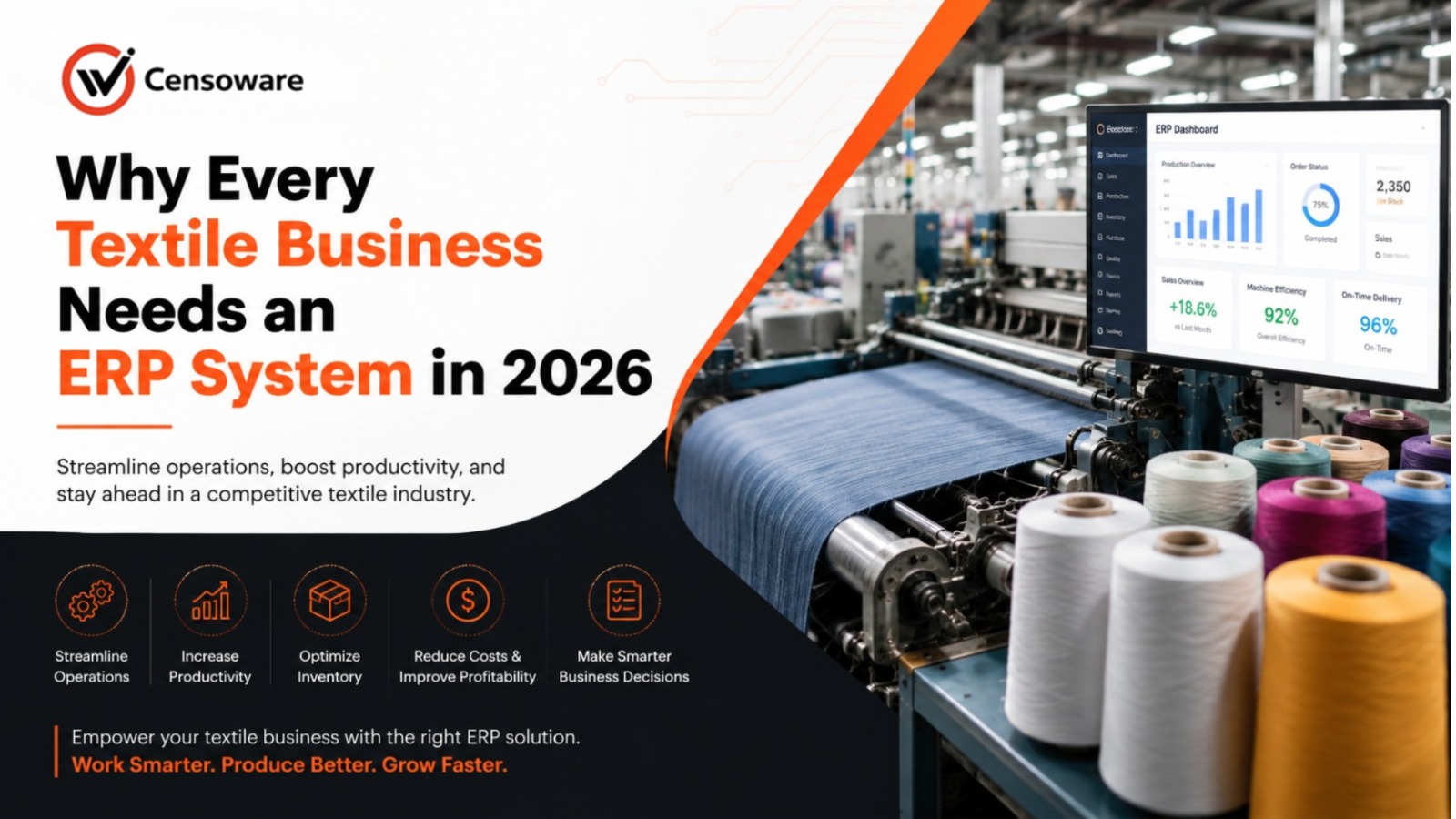
Why Every Textile Business Needs an ERP System in 2026
Discover how Textile ERP Software eliminates shop floor visibility gaps, streamlines production, and drives real-time efficiency across spinning, weaving, dyeing, and garment units.
- Introduction
- The Hidden Cost of Manual Textile Operations
- What an ERP System Actually Changes
- Real-Time Business Visibility from Anywhere
- How ERP for the Textile Industry Increases Productivity
- Frequently Asked Questions
Textile businesses that still run on registers, spreadsheets, and phone calls between departments are finding it harder every year to keep pace with customers who expect faster quotes, accurate delivery dates, and transparent order tracking. In 2026, competition inside the textile and garment industry is no longer only about price or fabric quality; it is also about how quickly and reliably a business can respond to a buyer. A Textile ERP Software built specifically for textile manufacturing has moved from being a nice-to-have for large mills to a practical necessity for units of almost every size.
This guide looks at why manual operations are becoming harder to sustain, what an ERP for the textile industry actually changes on the ground, and how real-time visibility and increased productivity come together to give textile businesses a genuine competitive edge in the year ahead.
What This Guide Covers
- Why manual processes are becoming a liability for textile businesses in 2026.
- The core benefits an ERP system brings to spinning, weaving, dyeing, and garment units.
- How real-time visibility changes day-to-day decision-making on the shop floor.
- Where the biggest productivity gains actually come from once an ERP is in place.
The Hidden Cost of Manual Textile Operations
In most manual setups, yarn and fabric stock is counted by hand and recorded in registers that reach the office hours or even days after the actual transaction happens on the floor. Production data collected on paper does not reflect what is really happening at any given moment, which means a manager reacting to a problem is often reacting to information that is already outdated. Order status usually lives in the memory of whichever employee took the customer call, so the moment that person is unavailable, everyone else is guessing.
As a textile business grows and adds machines, shifts, or branches, these small gaps compound quickly. Purchase records stop matching store records, wastage goes untracked because no one is comparing input to output, and GST or invoicing errors creep in because billing is disconnected from the actual movement of goods. Textile Business Management built around manual processes simply cannot scale without breaking somewhere.
The frustrating part is that none of these gaps are visible until they cause a real problem, such as a customer order shipped short, a machine idle for want of yarn that was actually available in another store, or an audit that surfaces months of unreconciled entries. By the time the issue is noticed, the cost has usually already been incurred, and all that is left to do is explain it rather than prevent it.
What an ERP System Actually Changes
An ERP system replaces this scattered way of working with one system that covers purchase, production, inventory, sales, and accounts together. Every department enters data once at the point where the activity actually happens, and that entry automatically updates every other part of the system that depends on it. There is no need to re-type the same purchase order into three different registers or wait for someone to manually reconcile numbers at the end of the week.
This single change removes an enormous amount of duplicate work, cross-checking, and phone calls between departments. Instead of chasing information, staff spend their time acting on it, and decisions get made using numbers that reflect what is happening right now rather than what happened last week.
It also changes how new employees are trained. Instead of learning a specific supervisor's personal system of registers and shortcuts, they learn one consistent process that works the same way regardless of who is on shift, which makes the business less dependent on any single individual's memory or habits.
Real-Time Business Visibility from Anywhere
One of the most valued outcomes of Textile ERP Software is the ability for an owner or manager to check stock levels, production stage, and order status from a phone or dashboard without walking the floor or calling a supervisor. During a customer call, staff can quote realistic delivery dates because they are looking at the actual production queue instead of an estimate.
For businesses running more than one unit or branch, this visibility becomes even more valuable. All locations report into the same system, so leadership can compare performance across units, spot a slowdown early, and act on it before it turns into a missed delivery.
This same visibility also changes how owners spend their time. Rather than visiting each unit to understand what is happening, they can review the numbers first and reserve floor visits for the specific issues that actually need their attention, which makes managing a growing business considerably less exhausting.
How ERP for the Textile Industry Increases Productivity
A large share of the productivity gain from ERP comes simply from removing paperwork. Automatic reorder alerts prevent yarn or dye stockouts from halting a production line, and production planning tools help sequence orders so machines are not sitting idle waiting for the next job. Quality tracking built into the system flags rework and rejection patterns early, before they become expensive.
Most importantly, staff at every level stop spending their day searching for information and start spending it doing the work they were hired to do. That shift, repeated across every department, is where the real productivity gain of Textile Business Management shows up on the bottom line.
Over a full year, these small, repeated time savings across purchase, production, dispatch, and accounts add up to meaningfully more output from the same team and the same machines, without requiring the business to add headcount just to keep pace with growing order volume.
Frequently Asked Questions
1. Is ERP only useful for large textile mills?
No. Cloud-based Textile ERP Software is now priced and packaged for small and medium units as well, with modules that can be added as the business grows rather than paid for all at once.
2. How long does it take to implement a textile ERP system?
Implementation timelines vary with business size and the number of modules involved, but most units go live in a matter of weeks when the rollout is phased by department rather than attempted all at once.
3. Does ERP replace the need for experienced staff?
No. It supports existing staff by removing repetitive paperwork and manual reconciliation, so their time goes toward decisions and floor work rather than data entry.
4. Can ERP handle GST and e-invoicing for textile businesses?
Yes. Most ERP for the textile industry is built with Indian GST and e-invoicing requirements in mind, generating compliant invoices directly from sales and dispatch records.
5. What is the right first step toward adopting ERP?
Start by identifying the single department, such as inventory or order tracking, where delays or losses are the highest, and begin the ERP rollout there before expanding to the rest of the business.
Final Thoughts
The textile industry in 2026 is being shaped by faster customer expectations, tighter margins, and businesses that can no longer afford blind spots in their inventory, production, or order tracking. An ERP system addresses these pressures directly by giving every department access to the same live information instead of scattered records that are always a step behind reality.
Textile businesses that make this shift early are not just solving today's paperwork problems; they are building the kind of real-time visibility and productivity that will separate the businesses that grow in 2026 from the ones that keep firefighting the same issues year after year.
The businesses that wait are not standing still either; their competitors are the ones already quoting faster, tracking orders more accurately, and using real numbers to negotiate better with suppliers. Adopting a Textile ERP Software is less about keeping up with technology trends and more about making sure the business is not the one left explaining delays while everyone else has already moved past them.
Censoware builds specialized custom Textile ERP software designed for spinning mills, weaving units, dye houses, and garment manufacturers. Ready to digitize your textile operations?