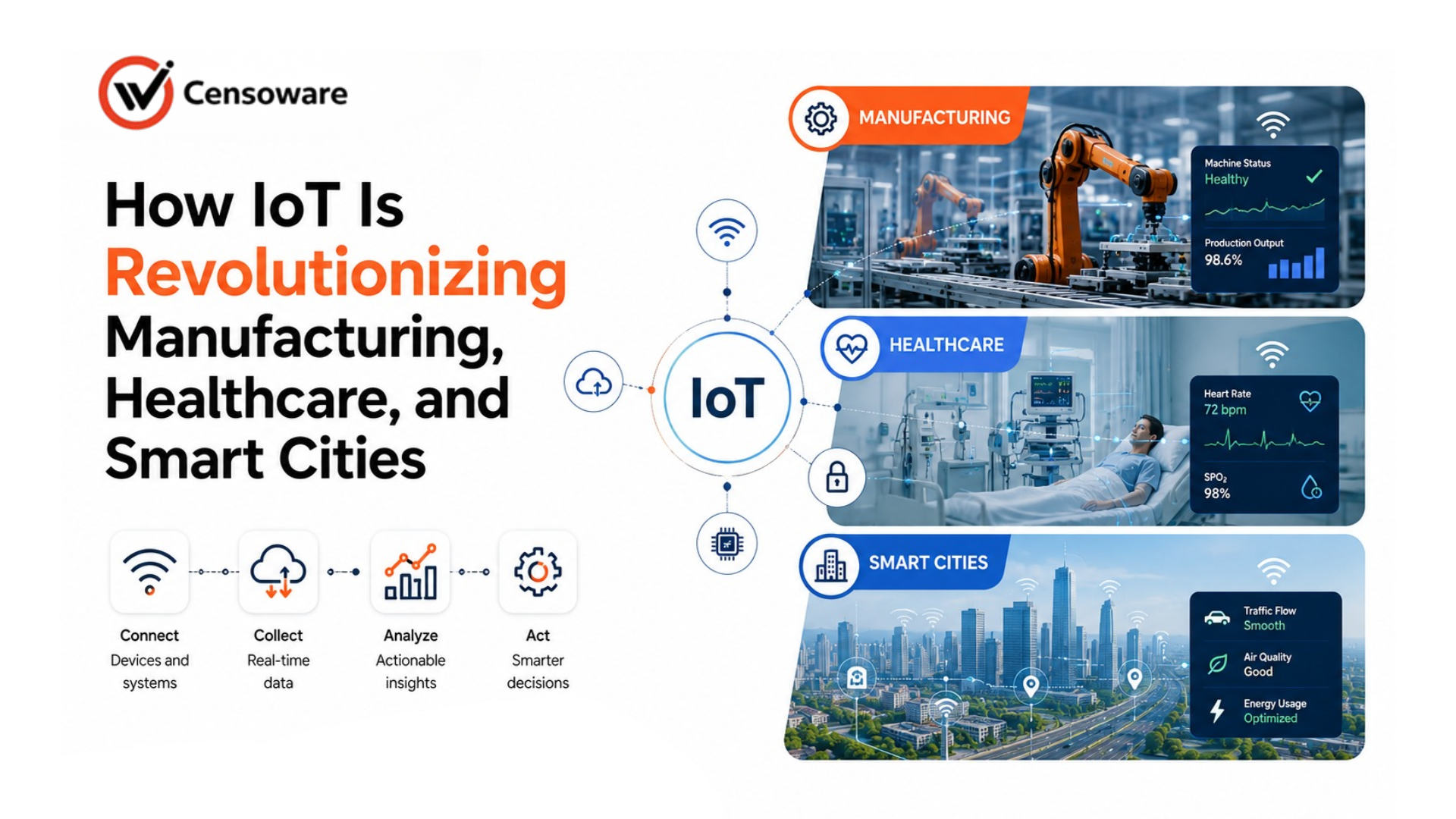
How IoT Is Revolutionizing Manufacturing, Healthcare, and Smart Cities
A practical guide to understanding what IoT enables at a technical level and how it is transforming major industries.
- Introduction
- The Foundation of Connected Systems
- Transforming Manufacturing, Healthcare, and Smart Cities
- The Common Thread
- Challenges Facing Implementation
- Frequently Asked Questions
The Internet of Things has quietly transformed from a futuristic concept into one of the most impactful technologies shaping industries today. By connecting physical devices and sensors to the internet, IoT enables real-time data collection and intelligent automation at a scale that was unimaginable a decade ago. This guide explores its impact across manufacturing, healthcare, and smart cities.
What This Guide Covers
- What IoT actually enables at a technical level.
- How IoT is transforming manufacturing, healthcare, and urban infrastructure.
- The common thread connecting these very different applications.
- The main challenges organizations face when deploying IoT systems.
The Foundation of Connected Systems
IoT refers to a network of physical devices embedded with sensors, software, and connectivity that allow them to collect and exchange data. The real power lies not in individual connected devices, but in the aggregated insight generated when thousands of devices work together as part of a larger, intelligent system.
Transforming Key Sectors
IoT's ability to collect and communicate data in real time is driving significant changes across major industries.
Transforming Manufacturing
IoT sensors installed throughout factories continuously monitor equipment performance and quality metrics, letting managers spot inefficiencies immediately rather than discovering them days later. Predictive maintenance uses this same sensor data to forecast equipment failure before it happens, reducing unplanned downtime. Supply chain visibility improves as tracking devices monitor shipments in real time, and IoT-connected cameras combined with machine learning can catch product defects with a consistency manual inspection can't match.
Transforming Healthcare
Wearable and home monitoring devices let providers track patients' vital signs remotely and continuously, particularly valuable for managing chronic conditions and enabling early intervention. Hospitals use connected equipment that tracks its own usage and alerts staff to maintenance needs, while asset-tracking devices reduce time spent searching for critical equipment. Smart medication dispensers improve adherence by alerting caregivers when doses are missed, and IoT devices in ambulances let paramedics transmit patient data to hospitals before the patient even arrives.
Transforming Smart Cities
IoT sensors in roads and traffic signals allow city planners to optimize signal timing dynamically and reduce congestion. Smart energy grids balance supply and demand in real time while integrating renewable sources more efficiently. Waste management systems monitor container fill levels to optimize collection routes, and environmental sensors track air quality and noise levels across urban areas, supporting public health initiatives. Smart parking systems help drivers find available spaces instantly, reducing both congestion and emissions.
The Common Thread
Across all three sectors, the transformative power of IoT comes from the same source: the ability to collect real-time data and convert it into actionable insight. This shift from reactive to proactive decision-making is what distinguishes IoT-enabled systems from their traditional counterparts.
Challenges Facing Implementation
Security remains the primary concern, since a large network of connected devices creates many potential entry points for attacks. Data privacy is critical too, especially in healthcare and public-space monitoring applications.
Infrastructure and Interoperability
The sheer volume of data generated also demands robust storage and processing infrastructure, and interoperability between devices from different manufacturers often requires custom integration work.
Frequently Asked Questions
1. Is IoT only relevant for large organizations?
No. Smaller manufacturers, clinics, and municipalities are increasingly deploying scaled versions of IoT systems, often starting with a single use case like equipment monitoring.
2. How does IoT actually reduce costs?
Mainly through predictive maintenance, energy optimization, and reduced manual monitoring, all of which cut down on unplanned downtime and wasted resources.
3. Is IoT data safe from cyberattacks?
Risk exists with any connected system, which is why strong security protocols and network segmentation are essential parts of any IoT deployment, not optional add-ons.
4. Can older equipment be connected to IoT systems?
In many cases, yes. Retrofit sensors can be added to existing machinery, allowing older equipment to participate in a connected system without full replacement.
5. What industries are adopting IoT fastest right now?
Manufacturing and healthcare currently show the most mature adoption, though smart city initiatives are expanding quickly as sensor costs continue to fall.
Final Thoughts
The Internet of Things has moved far beyond a niche trend to become a foundational element of modern manufacturing, healthcare, and urban infrastructure.
Organizations that address security and interoperability thoughtfully are best positioned to benefit from the real-time visibility and automation IoT makes possible.
Censoware helps organizations implement scalable and secure IoT infrastructure. Ready to connect your physical operations and unlock real-time insight?