What Is Gen AI and How Does It Work?
Gen AI has moved from research labs into everyday business tools. It writes emails, drafts code, designs images, and answers customer questions. Yet many people still ask the basic question: what is Gen AI, and how does it actually work? This guide explains it in plain language, with practical business examples.
What Is Gen AI?
Gen AI, short for generative artificial intelligence, creates new content rather than just analysing existing data. That content can be text, images, audio, video, software code, or even product designs.
Older AI systems mostly predicted or classified. For example, a spam filter decides whether an email is junk. A Gen AI system produces something new, such as a reply to that email, written in a natural tone.
The idea is not entirely new. Researchers have worked on generative models for decades, and you can read a broader overview of generative artificial intelligence on Wikipedia. What changed recently is the scale of data, computing power, and model design, which made the output good enough for everyday business use.
How Does Gen AI Work?
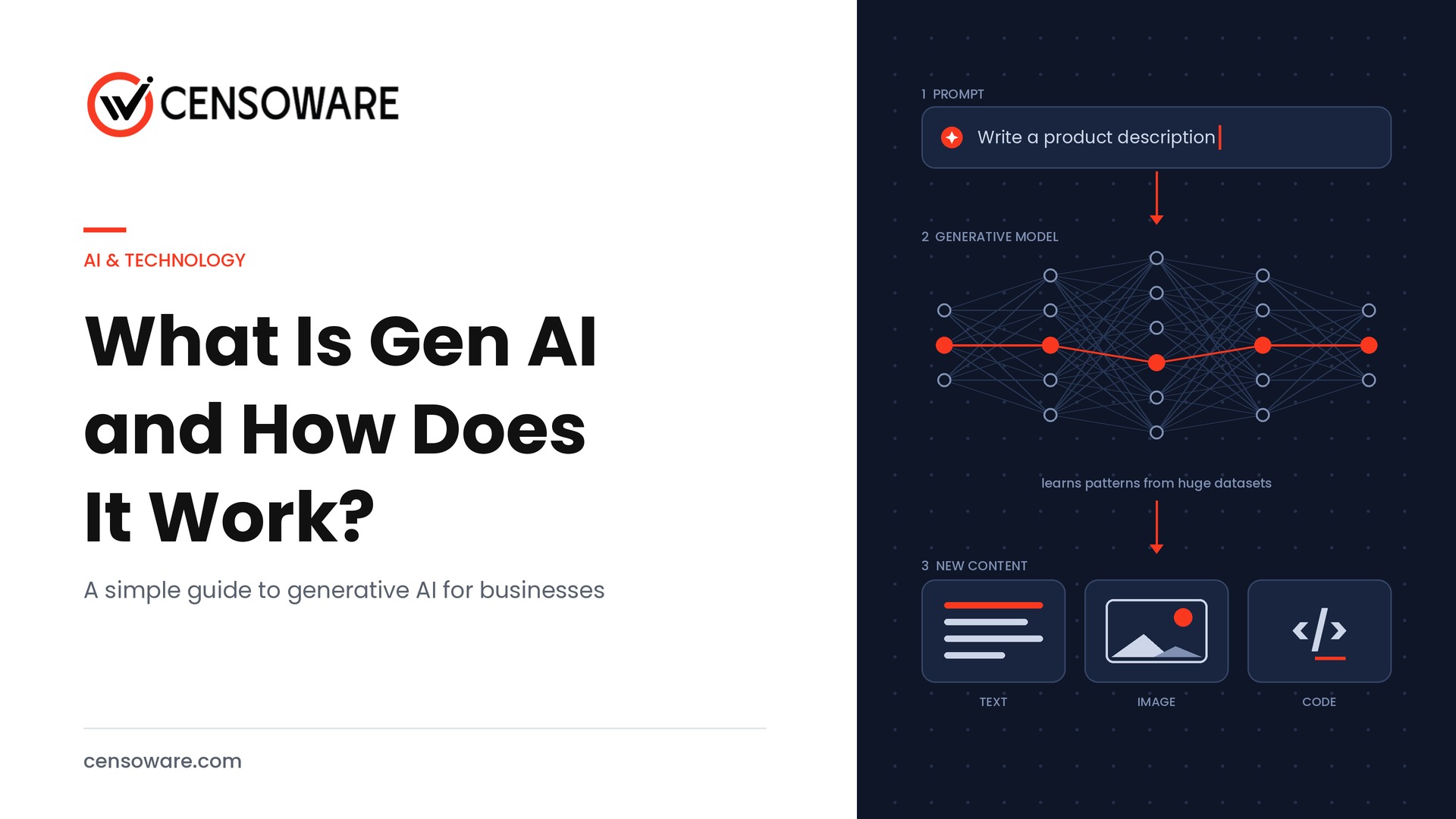
Behind every Gen AI tool is a model that learns patterns from huge amounts of data. The process can be understood in four stages.
1. Training on large datasets
The model is fed enormous collections of text, images, code, or audio. It does not memorise them like a database. It learns statistical relationships, such as which words usually follow each other or which shapes make up a face.
2. Learning through neural networks
The learning happens inside neural networks, which are layers of connected mathematical units. During training, the model repeatedly predicts a missing piece of data, compares its guess with the real answer, and adjusts its internal settings (called parameters) to reduce the error. Modern models have billions of these parameters.
3. Understanding context with transformers
Most text-based tools use an architecture called the transformer. Its key feature is “attention”, which lets the model weigh how important each word is relative to the others in a sentence. This is how it understands context, for example, telling whether “bank” means a river bank or a financial bank. The idea was introduced in the research paper Attention Is All You Need, which became the foundation of today’s large language models.
4. Generating output from your prompt
When you type a prompt, the model converts it into numbers, calculates the most likely continuation, and builds the response piece by piece. The result feels creative because the model combines learned patterns in new ways, not because it copies a stored answer.
After the base training, developers often fine-tune the model on specialised data and use human feedback to make answers safer and more useful.
Main Types of Gen AI Models
- Large language models (LLMs): generate and understand text and code. They power chatbots, writing assistants, and summarisers.
- Diffusion models: create images and video by starting from random noise and gradually refining it into a picture that matches your description.
- Generative adversarial networks (GANs): use two networks, one that creates and one that judges, which improve by competing with each other.
- Multimodal models: handle more than one type of input and output, such as a photo plus a text question.
For a clear explanation from researchers, MIT’s article Explained: Generative AI is a good next read.
Where Businesses Use Gen AI
- Customer support: chatbots that answer common questions around the clock.
- Marketing: first drafts of blogs, ad copy, product descriptions and social posts.
- Software development: code suggestions, bug explanations and test generation.
- Operations: summarising reports, meeting notes and long documents.
- Product experiences: personalised recommendations and smart search inside apps.
Many of these use cases work best when AI is built into your own systems instead of used as a separate tool. That is where custom app development services help, because the AI features can be shaped around your workflow, data, and users.
Limitations You Should Know
Gen AI is powerful, but it is not perfect.
- Hallucinations: the model can state wrong information confidently.
- Bias: outputs can reflect biases present in the training data.
- Privacy and security: sensitive business data should not be pasted into tools without proper controls.
- Need for review: important content should always be checked by a human.
Treat Gen AI as a skilled assistant, not an unquestioned authority.
How to Get Started With Gen AI
- Pick one clear problem, such as faster support replies or report summaries.
- Prepare your data. Clean, well-organised data gives better results.
- Start small with a pilot, measure the results, then expand.
- Connect AI to your existing software through API development and integration so it works with your CRM, ERP, or website.
- Plan for people and process. Our guide on how businesses can prepare for AI adoption covers readiness in more detail.
Frequently Asked Questions
Is Gen AI the same as ChatGPT?
No. ChatGPT is one product built on Gen AI. Gen AI is the broader technology behind many tools.------
Does Gen AI copy existing content?
It learns patterns from data and generates new output. However, results can sometimes resemble existing material, so reviewing and editing is important.
Can small businesses use Gen AI?
Yes. Many tools are affordable, and a small pilot project is often enough to see value.
Will Gen AI replace jobs?
It automates repetitive tasks, but human judgement, creativity, and accountability remain essential. Most roles will change rather than disappear.
Conclusion
Gen AI is a technology that learns patterns from massive datasets and uses them to create new text, images, code, and more. Understanding how it works, what it is good at, and where it falls short helps you use it wisely. Start with one focused use case, keep humans in the loop, and scale step by step.