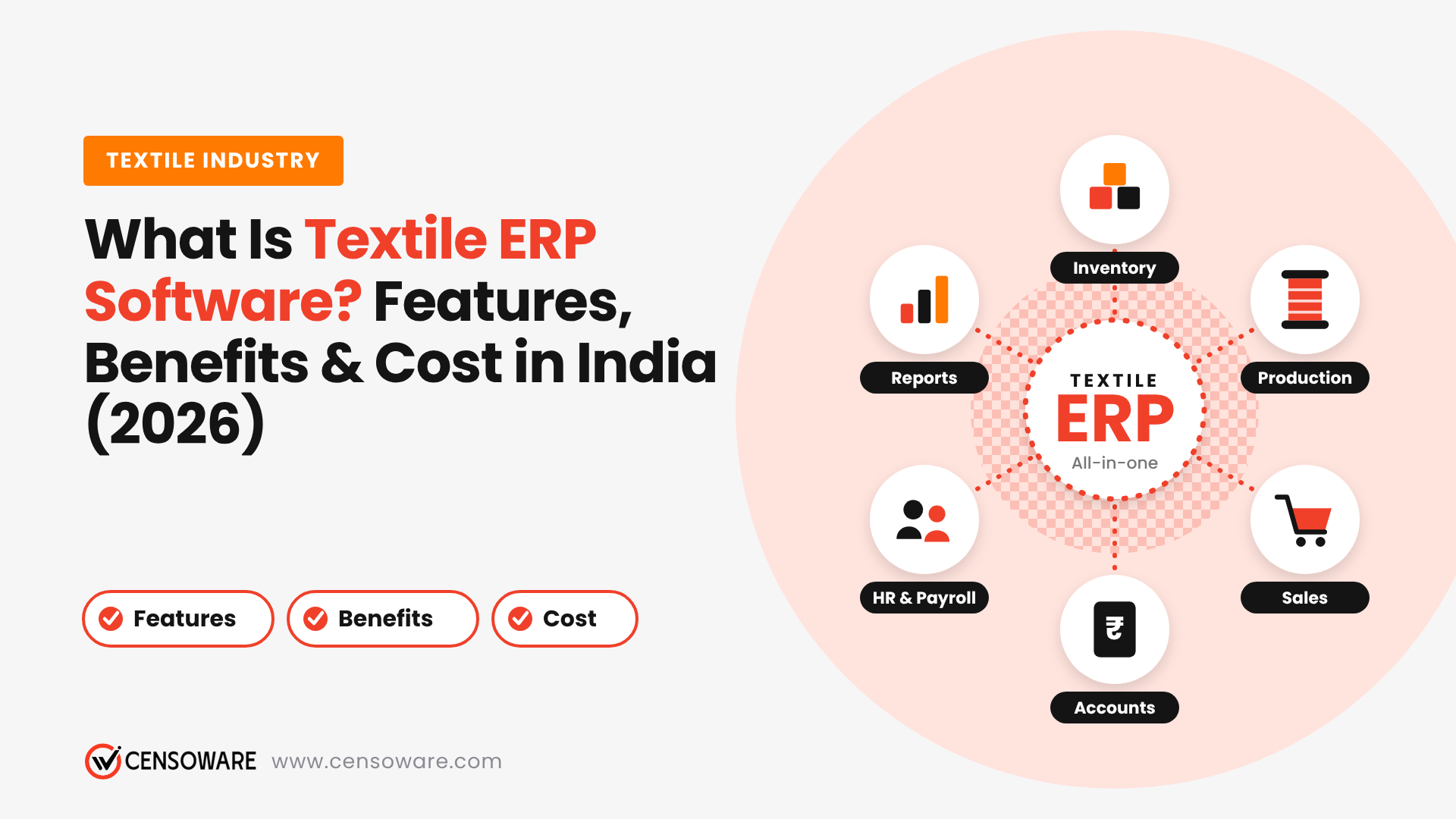
What Is Textile ERP Software? Features, Benefits & Cost in India (2026)
Learn what textile ERP software is, its key features, benefits, and cost factors for Indian mills and garment units, and how to choose the right system.
- What is textile ERP software?
- Key features to look for
- Benefits you'll actually notice
- How much does textile ERP cost in India?
- Before you choose
- Frequently Asked Questions
How many Excel sheets does your factory run on right now? One for yarn stock, another for orders, a third for job work, and a WhatsApp group holding it all together. If that sounds familiar, you're not alone. It's exactly the problem textile ERP software is built to solve.
What is textile ERP software?
Textile ERP is a single system that connects purchasing, inventory, production, sales, accounts, and dispatch. Instead of five tools that don't talk to each other, everyone works from the same live data.
Generic ERPs often miss textile realities such as yarn counts, fabric rolls, dyeing batches, shade matching, and job work. A textile-specific system handles these more easily. That matters in a sector this big: the Ministry of Textiles' annual report says the industry directly employs over 45 million people. With that much competition, small inefficiencies add up fast.
Key features to look for
- Inventory management: Track yarn, fabric, trims, and finished goods by lot, roll, or batch.
- Production planning: Plan spinning, weaving, knitting, dyeing, and stitching in one flow.
- Job work tracking: See exactly which material is with which vendor.
- Costing: Compare estimated cost with actual cost for every order. Ramco's guide to spinning ERP highlights this variance tracking as a cost-control tool.
- GST and accounts: Invoicing, e-way bills, and e-invoicing without double entry.
- Reports and mobile access: Check orders and stock on your phone, not just on the office PC.
Benefits you'll actually notice
- Fewer errors: Data is entered once, not copied across sheets.
- Less wastage: You see stock and consumption in real time.
- Better cash control: You know what buyers still owe you and what you owe vendors.
- Faster decisions: Reports take minutes, not days.
- GST readiness: Businesses above the notified turnover limit (₹5 crore at the time of writing) must generate e-invoices through the government's e-invoice portal. A good ERP does this for you automatically. Confirm the current limit with your CA before relying on it.
How much does textile ERP cost in India?
There's no single price, and any vendor quoting one without asking questions is guessing. Published figures vary widely. One Indian ERP buying guide puts typical pricing at roughly ₹2,000 to ₹10,000 per user per month, before implementation and training. Your final cost depends mainly on:
- Number of users: More users means a higher bill.
- Modules needed: Inventory and billing only, or full production, costing, and HR?
- Deployment: Cloud subscription or one-time on-premises licence?
- Customization: Ready-made software costs less than a system built around your process.
- Support: Ongoing maintenance is a real cost. Ask about it upfront.
Ready-made packages suit units with standard workflows. If your process is unusual, such as several job workers or custom costing, a tailored system usually pays off. Censoware offers both through its ERP and CRM products and custom app development, and quotes are based on your actual modules and users.
Before you choose
Ask every vendor three questions:
- Can you demo it using my workflow, not a generic one?
- Will it connect to Tally and my existing tools? (Our API integration services handle exactly this.)
- Who supports us after go-live, and for how long?
Not sure where to start? Request a free consultation, and we'll map your current process before recommending anything.
Frequently Asked Questions
Is ERP only for big textile mills?
No. Small and mid-size units benefit just as much, often more, because manual errors hurt thinner margins.
How long does implementation take?
It depends on scope. A simple setup can go live in weeks, while multi-unit custom builds take longer.
Can ERP replace Tally?
Many ERPs include accounting, or they integrate with Tally so you don't lose your existing books.
Do I need cloud or on-premises?
Cloud suits units that want access from anywhere with low upfront cost. On-premises suits units that prefer local control. Your vendor should explain the trade-offs for your size.
Conclusion
Textile ERP software replaces scattered sheets and guesswork with one live view of stock, production, costs, and compliance. The right system depends on your workflow, your team size, and how much customization you really need. Start with a demo built around your own process, compare quotes on the same scope, and choose a partner who will still be there after go-live.
Ready to move your unit off Excel? Talk to Censoware for a free consultation. We'll understand your process first, then suggest the right textile ERP for it.