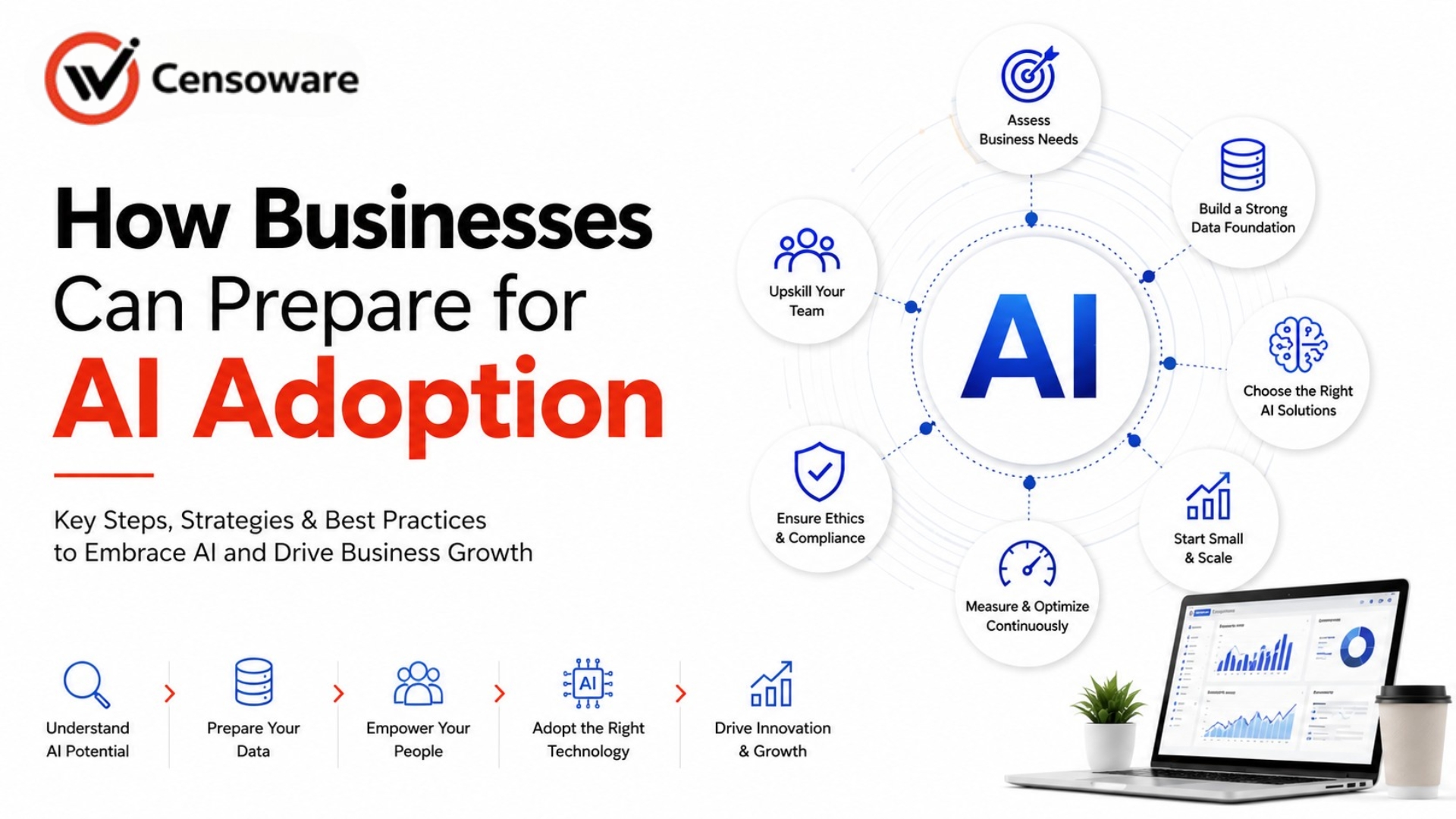
How Businesses Can Prepare for AI Adoption
A practical guide to readying your processes, data systems, and team culture for successful artificial intelligence integration.
- Introduction
- What Does AI Adoption Actually Mean?
- Why Businesses Are Prioritizing AI Adoption Now
- Key Steps to Prepare for AI Adoption
- Common Challenges Businesses Face
- Building an AI-Ready Culture
- Frequently Asked Questions
Businesses that prepare early for AI adoption are gaining a real head start, not just in efficiency, but in how quickly they can respond to changing markets, customer expectations, and competitive pressure. Adopting AI is no longer a bet reserved for large technology companies with dedicated research teams. Tools that once required specialized expertise are now accessible to companies of almost any size, which means the businesses that move first are setting the pace for everyone else in their industry.
This guide explains what AI adoption actually involves, why so many businesses are prioritizing it now, and the concrete steps that separate companies that adopt AI successfully from those that struggle to get any real value from it. Whether you run a small service business or a growing enterprise, understanding how to prepare is the difference between AI becoming a genuine advantage and becoming another expensive tool nobody uses.
What This Guide Covers
- What AI adoption means for a business and why it has moved from experimental to essential.
- The main reasons companies are prioritizing AI adoption right now.
- The practical steps a business can take to prepare its people, data, and processes.
- Common obstacles businesses run into and how to avoid them.
What Does AI Adoption Actually Mean?
AI adoption is the process of integrating artificial intelligence tools and systems into how a business actually operates, not simply purchasing software and hoping it gets used. It covers everything from automating repetitive back-office tasks to using predictive models for decision-making, to deploying customer-facing tools like chatbots or recommendation engines.
It is useful to separate the technology from the transformation. Buying an AI tool is a purchase. Adoption is a change in how work actually gets done, including new workflows, updated skills, and often a different way of thinking about what a team's time should be spent on. A company can own powerful AI software and still not have adopted AI in any meaningful sense if that software sits unused or is applied inconsistently across teams.
For businesses, AI adoption is not a single project with a defined end date. It is an ongoing capability, closer to how a company treats its use of the internet or cloud computing, something woven into daily operations rather than a one-time upgrade.
Why Businesses Are Prioritizing AI Adoption Now
Several forces are pushing AI adoption from optional to expected. Competitive pressure is one of the clearest. When one company in an industry uses AI to respond to customers faster, price more accurately, or produce content at lower cost, competitors feel pressure to close that gap quickly rather than fall permanently behind.
Cost and accessibility have also changed the calculation. Tools that once required a dedicated data science team can now be configured by existing staff with modest training, which puts AI adoption within reach of businesses that would never have considered it a few years ago. At the same time, customer expectations have shifted. People increasingly expect fast responses, personalized recommendations, and self-service options, and AI is often the most practical way to deliver that at scale.
Labor and time constraints matter as well. Many businesses are looking to AI not to replace their teams outright, but to remove repetitive work so people can focus on judgment calls, relationships, and problems that genuinely need a human perspective.
Key Steps to Prepare for AI Adoption
Preparation matters more than speed. Businesses that rush into AI adoption without groundwork often end up with tools that do not fit their actual workflows, while businesses that prepare deliberately tend to see faster and more lasting results.
Identify Realistic Use Cases
Rather than adopting AI everywhere at once, successful businesses start by mapping their processes and finding the points where repetitive work, slow turnaround, or inconsistent quality is costing the most time or money. That single area becomes the starting point.
Ensure Data Readiness
AI systems are only as useful as the information they are given. Many businesses discover during adoption that their data is scattered across disconnected systems, inconsistently formatted, or incomplete. Cleaning up and centralizing data before adoption saves significant time later.
Prepare Your People
Employees need to understand not just how to use a new tool, but why it is being introduced and what it changes about their role. Clear communication reduces resistance, while training that focuses on real tasks produces faster results.
Pilot and Measure
Start small and measure results before scaling. A single pilot project, focused on one clear outcome such as reducing response time or cutting manual data entry, gives a business real evidence of what works before committing budget and attention to a wider rollout.
Common Challenges Businesses Face
Even well-planned AI adoption runs into predictable obstacles. Resistance from employees is common, particularly when people worry that automation threatens their role rather than supporting it. Addressing this openly, rather than avoiding the conversation, tends to produce better outcomes than simply rolling out new tools and hoping concerns fade on their own.
Unclear ownership is another frequent issue. When no single person or team is responsible for how AI tools are configured, monitored, and improved, adoption tends to stall after the initial rollout. Businesses that treat AI adoption as an ongoing responsibility, rather than a one-time IT project, avoid this problem far more often.
Overestimating what AI can do without oversight is also a common misstep. AI tools work best as a support for human judgment rather than a full replacement for it, and businesses that skip review steps entirely often run into accuracy or trust issues that could have been caught early.
Building an AI-Ready Culture
Technology alone does not determine whether AI adoption succeeds. The businesses that get the most value tend to build a culture where experimentation is encouraged, mistakes during early testing are treated as normal, and employees are given room to suggest where AI could help in their own area of work.
Cultural Readiness
Technology alone does not determine whether AI adoption succeeds. The businesses that get the most value tend to build a culture where experimentation is encouraged, mistakes during early testing are treated as normal, and employees are given room to suggest where AI could help in their own area of work.
Leadership involvement matters here. When leaders visibly use and support new AI tools rather than delegating adoption entirely to a technical team, employees are more likely to engage seriously rather than treating the change as optional. Over time, this kind of visible commitment is often what separates businesses that fully integrate AI from those that adopt it only on paper.
Frequently Asked Questions
How long does AI adoption usually take for a business?
It varies widely depending on the size of the business and the complexity of the process being automated, but most businesses see meaningful results from a focused pilot project within a few months, with broader adoption unfolding over a year or more.
Is AI adoption only realistic for large companies?
No. Many AI tools are now priced and designed for small and mid-sized businesses, and starting with a narrow, well-defined use case often makes adoption more manageable for smaller teams than for large organizations juggling many departments at once.
What is the biggest reason AI adoption efforts fail?
Poor preparation is the most common cause, particularly unclear goals, unreliable data, and insufficient training, rather than any shortcoming in the AI tools themselves.
Does AI adoption mean reducing staff?
Not necessarily. Many businesses use AI adoption to remove repetitive tasks so existing staff can focus on higher-value work, rather than to eliminate roles outright.
Where should a business start if it has not begun preparing for AI adoption?
Start by identifying the single process causing the most delay or cost, and evaluate whether a targeted AI tool could meaningfully improve it before considering a wider rollout.
Final Thoughts
AI adoption is becoming one of the clearest ways a business can improve efficiency and stay competitive without dramatically increasing headcount or spend. The businesses seeing the strongest results are rarely the ones with the largest budgets. They are the ones that prepare deliberately, starting with clear goals, clean data, and a team that understands why the change is happening.
Businesses that treat AI adoption as an ongoing capability rather than a one-time project put themselves in a far stronger position to adapt as tools, customer expectations, and competitive pressure continue to evolve. That preparation is where a lasting advantage begins.
Censoware helps businesses prepare for and safely navigate AI adoption. Ready to design an AI introduction strategy tailored for your daily workflows?