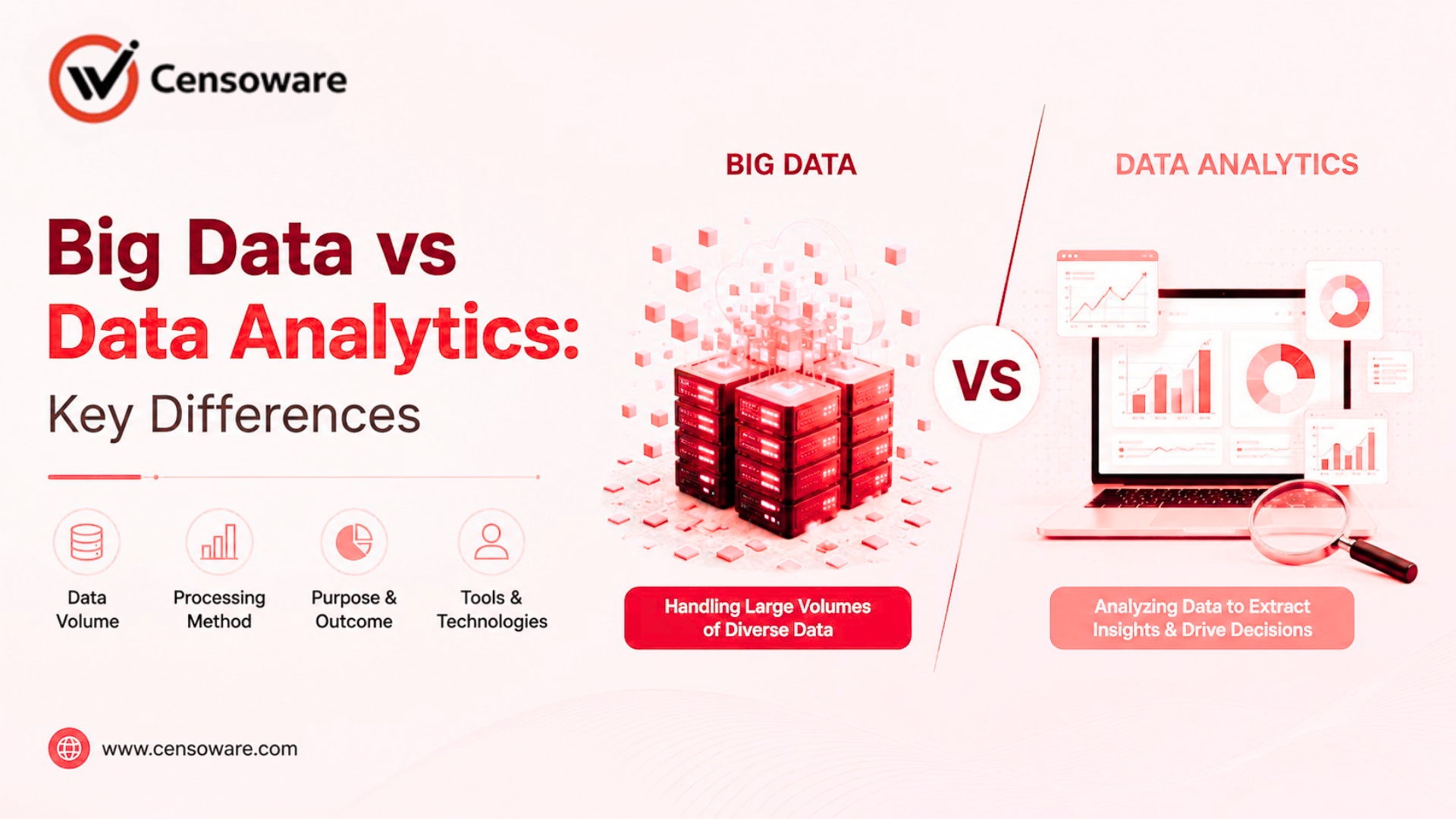
Big Data vs Data Analytics: Key Differences
Understand the distinction between raw data assets and the process used to turn them into actionable insights.
- Introduction
- What Is Big Data?
- What Is Data Analytics?
- Big Data vs Data Analytics: The Key Differences
- How Businesses Use Big Data and Data Analytics Together
- Which One Does Your Business Need First?
- Frequently Asked Questions
Big data and data analytics are often used as if they mean the same thing, but they describe two different parts of the same process. One is about the information itself, and the other is about what a business does with it. Understanding the difference matters, because investing in the wrong one first is a common reason data projects fail to deliver results.
This guide breaks down what big data and data analytics actually mean, how they differ, and how businesses of every size are using both to make faster, more informed decisions.
What This Guide Covers
- What big data and data analytics mean, and how the two terms relate to each other.
- The core differences between big data and data analytics in terms of purpose, scale, and tools.
- How businesses use big data and data analytics together to make better decisions.
- Practical ways to figure out which one your business needs first.
What Is Big Data?
Big data refers to datasets that are too large, fast-moving, or varied to be handled by traditional data processing tools. It is usually described using three characteristics: volume, the sheer amount of data generated; velocity, the speed at which it is created and needs to be processed; and variety, the mix of structured data like spreadsheets and unstructured data like videos, social media posts, or sensor readings.
Big data is generated constantly. Every online purchase, app interaction, GPS ping, and customer support message adds to it. On its own, big data is just raw material. It has no value until it is organized, cleaned, and examined for patterns. A warehouse full of unsorted boxes is a useful analogy: the boxes exist, but nothing useful happens until someone opens them and figures out what is inside.
What Is Data Analytics?
Data analytics is the process of examining data to draw conclusions and support decisions. It takes raw information, whether from a big data source or a much smaller dataset, and turns it into something a business can act on.
Data analytics generally falls into four types. Descriptive analytics explains what happened, such as last month's sales figures. Diagnostic analytics explains why it happened, digging into causes behind a trend. Predictive analytics estimates what is likely to happen next, based on historical patterns. Prescriptive analytics goes a step further and recommends what action to take.
Put simply, data analytics is the thinking process. It is the set of methods, statistics, and tools used to make sense of information and turn it into a decision, a forecast, or a strategy.
Big Data vs Data Analytics: The Key Differences
The clearest way to separate the two is to think of big data as the raw material and data analytics as the process applied to it.
Scale of Data
Big data is defined by scale. It describes datasets so large or complex that specialized infrastructure, such as distributed storage systems and processing frameworks, is needed just to hold and manage it. Data analytics does not require that scale. A small business analyzing a few hundred customer surveys is still doing data analytics, even though the dataset is nowhere near "big."
Focus and Purpose
Big data is concerned with collection, storage, and management. Data analytics is concerned with interpretation and action. A company can have enormous amounts of big data sitting in storage and still make poor decisions if no one is analyzing it properly. Conversely, strong data analytics practices can extract real value even from modest, well-organized datasets.
Infrastructure and Tools
The tools differ as well. Big data relies on infrastructure built for scale, including distributed file systems, cloud data warehouses, and real-time streaming platforms. Data analytics relies on tools built for interpretation, including statistical software, dashboards, visualization platforms, and increasingly, machine learning models. In short, big data answers the question "how much information do we have and where does it live," while data analytics answers the question "what does this information actually tell us."
How Businesses Use Big Data and Data Analytics Together
In practice, the two rarely operate in isolation. Big data provides the scale and detail; data analytics provides the meaning. A retailer collecting big data from point-of-sale systems, website traffic, and loyalty programs gains little until analytics is applied to spot buying patterns, predict demand, or personalize offers.
Streaming services use big data to capture what millions of viewers watch, pause, or skip, then apply data analytics to recommend the next show. Logistics companies gather big data from GPS trackers and delivery systems, then use analytics to optimize routes and cut fuel costs.
Coimbatore Focus
Coimbatore businesses in manufacturing, textiles, and retail are increasingly following the same pattern, collecting more operational and customer data than ever before, and turning to analytics to convert that information into decisions on pricing, inventory, and customer service.
The organizations that get the most value are rarely the ones with the largest datasets. They are the ones that pair sufficient data with disciplined, consistent analysis.
Which One Does Your Business Need First?
Most businesses do not start by needing big data. They start by needing better data analytics applied to the information they already have. A company with a modest customer database, sales history, and website traffic can often uncover meaningful insights long before its data qualifies as "big."
Big data infrastructure becomes necessary when the volume, speed, or variety of information outgrows what standard tools like spreadsheets or a single database can handle, for example, when a business needs to process millions of transactions daily or analyze data streaming in from thousands of connected devices in real time.
For most small and mid-sized businesses, the practical starting point is building strong data analytics habits, asking the right questions of existing data, tracking the right metrics, and making decisions based on evidence rather than instinct. Big data investments tend to pay off once that foundation is already in place.
Frequently Asked Questions
Is big data just a bigger version of data analytics?
No. Big data refers to the datasets themselves, particularly their volume, speed, and variety. Data analytics refers to the methods used to examine data and draw conclusions from it. A business can practice data analytics without ever having big data.
Can a small business benefit from data analytics without having big data?
Yes. Data analytics adds value at any scale. A small business analyzing customer purchase history or website behavior can make better decisions long before its data reaches the volume typically associated with big data.
What tools are typically used for each?
Big data relies on infrastructure such as distributed storage systems, cloud data platforms, and real-time processing frameworks. Data analytics relies on statistical tools, dashboards, visualization software, and, increasingly, machine learning models.
Does a business need big data before it can do predictive analytics?
Not necessarily. Predictive analytics can be applied to moderately sized datasets. Larger and more varied datasets can improve the accuracy of predictions, but they are not a strict requirement to get started.
Which should a business invest in first, big data infrastructure or data analytics capability?
Most businesses see faster returns from strengthening data analytics practices first, since this improves decision-making with data that already exists. Big data infrastructure becomes a priority once data volume, speed, or complexity outgrows existing tools.
Final Thoughts
Big data and data analytics are connected but distinct. Big data describes the scale and complexity of information a business collects, while data analytics describes what that business does with it to make better decisions.
The businesses that benefit most rarely have the largest datasets. They are the ones that consistently turn the data they have, big or small, into clear, actionable insight. That habit, more than the size of the dataset, is where real business value begins.
Censoware helps businesses connect their data collection systems with custom dashboards and analytics tools. Ready to unlock the insights hidden in your data?