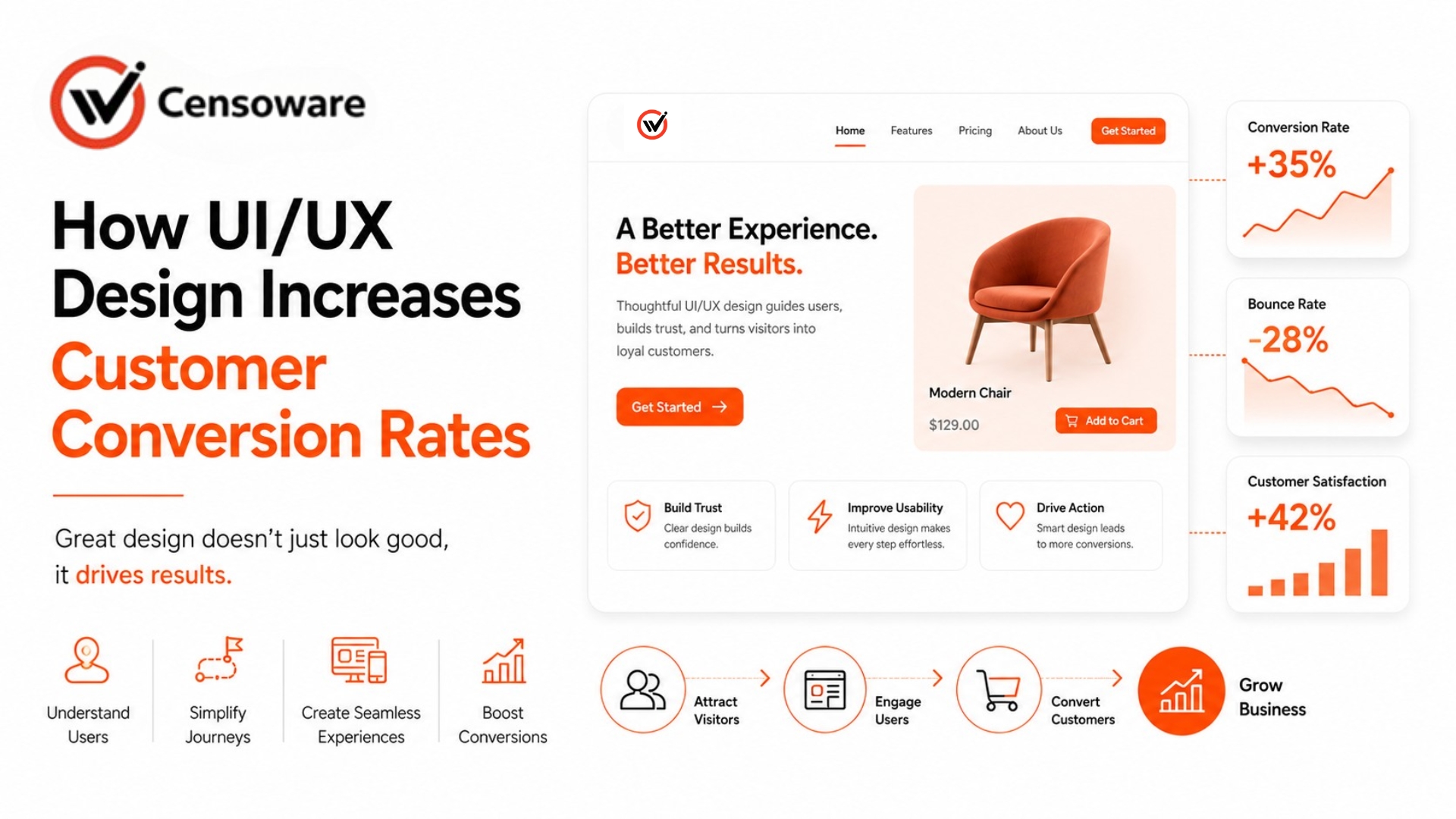
How UI/UX Design Increases Customer Conversion Rates
A strategic guide to understanding how polished visual elements and seamless user flows directly drive revenue and customer action.
- Introduction
- What Is UI/UX Design?
- How UI/UX Design Impacts Customer Conversion Rates
- UI/UX Experience Trends Businesses Should Understand
- Why Improving Your UI/UX Experience Now Matters
- Frequently Asked Questions
Businesses that invest in thoughtful UI/UX design are turning more visitors into customers, reducing drop-off, and building loyalty that keeps people coming back. A polished interface and a smooth experience are no longer extras reserved for large technology companies. They have become one of the most reliable ways for any business, regardless of size, to grow revenue from the traffic it already has.
This guide explains what UI/UX design actually involves, the elements that have the strongest effect on customer conversion rates, and how businesses across industries are using design improvements to win more customers. Whether you run an online store, a service-based website, or a mobile app, understanding UI/UX design is one of the fastest ways to turn existing visitors into paying customers.
What This Guide Covers
- What UI/UX design means and why it has become central to online sales.
- The specific elements of UI/UX design that directly influence whether a visitor converts.
- How businesses are using UI/UX design and a stronger UI/UX experience to lift conversion rates.
- Practical ways to start improving your own website or app today.
What Is UI/UX Design?
UI/UX design covers two connected but distinct disciplines. UI, or user interface design, focuses on how a product looks and how its visual elements, buttons, menus, colors, and layouts, are arranged on the screen. UX, or user experience design, focuses on how a product feels to use, including how easily someone can find what they need, complete a task, or reach a decision without friction or confusion.
Put simply, UI is what people see, and UX is what people feel. A checkout page with clear buttons and readable text is good UI. A checkout process that takes thirty seconds instead of five minutes, with no unnecessary steps, is good UX. The two work together. A beautifully designed page with a confusing UX experience will still lose customers, just as a smooth UX experience with poor visual design can feel untrustworthy.
For businesses, UI/UX design is not decoration. It is a functional part of the sales process. Every screen a customer interacts with is either moving them closer to a purchase or giving them a reason to leave.
How UI/UX Design Impacts Customer Conversion Rates
Conversion rate measures the percentage of visitors who complete a desired action, whether that is making a purchase, filling out a form, or signing up for a service. UI/UX design influences this number at almost every stage of the customer journey, and a few elements consistently make the biggest difference.
Page Load Speed
One of the strongest predictors of conversion. Visitors form an opinion about a website within seconds, and slow-loading pages cause people to leave before they ever see what is being offered.
Clear Navigation
When customers cannot quickly find the product, pricing, or information they came for, most will not search further; they will simply leave.
Visual Hierarchy
The way design draws attention to the most important elements first determines whether customers notice your call-to-action buttons or scroll past them.
Mobile Responsiveness
This has become non-negotiable. A large share of traffic now arrives from phones, and a site that does not adapt cleanly to smaller screens loses trust immediately.
Trust Signals
Clear pricing, visible contact details, and consistent design play a quiet but powerful role, since uncertainty is one of the most common reasons customers abandon a purchase partway through.
Frictionless Forms
Forms deserve particular attention. Long, complicated forms with unnecessary fields are one of the most common conversion killers on the internet. Reducing friction at checkout, sign-up, or inquiry stages, even by removing a single unnecessary field, can measurably improve completion rates.
UI/UX Experience Trends Businesses Should Understand
The way businesses approach UI/UX experience has shifted considerably in recent years. Design decisions that used to rely on instinct are now backed by data, testing, and direct observation of real customer behavior.
A/B testing has become standard practice, allowing businesses to compare two versions of a page and measure which one converts better before committing to a final design. Mobile-first design is now the default starting point for most new projects, rather than an adjustment made after the desktop version is finished. Personalization is also growing quickly, with websites and apps adjusting content, recommendations, and layout based on individual visitor behavior rather than showing every customer the same experience.
Accessibility has moved from an afterthought to a core requirement, as businesses recognize that a UI/UX experience built for everyone, including customers using screen readers or navigating with limited dexterity, expands the addressable market rather than restricting it.
Coimbatore Focus
Coimbatore businesses in retail, education, and services are increasingly investing in UI/UX design for their websites and apps, recognizing that customers comparing options online will rarely wait for a slow or confusing experience when faster alternatives are one click away.
These shifts point to a clear pattern. UI/UX design is no longer treated as a one-time project finished at launch. It has become an ongoing process of testing, learning, and refining based on how real customers actually behave.
Why Improving Your UI/UX Experience Now Matters
A common misconception is that strong UI/UX design requires an expensive redesign or a dedicated in-house design team. That may have been true years ago, but today, tools for testing, prototyping, and improving design are far more accessible, even for small businesses working with limited budgets.
What matters more than budget is intent. Businesses that understand which parts of their UI/UX experience are causing customers to hesitate or leave are far better positioned to fix the right problems first, rather than redesigning everything at once. A single confusing step in a checkout flow can quietly cost more sales over a year than almost any marketing campaign can recover.
Improving UI/UX design does not require transforming an entire website overnight. It often starts with identifying the one screen, form, or step where the most customers are dropping off, and addressing that first.
Frequently Asked Questions
How much can UI/UX design actually affect conversion rates?
The impact varies by business, but even small UI/UX design changes, such as simplifying a form or speeding up a page, often produce noticeable improvements in conversion rates because they remove friction at exactly the moment a customer is deciding to act.
Is UI/UX design only relevant for e-commerce websites?
No. Service businesses, healthcare providers, educational platforms, and B2B companies all rely on websites and apps to convert visitors into leads or customers. Anywhere a customer takes an action online, UI/UX design plays a role.
What is the difference between UI and UX in practical terms?
UI covers the visual layer, colors, buttons, and typography. UX covers the functional layer, how easily someone moves through a process. Strong conversion rates usually require both working well together.
Do small businesses need to invest heavily in UI/UX design?
Not necessarily. Many effective improvements, like clearer calls-to-action, simplified forms, and faster load times, cost very little to implement but have an outsized effect on conversion.
Where should a business start if it has never focused on UI/UX experience?
Start by reviewing the page or step where the most visitors leave without completing an action. Fixing that single point of friction is usually more valuable than attempting a full redesign all at once.
Final Thoughts
UI/UX design is one of the most direct ways a business can influence its conversion rates without increasing advertising spend. Every interaction a customer has with a website or app either builds confidence or creates doubt, and that difference shows up directly in the numbers.
The businesses that convert the most visitors are rarely the ones with the largest design budgets. They are the ones that understand where their UI/UX experience is creating friction and take deliberate steps to remove it. That understanding is where stronger conversion rates begin.
Censoware helps businesses build high-converting, user-friendly digital products. Ready to analyze and optimize your website or app's UI/UX design?
Consult our UI/UX design team.