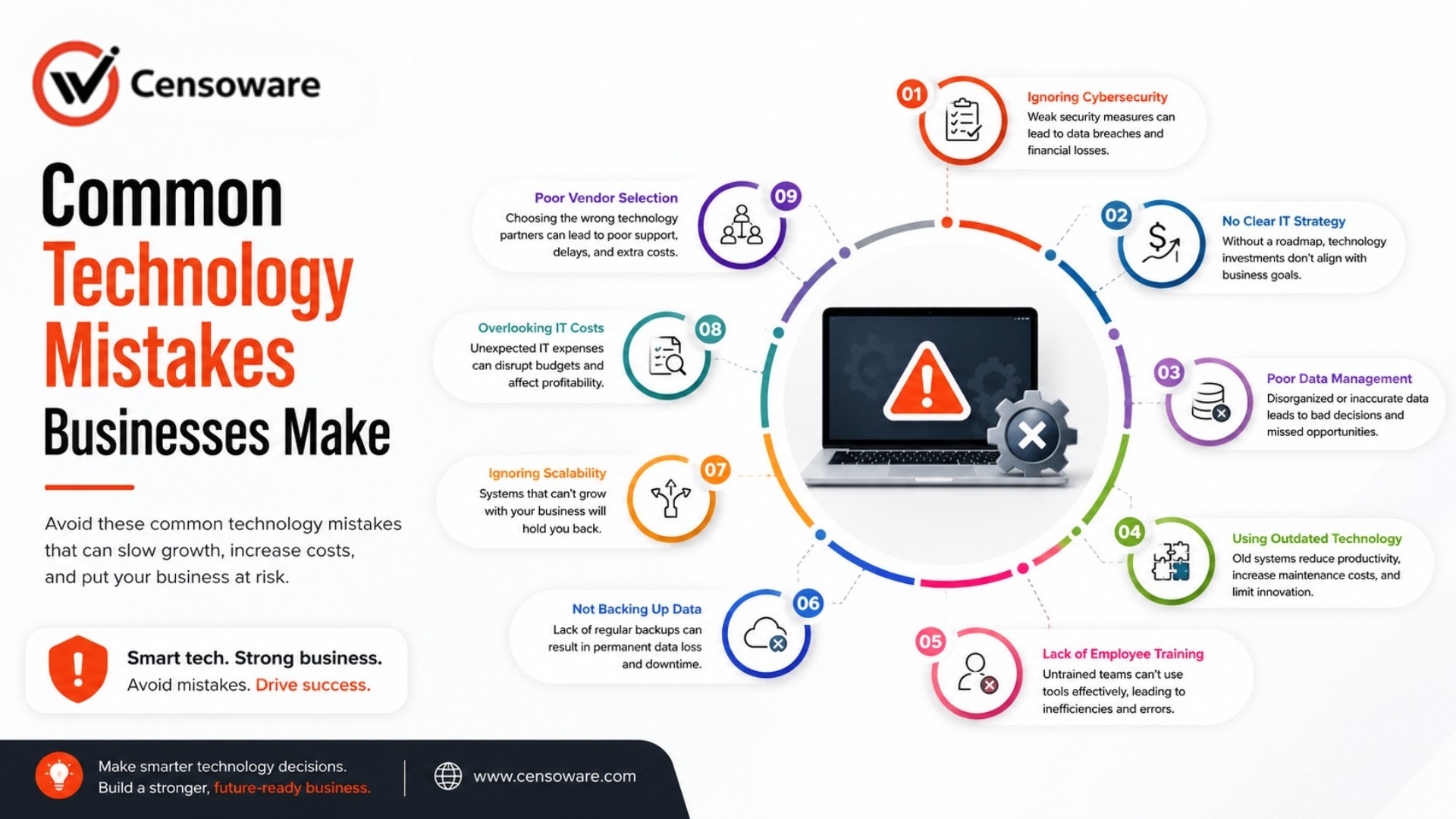
Common Technology Mistakes Businesses Make
Many companies spend significant time and money on systems that underperform. Understanding predictable pitfall patterns is the first step to avoiding them.
- Introduction
- Mistake 1: Buying Tools Without a Clear Problem
- Mistake 2: Choosing Tools That Cannot Grow
- Mistake 3: Underestimating Team Adoption
- Mistake 4: Using Disconnected Tools
- Mistake 5: Neglecting Security
- Mistake 6: Treating Tech as a One-Time Project
- Mistake 7: Skipping Measurement
- Frequently Asked Questions
Technology has the potential to transform how a business operates. But not every technology investment delivers the results businesses expect. Many companies spend significant time and money on systems that underperform, create new problems, or simply go unused.
The good news is that most technology mistakes follow predictable patterns. Understanding what those patterns are, and why they happen, makes it much easier to avoid them. This guide covers the most common mistakes businesses make with technology and explains how to take a smarter approach from the start.
What This Guide Covers
- Why technology investments sometimes fail to deliver results.
- The most common technology mistakes businesses make at every stage.
- How poor planning leads to expensive course corrections.
- Why the wrong tools create more problems than they solve.
- How to avoid these mistakes with a smarter approach.
Mistake 1: Buying Tools Without Solving a Clear Problem
Investing in software without first identifying the specific problem it needs to solve is a common pitfall. Businesses often respond to persuasive sales pitches or mimic competitors without defining their own goals.
The Fix
Before evaluating any technology, document the exact problem being solved. Describe the current process, the friction points, and what a successful outcome looks like in practical terms.
Without this clarity, software is often partially implemented and then abandoned because it doesn't fit the team's actual workflow.
Mistake 2: Choosing Tools That Cannot Grow With the Business
Many companies choose software based on what they need today without considering what they will need in two or three years. A tool that works well for a small team can become a constraint as the business scales.
When businesses hit these limitations during growth, they face the expensive and disruptive task of migrating data and retraining staff under pressure. Always ask how a tool handles increased volume, more users, and additional complexity.
Mistake 3: Underestimating the Importance of Team Adoption
Technology only works when people use it. Poor adoption often happens because staff were not involved in the selection, training was insufficient, or the system added complexity instead of reducing it.
Building Ownership
Successful adoption starts with involving the actual users in the planning and testing phases. Their input improves the solution and increases their sense of ownership over the outcome.
Mistake 4: Using Too Many Disconnected Tools
Accumulating a stack of disconnected tools—CRM, project management, invoicing—creates fragmentation. When data lives in separate systems, employees spend hours manually transferring information and reconciling differences.
Consolidating or integrating systems so they share data automatically reduces manual effort and improves information reliability across the entire business.
Mistake 5: Neglecting Security and Data Protection
Security is often treated as a secondary concern, yet data breaches and ransomware attacks cause lasting reputational and financial harm. The cost of recovering from an incident is almost always higher than the cost of prevention.
Every investment should include a basic security review: understanding where data is stored, who has access, and how it is protected. For custom software, security should be baked into the design from day one.
Mistake 6: Treating Technology as a One-Time Project
Technology is an ongoing investment, not a project with a fixed end date. Systems that aren't regularly reviewed, maintained, and iterated upon will gradually become outdated and underperform.
Smart management includes scheduled reviews to assess if tools still fit, regular updates to keep them performing well, and a willingness to iterate based on team feedback.
Mistake 7: Skipping the Measurement Phase
Without clear metrics, it's impossible to know if a tool is delivering value. Informal impressions are unreliable; a tool people like may not actually be moving the needle on productivity.
Success Metrics
Define success in specific terms before implementation: How much time should be saved? What error rate is acceptable? What response time improvement is expected? Measure these before and after.
Frequently Asked Questions
How can I tell if our current technology is holding us back?
Look for frequent manual workarounds, staff complaints about tool limitations, and data that lives in separate systems that don't communicate.
Is custom software always better than off-the-shelf tools?
Not always. Custom software is most valuable when your process is unique, when integration is critical, or when off-the-shelf tools require significant workarounds.
How do we get our team to adopt new technology?
Involve them early, explain the "why," and show how it makes their work easier. A phased rollout with accessible support is key.
What is the most common reason tech projects fail?
Lack of a clear problem definition. Without a specific outcome, it's impossible to measure success or make informed implementation decisions.
How often should we review our tech stack?
At minimum, annually. Fast-growing businesses should review every six months to ensure tools still fit their current scale.
Final Thoughts
Technology mistakes are expensive but avoidable. Success comes from starting with clear problem definitions, choosing scalable solutions, and measuring results consistently.
Censoware helps businesses design solutions that avoid these pitfalls from the beginning. Ready to build a system that actually improves the way you operate?