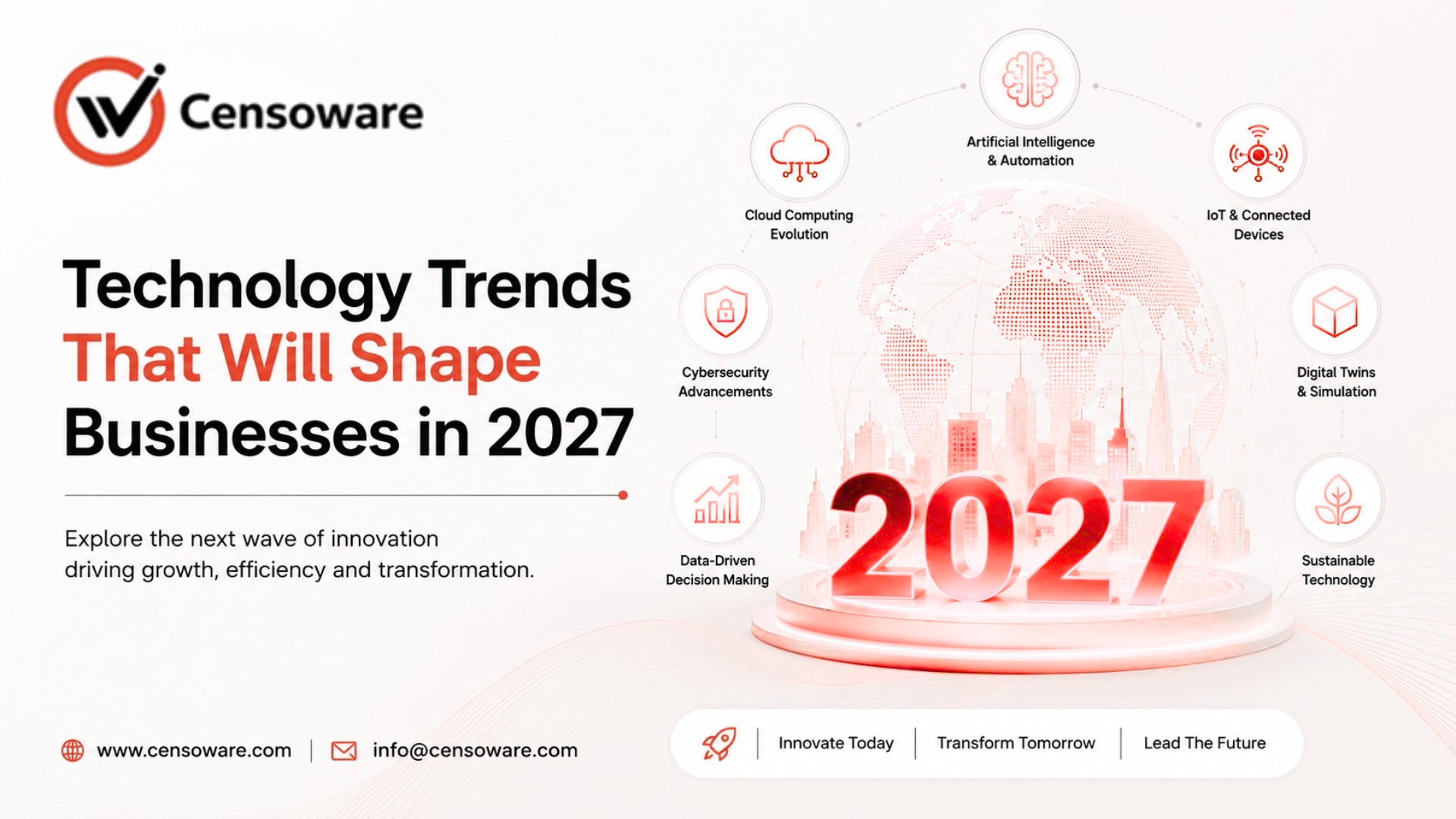
Technology Trends That Will Shape Businesses in 2027
The movements gaining momentum today will define the competitive landscape of 2027. Understanding these shifts allows leaders to lead rather than react.
- Introduction
- Trend 1: AI-Powered Business Operations
- Trend 2: Hyper-Personalized Customer Experiences
- Trend 3: Voice and Conversational Interfaces
- Trend 4: Edge Computing and Real-Time Data
- Trend 5: Low-Code and No-Code Development
- Trend 6: Cybersecurity as a Business Priority
- Trend 7: Sustainable Technology Practices
- How to Prepare Your Business for 2027
- Frequently Asked Questions
Technology does not stand still, and neither does the competitive landscape for businesses that depend on it. The trends gaining momentum today will define how businesses operate, serve customers, and compete in 2027 and beyond. Understanding what is coming allows business leaders to plan ahead rather than react under pressure.
This guide examines the technology trends that will have the greatest impact on businesses in the near future, explains what each trend means in practical terms, and outlines how businesses can begin preparing now.
What This Guide Covers
- Why understanding emerging trends gives businesses a planning advantage.
- The most impactful technology trends heading into 2027.
- How each trend affects operations and customer expectations.
- Trends most relevant for small and mid-sized businesses.
- Practical steps to prepare for what is coming next.
Trend 1: AI-Powered Business Operations
By 2027, AI will be a standard component of everyday business tools rather than a specialist technology. It will be embedded in customer support, financial forecasting, and internal workflow management.
For businesses, this means AI will handle data analysis, report generation, and pattern identification in customer behavior. The businesses that benefit most will be those that invest now in data quality; AI is only as useful as the integrated data it has access to.
Trend 2: Hyper-Personalized Customer Experiences
Customer expectations are rising toward a baseline where hyper-personalization is expected. Technology makes it possible to anticipate needs and deliver tailored experiences at scale without manual effort.
The SMB Opportunity
Smaller businesses can use technology to deliver personalization that feels genuine—a powerful differentiator against larger competitors who often struggle to maintain a personal touch at their scale.
Trend 3: Voice and Conversational Interfaces
Conversational channels—AI chat tools, voice assistants, and messaging platforms—will handle a significant portion of customer interactions by 2027. Businesses with voice-friendly content and structured information architecture will be better positioned to meet customers where they are.
Trend 4: Edge Computing and Real-Time Data
Processing data closer to where it is generated (edge computing) enables faster decision-making. For logistics, retail, and manufacturing, this means real-time visibility into vehicle locations and package statuses rather than waiting for end-of-day reports.
Trend 5: Low-Code and No-Code Development
By 2027, capable low-code platforms will allow business users to build workflow automations and internal apps with less development time. While professional developers are still critical for scalable solutions, these tools allow for faster iteration and response to changing needs.
Trend 6: Cybersecurity as a Business Priority
As threats grow, cybersecurity will become a core priority rather than an IT afterthought. Moving into 2027, stringent regulations and higher customer expectations mean businesses must design security into their systems from the beginning to earn trust and avoid financial damage.
Trend 7: Sustainable Technology Practices
Sustainability is becoming a key factor in procurement and development. Energy-efficient infrastructure and transparent data handling will be meaningful considerations for customers, investors, and regulators alike by 2027.
How to Prepare Your Business for 2027
- Audit Data: Consolidate fragmented systems and improve data quality.
- Explore AI: Identify tools relevant to your specific industry use cases.
- Optimise for Mobile: Invest in fast-loading, mobile-first digital experiences.
- Security First: Build security into every technology decision phase.
- Create a Roadmap: Identify trends most relevant to your business model.
- Find a Partner: Work with developers who understand emerging tech directions.
Frequently Asked Questions
Which trend will have the biggest impact on small businesses?
AI-powered operations and hyper-personalization have the broadest impact as they improve both internal efficiency and customer satisfaction simultaneously.
Do I need to invest in all of these trends?
No. Focus on the two or three most relevant to how your business creates value. Adopting every trend dilutes focus; strategic investment is more effective.
How quickly do businesses need to respond?
Preparing now ensures you aren't playing catch-up in 2027. Early experience with these tools provides a significant competitive advantage over late adopters.
Is it expensive to prepare for these shifts?
It depends on your current foundation. Businesses with integrated data and modern systems will find it less expensive than those starting from fragmented, manual setups.
How does Censoware help businesses stay ahead?
We build scalable, integrated systems today that support the tools of tomorrow, ensuring your foundation is ready for AI, voice interfaces, and advanced security needs.
Final Thoughts
The businesses that thrive in 2027 are building their foundations today. Technology shifts happen over years, and those who plan ahead will lead when the mainstream catches up.
Censoware helps you navigate the future of technology with practical strategies and robust digital systems. Ready to lead your industry into 2027?