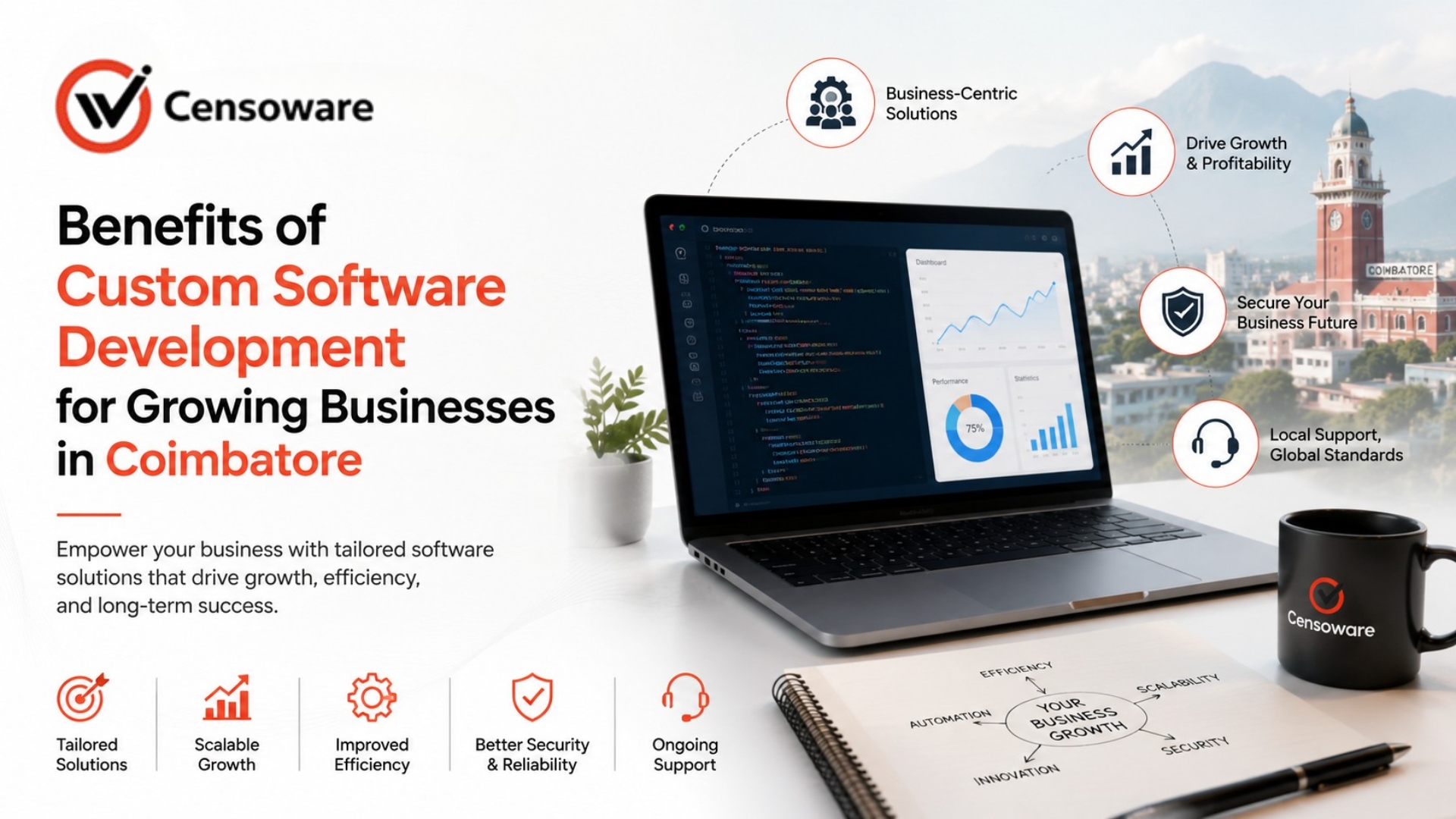
Benefits of Custom Software Development for Growing Businesses in Coimbatore
Custom software is not a luxury reserved for large enterprises. For the growing businesses of Coimbatore, it is increasingly becoming a competitive necessity.
- Introduction
- Improved Operational Efficiency
- Industry-Specific Solutions
- Better Integration With Existing Systems
- Types of Custom Software That Deliver ROI
- How to Build the Business Case
- Long-Term Cost Savings and ROI
- Frequently Asked Questions
When a Coimbatore business decides to invest in custom software development, the decision rarely comes overnight. It usually arrives after months of workarounds, duplicate data entry, frustrated staff, and the quiet realization that the tools are working against the business rather than for it. Once that decision is made and the right solution is in place, the benefits tend to compound quickly.
What This Guide Covers
- How custom software improves operational efficiency for Coimbatore businesses.
- Industry-specific solutions for textile, manufacturing, healthcare, and education sectors.
- How custom software integrates better with your existing tools and systems.
- The long-term cost savings and return on investment that custom software delivers.
This guide breaks down exactly what custom software delivers and why the businesses that invest in it consistently outperform those that do not.
Improved Operational Efficiency
The most immediate benefit of custom software is the elimination of operational waste. This is the daily waste of time spent entering the same data into multiple systems, generating reports manually, or chasing approvals through disconnected tools.
When software is built around your actual workflow, every step is intentional. The result is that your people spend more time on work that actually creates value and less time managing their tools.
Automated Workflow Drivers
Custom software can trigger actions automatically: purchase order drafts when stock drops, payment alerts for overdue invoices, or automatic moves to the dispatch queue after quality inspection. These automations ensure critical steps never fall through the cracks.
Industry-Specific Solutions for Coimbatore's Core Sectors
Textiles and Garments
Custom software handles textile-specific requirements like lot-wise production tracking, shade variation data, and buyer-specific quality parameters. It automates export documentation in international formats, letting your team focus on execution rather than paperwork.
Manufacturing and Engineering
For Coimbatore's motor, CNC, and auto component makers, custom systems integrate machine sensors for real-time utilization data, manage complex bills of materials, and track tooling life. Data is presented exactly how your production team needs it.
Healthcare and Education
Hospitals benefit from separate inpatient/outpatient workflows and NABH-compliant documentation. Educational institutions get combined scheduling, attendance, fee collection with fine automation, and examination management in a single integrated system.
Better Integration With Existing Systems
Custom software doesn't have to replace everything; it can be built to connect with the tools your business already relies on, like accounting software or specialized e-commerce platforms.
Through API integration, your team sees all relevant information in one place. No more manually moving data between payment gateways, logistics partners, or government compliance portals. This eliminates hours of manual data preparation.
Types of Custom Software That Deliver Strong ROI
- Custom ERP Systems: Unified platforms connecting sales, production, inventory, and finance.
- Workflow Automation Tools: Systems that eliminate manual handoffs and automate approval routing.
- Customer and Supplier Portals: Branded self-service platforms for orders, status tracking, and document access.
- Custom Reporting Dashboards: Live analytics tools giving leadership visibility for better decision-making.
- Compliance and Documentation Systems: Tools that generate regulatory or export documents in exact required formats.
How to Build the Business Case for Custom Software
1. Identify Friction Points
Map workflows where your team loses time look for manual entries, repeated corrections, or reliance on WhatsApp/email.
2. Calculate Current Cost
Multiply hours spent on workarounds by the cost of that time. Add the cost of errors like billing mistakes or missed deadlines.
3. Define Required Outcomes
Set specific goals: reduce data entry by 40%, cut turnaround times, or enable real-time visibility across locations.
4. Compare Total Cost of Ownership
Compare custom development against 5 years of SaaS subscriptions plus the cost of existing workarounds.
5. Plan for Phased Delivery
Build high-impact modules first to realize benefits early, then expand the system based on initial phase feedback.
Long-Term Cost Savings and Return on Investment
While the upfront investment in custom development is higher than a subscription, it's an asset you own. There are no renewal negotiations or per-user fees that penalize your growth. Over five years, many businesses pay more in SaaS subscriptions than a custom solution would have cost.
Productivity gains translate directly into margins. When a team of four handles what previously required six, or when automated invoicing eliminates revenue leakage, the ROI becomes undeniable.
Frequently Asked Questions
Is custom software development only worthwhile for large businesses?
No. Mid-sized businesses with 20 to 200 employees consistently see strong returns, especially in specialized industries where generic tools fall short.
How do we ensure the custom software actually gets used by our team?
By designing it around their actual workflow and providing role-specific training. When a tool matches how they work, resistance disappears.
What happens if our business requirements change after the software is built?
A well-architected system is designed for change. New modules can be added and existing workflows adjusted without rebuilding the entire platform.
How do we measure whether the software investment is delivering ROI?
Track the metrics you set initially: time saved, error rates, and turnaround times. Most businesses see measurable returns within three to six months.
Final Thoughts
Custom software development is an operational investment that directly affects how efficiently your team works and how confidently you can scale. When software is designed around your business instead of the other way around, growth becomes a question of ambition, not whether your tools can keep up.
Censoware helps Coimbatore's core industries build purpose-built solutions. Ready to turn your software from a cost into a competitive advantage?