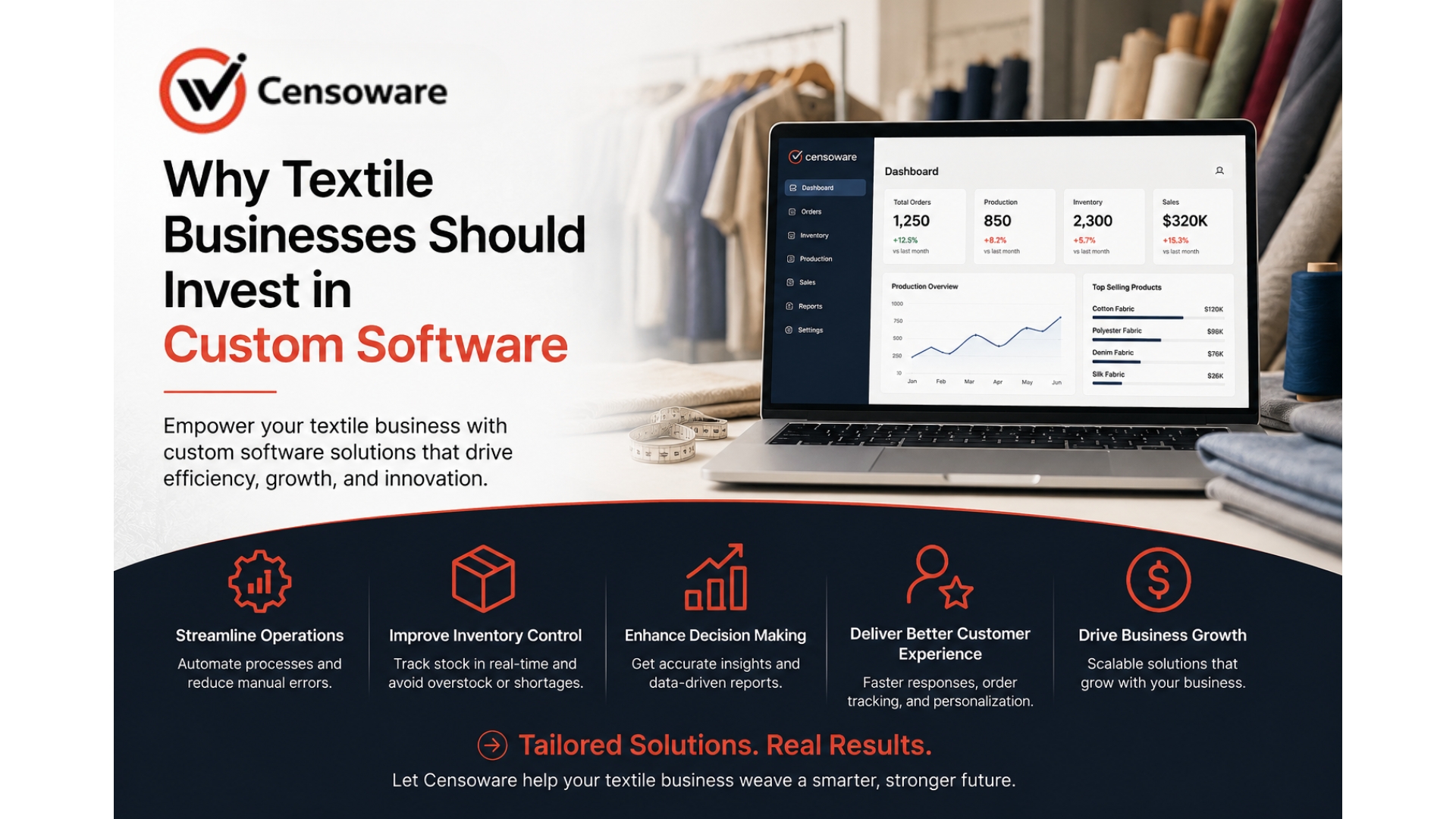
Why Textile Businesses Should Invest in Custom Software
Running a textile business means operating inside a system of extraordinary complexity. Every order triggers a chain of decisions that spans raw material procurement, production scheduling, quality verification, and logistics coordination. The margin for error is thin, and the cost of getting it wrong is real. Yet a surprising number of textile businesses continue to manage this complexity with tools that were never built for it.
- Introduction
- Why the Textile Industry Needs Its Own Software
- How Custom Textile Management Software Is Built
- The Operational Areas That Benefit Most
- The Financial and Strategic Case for Investment
- How to Choose the Right Textile Industry Software
- Custom Software as a Foundation for Long-Term Growth
- Frequently Asked Questions
Spreadsheets break under scale. Generic ERP systems require endless workarounds. Off-the-shelf tools handle the easy parts and leave the hard parts to manual effort. The solution is textile management software designed from the ground up to match how textile businesses actually work. This guide explains what that software does, why it matters, and how it creates lasting value for businesses prepared to invest in it.
What This Guide Covers
- Why the textile industry needs software built specifically for it.
- How custom textile management software is structured and what it covers.
- The operational areas that benefit most from a purpose-built system.
- The financial and strategic case for making the investment.
- How to evaluate and choose the right textile industry software.
- Frequently asked questions.
Textile businesses that have moved to purpose-built software consistently report improvements across inventory accuracy, production throughput, delivery reliability, and customer satisfaction. The advantages compound over time. Understanding where those advantages come from is the first step toward capturing them.
Why the Textile Industry Needs Its Own Software
The gap between what generic software offers and what textile businesses actually need is wider than most people outside the industry realize. Standard business software is designed around a straightforward commercial model: purchase goods, store them, sell them. Textile manufacturing does not fit that model at any stage of the process.
A single product in a textile business might exist in dozens of variants defined by fiber content, yarn count, weave structure, dye lot, finish type, and fabric width. The same item may be at multiple stages of production simultaneously, with some quantity in greige form, some in the dyeing queue, and some already inspected and waiting for dispatch. Tracking all of this inside a system built for retail inventory is not just difficult. It produces data that cannot be trusted.
When data cannot be trusted, every decision becomes a guess. Production planners overbook machines to compensate for uncertainty. Procurement teams order excess stock to avoid running short. Customer service commits to delivery dates they cannot actually verify. These habits are expensive, and they are a direct consequence of using software that was never designed for textile operations. Custom textile industry software removes the guesswork by giving every function accurate, real-time information it can act on.
How Custom Textile Management Software Is Built
Purpose-built textile management software is an integrated platform where every module speaks the language of the textile trade. Rather than forcing textile operations into generic categories, the system is structured around the way textile businesses actually move materials, manage production, and serve customers.
The inventory module tracks stock not just by quantity but by all the attributes that define a textile product: composition, lot number, shade, width, weight, and processing stage. The production module maps workflows across the full manufacturing sequence, from warping and sizing through weaving, dyeing, finishing, and inspection, with visibility into machine utilization and job status at every point.
The commercial module handles the specific complexity of textile orders, including tolerance management on quantities, partial deliveries against standing orders, sample approval workflows, and buyer-specific labeling and packing requirements. All modules share a single data layer, which means that a change in production status is immediately visible to the commercial team, and a new customer order is immediately reflected in material planning. That connectivity is what transforms a collection of functional tools into a genuine textile management system.
The Operational Areas That Benefit Most
The impact of textile management software is distributed across the business, but five operational areas experience the most significant and measurable improvements.
Stock and Inventory Accuracy
Inventory inaccuracy is one of the most expensive and persistent problems in textile operations. When stock records do not reflect physical reality, production plans are built on false assumptions, and the consequences cascade through every subsequent step. Custom textile management software maintains inventory accuracy by capturing movements at every point in the process, from goods receipt through each production stage to finished goods storage and dispatch. The result is a stock position that reflects what is actually available rather than what was theoretically expected.
Production Scheduling and Throughput
Textile production scheduling is a multi-variable problem. Machine availability, operator skills, material readiness, customer priority, and process sequencing all interact simultaneously. Custom textile industry software handles this complexity by maintaining a live view of all variables and enabling planners to build schedules that are realistic rather than optimistic. When delays occur, the impact on downstream jobs is visible immediately, and planners can adjust priorities before problems escalate into missed commitments.
Quality Management
Quality in the textile industry is measured against precise specifications: thread count, color fastness, dimensional stability, tensile strength, and surface appearance, among others. Custom software embeds quality checks into the production workflow at the points where defects are most likely to arise and most cost-effective to catch. Each inspection result is recorded against the specific batch, machine, and operator, creating a traceable quality history that supports both continuous improvement and customer compliance reporting.
Customer Order Management
Textile customers place complex orders and expect precise execution. They specify quantities with tolerances, require specific labeling and documentation, and hold suppliers accountable for delivery timing. Custom textile management software gives commercial teams complete visibility into order status, material availability, and production progress so that every customer interaction is grounded in accurate information. When a customer calls to check on a shipment, the answer is available in seconds, not after a round of internal emails.
Financial and Performance Reporting
The financial performance of a textile business is determined by margins that can be measured to the decimal point: material yield, machine efficiency, labor productivity, and cost per meter or per unit. Custom software captures the operational data that makes these calculations possible and presents them in reports built around the metrics textile managers actually use. Leaders can identify underperforming product lines, high-cost processes, and margin erosion trends before they become serious problems.
The Financial and Strategic Case for Investment
The business case for investing in custom textile industry software rests on a straightforward calculation: the cost of inefficiency consistently exceeds the cost of the software that eliminates it. Most textile businesses, when they examine the numbers honestly, find that inventory discrepancies, production rework, emergency procurement, and administrative duplication represent a significant and avoidable drain on profitability.
Custom software addresses each of these costs directly. Inventory accuracy reduces write-offs and overstock. Earlier quality detection reduces rework and customer returns. Better production visibility reduces idle time and expediting costs. Reliable delivery performance reduces the chargebacks and relationship damage that come from missed commitments. Each of these improvements carries a measurable financial value that compounds with scale.
The strategic case is equally compelling. A textile business running on accurate, connected data can grow without the operational chaos that typically accompanies rapid scale. It can take on larger customers with more demanding requirements. It can enter new product categories with confidence that its operations can support them. It can make faster decisions because the information needed to make them is always available. These capabilities define the difference between businesses that lead their segments and those that struggle to keep up.
How to Choose the Right Textile Industry Software
Selecting textile management software requires going beyond feature lists and vendor presentations. The most important test is whether the system genuinely reflects textile operations or merely claims to. Ask the vendor to demonstrate how the system handles real scenarios from your business: managing shade variation across dye lots, tracking greige stock against multiple open weaving orders, and recording inspection results at the grey stage before dyeing. The responses to these questions will reveal whether the system was built by people who understand the industry.
Scalability deserves careful attention. The right textile industry software should be capable of growing with the business. A system that works well for fifty customers and five hundred active orders should also perform reliably at five hundred customers and five thousand orders. Understand how the vendor handles system load, data volume, and additional user access before committing.
Implementation support and the ongoing development relationship are as important as the software itself. A custom system that cannot be updated as the business evolves, as customer requirements change, or as regulatory demands shift will become an obstacle rather than an asset. Choose a partner whose commitment extends beyond the initial deployment and whose team has the depth to support the business through growth and change over the long term.
Custom Software as a Foundation for Long-Term Growth
The value of custom textile management software does not peak at implementation. It grows steadily as the system accumulates clean operational data, as workflows are refined to match the software’s capabilities, and as the team develops deeper fluency with the tools available to them. Businesses that commit to this investment early build advantages that are difficult for competitors to replicate quickly.
A textile business operating on a well-implemented custom system can respond to market changes faster, serve customers more consistently, and identify opportunities that would be invisible without accurate performance data. These are not incremental improvements. They are structural advantages that determine which businesses define the direction of the industry and which ones follow it.
Textile businesses that invest in purpose-built software today are not just solving today’s operational problems. They are building the foundation on which the next phase of their growth will stand. That investment, made thoughtfully and supported well, pays returns that continue to grow for as long as the business does.
Frequently Asked Questions
1. What makes textile management software different from standard business software?
Textile management software is built around the specific workflows, terminology, and data structures of the textile industry, rather than adapting a generic commercial model. It tracks inventory with textile-specific attributes such as shade lot, fiber composition, and fabric width and manages production across the multi-stage processes that define textile manufacturing.
2. Which types of textile businesses benefit most from custom software?
Fabric mills, garment manufacturers, yarn producers, dyeing and finishing units, and textile trading companies all benefit from purpose-built textile industry software. The greater the operational complexity, the more significant the benefits, though even smaller businesses see measurable improvements in inventory accuracy and order management.
3. How does textile management software improve delivery performance?
By connecting order management directly to production planning and inventory, the system gives commercial teams real-time visibility into the status of every open order. Production planners can identify capacity constraints and material shortages before they affect delivery dates and adjust schedules proactively rather than reactively.
4. What should a textile business expect during software implementation?
Implementation typically involves a discovery phase to map existing workflows, a configuration phase to align the system with those workflows, and a phased rollout that allows the team to build confidence before going fully live. Data migration, staff training, and parallel running with existing systems are standard components of a well-managed implementation.
5. How does custom textile industry software support compliance and export requirements?
Custom software can generate the documentation required by international retailers and export regulations, including test certificates, packing lists, country of origin declarations, and inspection reports. Quality records maintained within the system provide the traceability that auditors and certification bodies require, reducing the administrative burden of compliance significantly.
Conclusion
The textile industry rewards businesses that operate with precision, and it punishes those that rely on systems unable to support it. Custom textile management software is the infrastructure that makes precision possible at scale. It connects procurement, production, quality, and commercial functions on a single platform built around the way textile businesses actually work, and it gives every team the accurate information they need to do their job well.
The decision to invest in purpose-built textile industry software is ultimately a decision about the kind of business you intend to build. Businesses that make this investment gain a foundation for growth that compounds in value over time. Those that delay it carry operational costs that command just as reliably. The choice, made clearly and early, is one of the most consequential decisions a textile business leader can make.