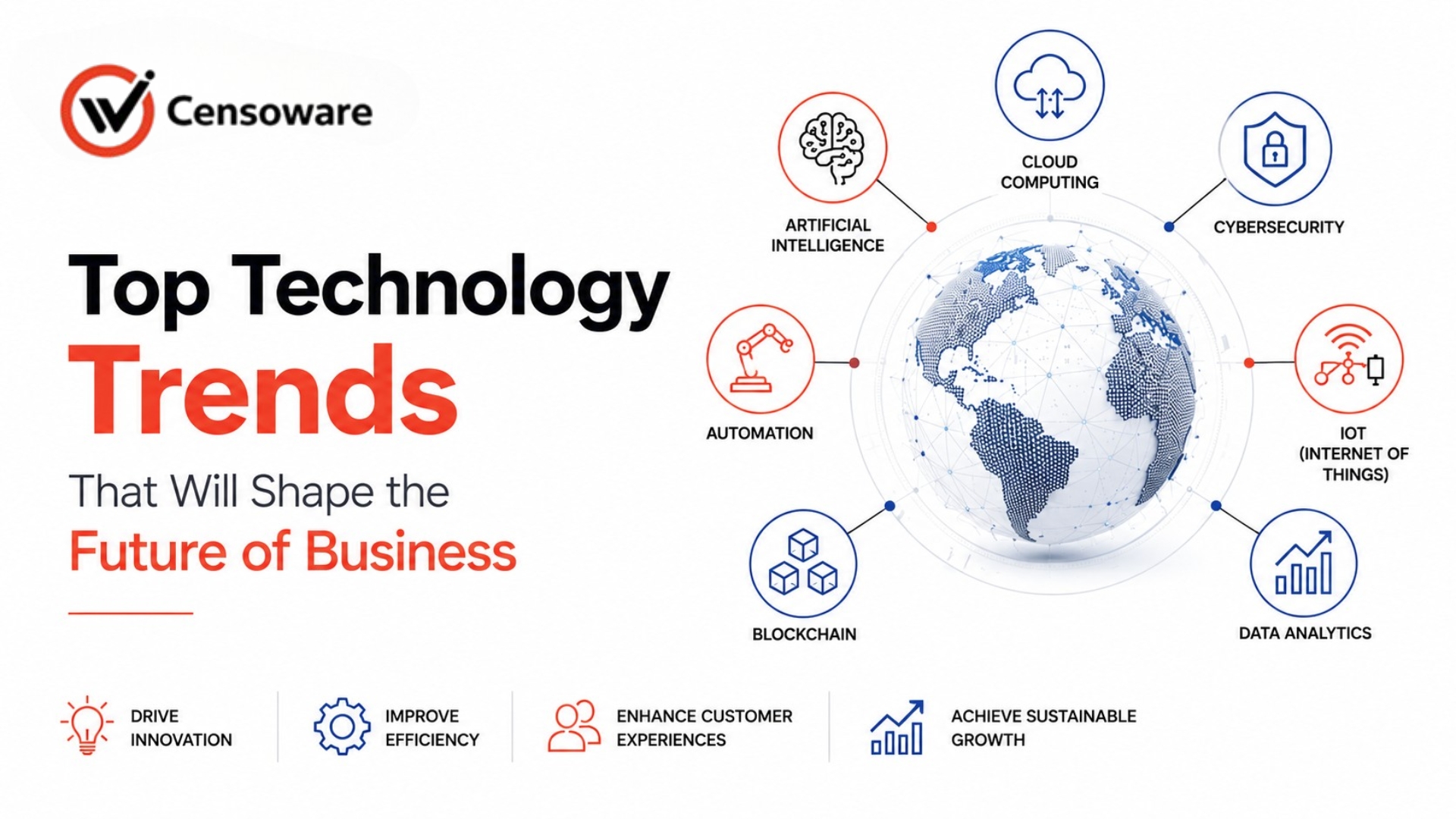
Top Technology Trends That Will Shape the Future of Business
A practical guide to understanding the specific trends currently reshaping how companies operate, compete, and serve customers.
- Introduction
- What Is Driving the Current Wave of Business Technology Trends?
- How These Trends Are Impacting Business Operations
- Technology Trends Businesses Should Understand
- Why Adopting These Trends Now Matters
- Frequently Asked Questions
Every year brings a new list of buzzwords, but 2026 marks a genuine turning point in how technology and business strategy intersect. Artificial intelligence has moved from pilot projects to core infrastructure, automation is reshaping entire workflows, and the businesses seeing the biggest gains are not necessarily the ones spending the most. They are the ones adopting the right technology at the right stage of their growth.
This guide explains the technology trends most likely to affect how businesses operate over the next few years, why each one matters, and how companies of different sizes are already putting them to work. Whether you run a small operation or lead a large enterprise, understanding these shifts is one of the clearest ways to stay competitive as customer expectations and operating costs continue to rise.
What This Guide Covers
- Why technology has become a direct driver of business growth, not just an IT concern.
- The specific trends currently reshaping how companies operate, compete, and serve customers.
- How businesses across industries are putting these trends into practice.
- Practical ways to start adopting the right technology for your business today.
What Is Driving the Current Wave of Business Technology Trends?
Most of the technology shifts businesses are watching in 2026 trace back to one underlying force: artificial intelligence has matured from an experimental tool into a working part of daily operations. Where companies once tested AI in isolated pilots, they are now weaving it directly into customer service, product development, supply chains, and decision-making.
This shift changes what businesses need from their technology stack. Systems built for a cloud-first, human-operated world are being adapted, and in many cases rebuilt, for an environment where software agents handle tasks that used to require a person at every step. Security models, IT budgets, and even hiring plans are adjusting to match this new reality.
For businesses, the practical takeaway is that technology adoption is no longer just an IT department decision. It shapes how fast a company can respond to customers, how much it spends to operate, and how resilient it is when conditions change quickly.
How These Trends Are Impacting Business Operations
Technology trends affect a business at nearly every stage of its operations, and a handful of shifts are having an outsized effect right now.
AI-Driven Automation
AI-driven automation is one of the clearest examples. Companies are using it to handle repetitive tasks such as answering routine customer questions, processing invoices, and monitoring supply chains, freeing employees to focus on higher-value work. Multiagent systems take this further, allowing several specialized AI agents to divide a task, hand off work to one another, and complete a process with little human intervention, similar to a coordinated team rather than a single assistant.
Evolving Cybersecurity
Cybersecurity is evolving alongside these changes. As more business processes run through AI systems, the threats businesses face are also becoming faster and more automated, pushing companies to secure not just their networks but their data, their models, and the applications built on top of them.
Cloud Infrastructure and Personalization
Cloud infrastructure is shifting too. Businesses that once measured cloud success by uptime and storage now need infrastructure built to support constant AI workloads, which changes how technology budgets are planned and spent. Meanwhile, personalization powered by real-time data is allowing even small businesses to tailor pricing, recommendations, and content to individual customers rather than showing everyone the same experience.
Technology Trends Businesses Should Understand
Several specific trends stand out as the ones most likely to shape business strategy over the next few years.
Agentic AI and multiagent systems are moving businesses from AI that simply responds to questions toward AI that takes action, completing multistep tasks such as research, drafting, and quality checks without constant supervision. Domain-specific AI models, trained on data from a particular industry, are also gaining ground because they tend to deliver more accurate, compliant results than general-purpose models in fields such as healthcare, finance, and manufacturing.
Physical AI, the use of intelligence in robots, drones, and connected equipment, is extending automation beyond software and into warehouses, factories, and delivery operations. At the same time, AI governance has moved from a policy discussion to a practical requirement, as regulations in multiple regions now impose real obligations on how businesses build and monitor AI systems, particularly in high-risk uses.
Cloud computing continues to evolve as businesses shift from general-purpose cloud services toward infrastructure designed specifically to support AI workloads efficiently. And as connectivity improves through faster networks, businesses in retail, logistics, and services are finding it easier to serve customers in real time regardless of location.
Why Adopting These Trends Now Matters
A common misconception is that keeping up with technology trends requires a large budget or a dedicated innovation team. That may have been closer to true a decade ago, but tools for automation, AI adoption, and data analysis are now accessible to businesses of nearly any size.
Focus Over Budget
What matters more than budget is focus. Businesses that identify which part of their operations is slowest, most repetitive, or most error-prone are far better positioned to apply the right technology to that specific problem, rather than attempting to modernize everything at once. A single automated process or a well-placed AI tool can often save more time and money over a year than a broad, unfocused technology overhaul.
Adopting new technology does not require transforming an entire business overnight. It often starts with identifying the one process, department, or customer touchpoint where a targeted improvement will have the clearest impact.
Frequently Asked Questions
1. Do small businesses really need to worry about trends like AI agents and automation?
Yes, though the scale differs. Small businesses can often adopt a single automation tool, such as an AI-powered customer service assistant, and see a meaningful reduction in manual work without the cost of a full technology overhaul.
2. Is physical AI relevant outside of manufacturing?
Not exclusively. While factories and warehouses are early adopters, physical AI is also appearing in healthcare, logistics, and retail, wherever a business relies on equipment, delivery, or in-person service that can benefit from sensors and automation.
3. What is the difference between AI automation and multiagent systems?
Automation typically handles a single, defined task. Multiagent systems coordinate several AI agents, each with a different role, to complete a more complex process from start to finish, closer to how a small team would divide the work.
4. How much should a business budget for adopting new technology trends?
There is no fixed number. Many effective first steps, such as adopting an existing AI tool or automating one workflow, cost far less than a full system overhaul but can still produce a noticeable improvement in efficiency.
5. Where should a business start if it has not focused on new technology at all?
Start by identifying the single process that consumes the most time or causes the most errors. Addressing that one bottleneck with the right tool is usually more valuable than attempting to adopt every emerging trend at once.
Final Thoughts
Technology trends in 2026 are no longer optional considerations for businesses to watch from a distance. AI-driven automation, smarter cloud infrastructure, and evolving security practices are already shaping which companies operate efficiently and which fall behind.
The businesses gaining the most ground are rarely the ones with the biggest technology budgets. They are the ones that understand which trends are relevant to their operations and take deliberate, focused steps to put them to work. That understanding is where a stronger, more competitive business begins.
Censoware helps businesses navigate modern technology trends. Ready to design a technology adoption strategy tailored for your daily workflows?