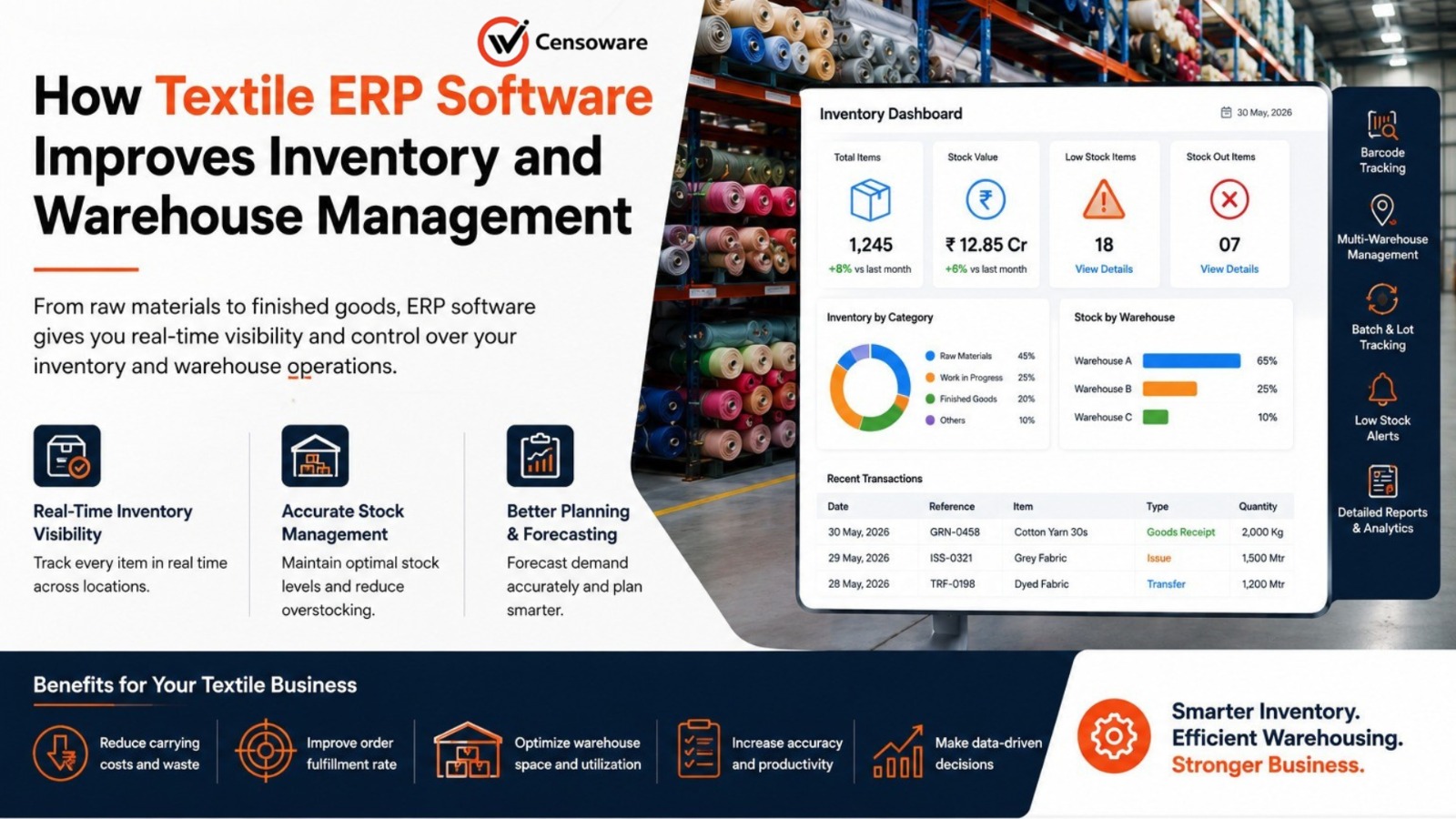
How Textile ERP Software Improves Inventory and Warehouse Management
Learn how Textile Inventory Management, barcode scanning, batch tracking, and Warehouse ERP features optimize stock control for yarn, fabric, and garments.
- Introduction
- Yarn Tracking from Purchase to Consumption
- Fabric Inventory Across Multiple Stages
- Barcode Integration for Faster, Accurate Counting
- Batch Management and Warehouse Optimization
- Reducing Stockouts and Overstocking Together
- Frequently Asked Questions
Textile inventory is unlike most other categories of stock. A single warehouse might be holding raw yarn in multiple counts and colors, greige fabric waiting for processing, dyed fabric sorted by shade and batch, and finished garments packed for dispatch, all moving at different speeds and needing different handling. Managing this by hand, with registers and manual counting, becomes unreliable the moment the business crosses a certain size.
This guide explains how Textile Inventory Management built into an ERP system brings order to this complexity, from yarn tracking on the shop floor to full Warehouse ERP capabilities that make stock accurate, searchable, and predictable. It also looks at the practical, day-to-day differences this accuracy makes for managers, warehouse staff, and the customers who rely on realistic delivery commitments.
What This Guide Covers
- Why yarn and fabric inventory are harder to manage than typical retail stock.
- How barcode integration and batch management reduce manual counting errors.
- The role of ERP in optimizing warehouse layout and storage decisions.
- What accurate inventory does for production planning and customer commitments.
Yarn Tracking from Purchase to Consumption
Yarn is typically purchased in bulk and consumed gradually across multiple production orders, which makes it easy to lose track of exactly how much of a particular count or lot remains at any given time. An ERP system tracks yarn from the moment it is received, through every issue to production, right down to the remaining balance, so stock levels are always current instead of being estimated at month-end.
This level of tracking also makes it possible to trace which yarn lot went into which finished batch, which matters when a quality issue needs to be traced back to its source.
It also helps with planning future purchases, since consumption patterns recorded over several months reveal which yarn counts are used most heavily and how quickly stock actually depletes, rather than relying on a purchase manager's general sense of what usually runs low.
Fabric Inventory Across Multiple Stages
Fabric moves through several states before it becomes a finished product, and greige fabric, processed fabric, and finished fabric all need to be tracked separately even though they may physically sit in the same warehouse. Textile Stock Management within an ERP system keeps these stages distinct, so a manager can see exactly how much fabric is waiting for dyeing versus how much is ready for cutting, without relying on someone's memory of what happened last week.
This stage-wise visibility also makes it easier to plan warehouse space, since fabric waiting for a long processing step can be stored differently from fabric that is about to move quickly into cutting and stitching.
Barcode Integration for Faster, Accurate Counting
Manual stock counting is slow and prone to human error, particularly when rolls or bundles look similar and are stored close together. Barcode integration allows each roll, bundle, or batch to be scanned in and out of the warehouse, updating the system instantly and removing the need for handwritten tally sheets.
Over time, this also builds a reliable movement history for every batch, which is valuable both for internal audits and for resolving any customer dispute about quantities delivered.
Scanning also speeds up physical stock verification significantly, since a full warehouse count that once took an entire day with manual tally sheets can often be completed in a fraction of the time once every item carries a scannable identity.
Batch Management and Warehouse Optimization
Batch management ensures that fabric or yarn from a specific dye lot or production run can be tracked and issued together, which matters when color consistency across a large order is critical. An ERP system also supports Warehouse ERP practices such as organizing storage by turnover rate, keeping fast-moving items closer to dispatch areas, and flagging slow-moving stock that is tying up warehouse space unnecessarily.
For businesses handling export orders or large bulk buyers, batch-level tracking also makes it far easier to respond to a customer query about a specific shipment, since the exact batch, its production date, and its handling history can be pulled up immediately instead of requiring a physical search through the warehouse.
Reducing Stockouts and Overstocking Together
Manual inventory management tends to swing between two problems: running out of a fast-moving yarn or fabric at the worst possible time, and tying up cash in slow-moving stock that sits in the warehouse for months. An ERP system reduces both risks at once by comparing current stock against consumption trends and upcoming production needs, generating reorder alerts before a stockout happens while also flagging stock that has stopped moving.
This balance is difficult to achieve manually because it requires constantly comparing multiple moving numbers, something a system can do continuously in the background without depending on someone remembering to check.
Frequently Asked Questions
1. Can ERP handle inventory across multiple warehouses?
Yes. Textile ERP Software can track stock separately by warehouse or location while still giving management a combined view whenever it is needed, which is particularly useful for businesses that store raw material and finished goods at different sites.
2. Is barcode integration mandatory to use ERP inventory features?
No, but it significantly reduces manual counting errors and speeds up stock movement, so most manufacturers adopt it alongside the ERP rollout once they see how much time it saves during physical verification.
3. How does batch management help with quality control?
It allows any quality issue to be traced back to the exact batch or lot it came from, making it easier to isolate the problem instead of reviewing the entire stock or issuing a blanket recall.
4. Does better inventory management actually reduce costs?
Yes. Accurate stock levels reduce emergency purchases, prevent overstocking of slow-moving material, and free up warehouse space that would otherwise be tied up unnecessarily in excess or unusable stock.
5. How does inventory accuracy affect customer commitments?
When stock levels are accurate in real time, sales staff can confirm order quantities and delivery timelines with confidence, rather than promising dates based on outdated information that later has to be walked back.
Final Thoughts
Textile Inventory Management is one of the areas where the gap between manual and system-driven operations is most visible. A warehouse running on registers is always working with numbers that are slightly out of date, while an ERP-driven warehouse works with numbers that are accurate the moment a transaction happens.
For textile businesses handling multiple material types across several production stages, this accuracy is not a convenience; it is what makes reliable production planning and confident customer commitments possible in the first place.
As order volumes grow and warehouses fill with more variety, the gap between manual and system-driven inventory only widens, which is why textile businesses that adopt structured Warehouse ERP practices early tend to scale far more smoothly than those still relying on registers and memory. Getting inventory right is often the single most impactful starting point for any textile business beginning its ERP journey, since nearly every other department, from production to sales to accounts, depends on knowing exactly what stock is actually on hand.
Censoware builds custom Textile ERP and Warehouse Management systems for seamless inventory control. Ready to eliminate manual stock counting and warehouse errors?