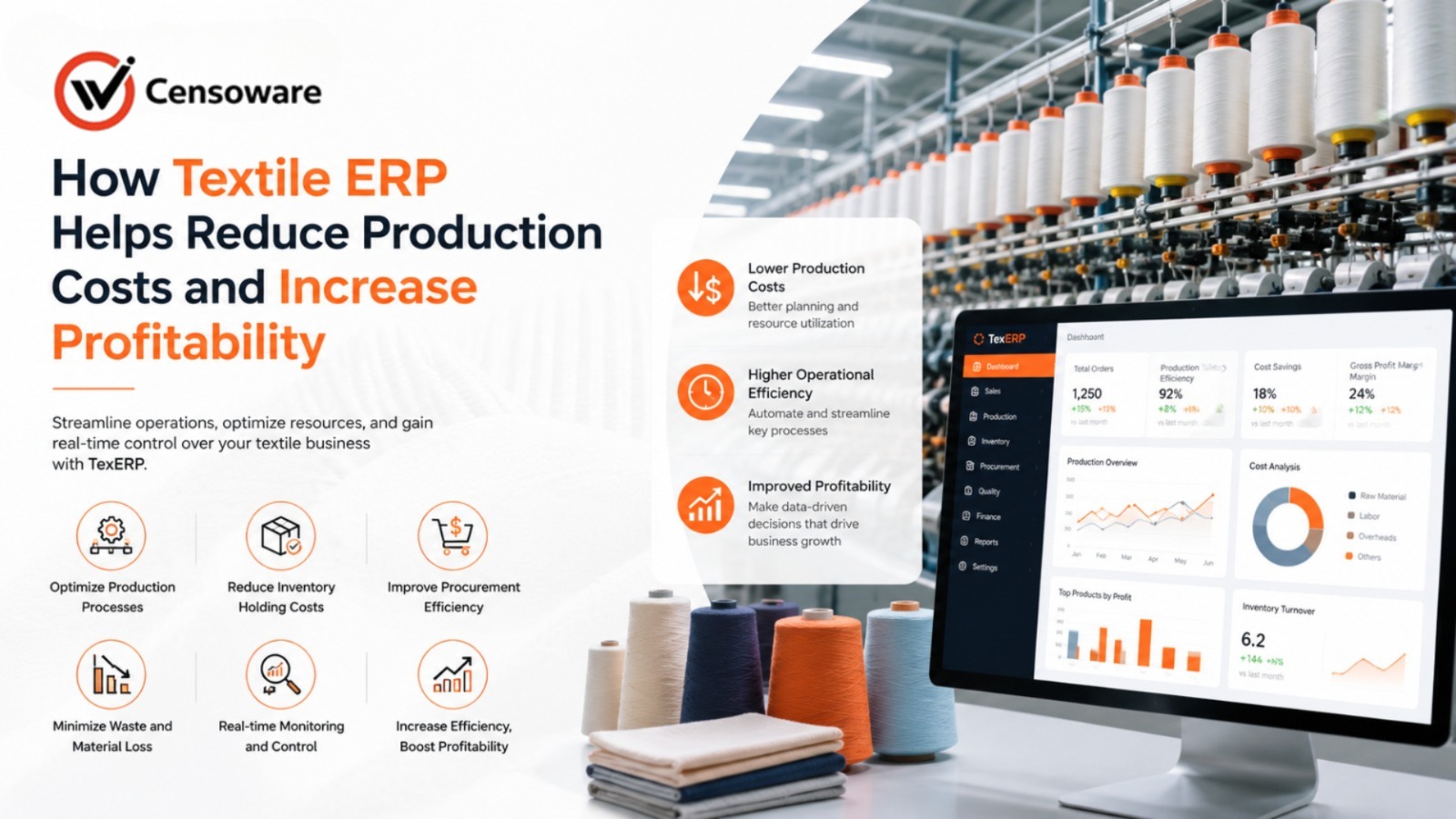
How Textile ERP Helps Reduce Production Costs and Increase Profitability
Learn how ERP for Textile Mills minimizes material wastage, optimizes machine utilization, improves workforce productivity, and sharpens financial decision-making.
- Introduction
- Reducing Material Wastage Through Better Tracking
- Optimizing Machine Utilization
- Minimizing Downtime and Unplanned Stops
- Improving Workforce Productivity
- Better Financial Reporting for Sharper Decisions
- Turning Cost Data into Ongoing Savings
- Frequently Asked Questions
Profitability in textile manufacturing is rarely lost through one large mistake. It is usually worn away gradually, through material wastage that no one measures, machines that sit idle without anyone noticing, and financial reports that arrive too late to influence a decision that has already been made. Individually, these losses can seem small, but across a full production cycle they add up to a significant gap between what a business could be earning and what it actually earns.
This guide explains how ERP for Textile Mills addresses these hidden costs directly, helping manufacturers move from reacting to cost overruns after the fact to preventing them in the first place. It covers the specific areas, from material wastage to workforce time, where Manufacturing Cost Reduction consistently delivers the most measurable results.
What This Guide Covers
- Where hidden costs typically accumulate in textile production.
- How ERP reduces material wastage and improves machine utilization.
- The connection between workforce productivity and better cost control.
- How improved financial reporting supports more profitable decisions.
Reducing Material Wastage Through Better Tracking
Material wastage is one of the largest and most avoidable costs in textile production, but it is difficult to control without comparing actual consumption against standard usage for every order. An ERP system tracks this comparison automatically, flagging orders where wastage exceeds normal limits so the cause can be investigated while the batch details are still fresh, rather than being lost in a monthly summary.
Because this tracking happens order by order, it also becomes possible to compare wastage trends across different fabric types, machines, or operators, giving management a factual basis for deciding where to focus training or process improvements rather than treating wastage as an unavoidable cost of doing business.
Optimizing Machine Utilization
Machines that sit idle between jobs, or that run below capacity because of poor scheduling, represent a real cost even though no invoice ever shows up for it. Manufacturing Cost Reduction through ERP comes partly from visibility into machine-wise utilization data, which helps planners identify bottlenecks, rebalance workload, and reduce the gaps between one job finishing and the next one starting.
Utilization data collected over weeks and months also helps justify investment decisions, showing clearly whether a bottleneck machine genuinely needs a second unit or whether better scheduling on the existing machine would solve the problem at no additional cost.
Minimizing Downtime and Unplanned Stops
Unplanned downtime, whether from a material shortage, a maintenance issue, or unclear job instructions, quietly eats into production capacity every day it happens. ERP systems that track machine status and maintenance schedules help anticipate problems before they cause a stoppage, and connect inventory data so a shortage never comes as a surprise on the shop floor.
Preventive maintenance scheduling built into the system also reduces the number of breakdowns that happen mid-shift, replacing costly emergency repairs with planned maintenance windows that have far less impact on the overall production schedule.
Improving Workforce Productivity
A significant portion of staff time in manual operations goes toward paperwork, searching for information, and resolving confusion between departments rather than productive work. Textile Cost Management improves when this time is freed up, since the same workforce can handle more volume without additional headcount simply because less of their day is lost to administrative friction.
This also improves morale on the floor, since staff spend less time frustrated by missing information or repeated confusion between departments, and more time doing work that has a clear, visible outcome.
Better Financial Reporting for Sharper Decisions
When costing data flows automatically from purchase, production, and payroll into the accounts module, financial reports reflect the real cost of production rather than rough estimates. This allows management to see which products, customers, or production lines are genuinely profitable, and make pricing or process decisions based on current numbers instead of assumptions carried over from previous years.
This level of financial clarity also strengthens conversations with banks or investors, since a business that can produce accurate, real-time costing and profitability reports demonstrates a level of financial control that builds confidence far beyond what a manual set of books can show. It also makes internal budgeting conversations more productive, since department heads can discuss actual figures rather than negotiating around estimates that everyone privately suspects are inaccurate.
Turning Cost Data into Ongoing Savings
The real value of cost tracking through ERP is not a one-time report but an ongoing habit of reviewing where money is being lost and correcting it before it becomes a recurring pattern. Manufacturers who review wastage, utilization, and downtime data on a regular schedule, rather than only during an annual review, tend to catch small issues while they are still cheap to fix.
Over several production cycles, these small, repeated corrections compound into a meaningfully leaner operation, which is ultimately a more sustainable path to profitability than any single cost-cutting initiative could achieve on its own.
Frequently Asked Questions
1. How much can ERP actually reduce production costs?
The exact figure varies by business, but manufacturers commonly see meaningful reductions in wastage and idle machine time within the first few months of consistent use, with further gains as the data builds up.
2. Does ERP for textile mills require replacing existing machinery?
No. ERP works alongside existing machines and processes, focusing on tracking data and improving planning rather than requiring new equipment or a change in how machines physically operate.
3. Can smaller textile mills benefit from cost tracking features?
Yes. Even a small mill loses money to wastage and idle time, and cloud-based ERP options make these features accessible without a large upfront investment in hardware or IT infrastructure.
4. How does ERP improve pricing decisions?
By showing the true cost of production for each order, including material, machine time, and labor, ERP helps businesses price orders accurately instead of relying on rough estimates that may not reflect actual costs.
5. Is financial reporting from ERP suitable for statutory compliance?
Yes. Most Textile Cost Management modules are built to align with standard accounting and GST requirements, making statutory reporting easier alongside internal cost analysis and management review.
Final Thoughts
Reducing production costs in a textile business rarely comes down to one dramatic change. It comes from closing the small, repeated gaps in material usage, machine time, downtime, and reporting accuracy that quietly reduce profitability over time.
ERP for Textile Mills addresses these gaps directly, giving manufacturers the visibility they need to catch cost overruns early and make decisions based on real numbers, which is ultimately what turns steady production into steady profitability. The mills that treat cost control as a continuous, data-backed habit rather than an occasional audit are the ones best positioned to protect their margins as raw material prices and market conditions continue to shift.
Censoware builds specialized custom Textile ERP solutions designed to maximize shop floor efficiency, eliminate material leaks, and drive profitability. Ready to optimize your production costs?