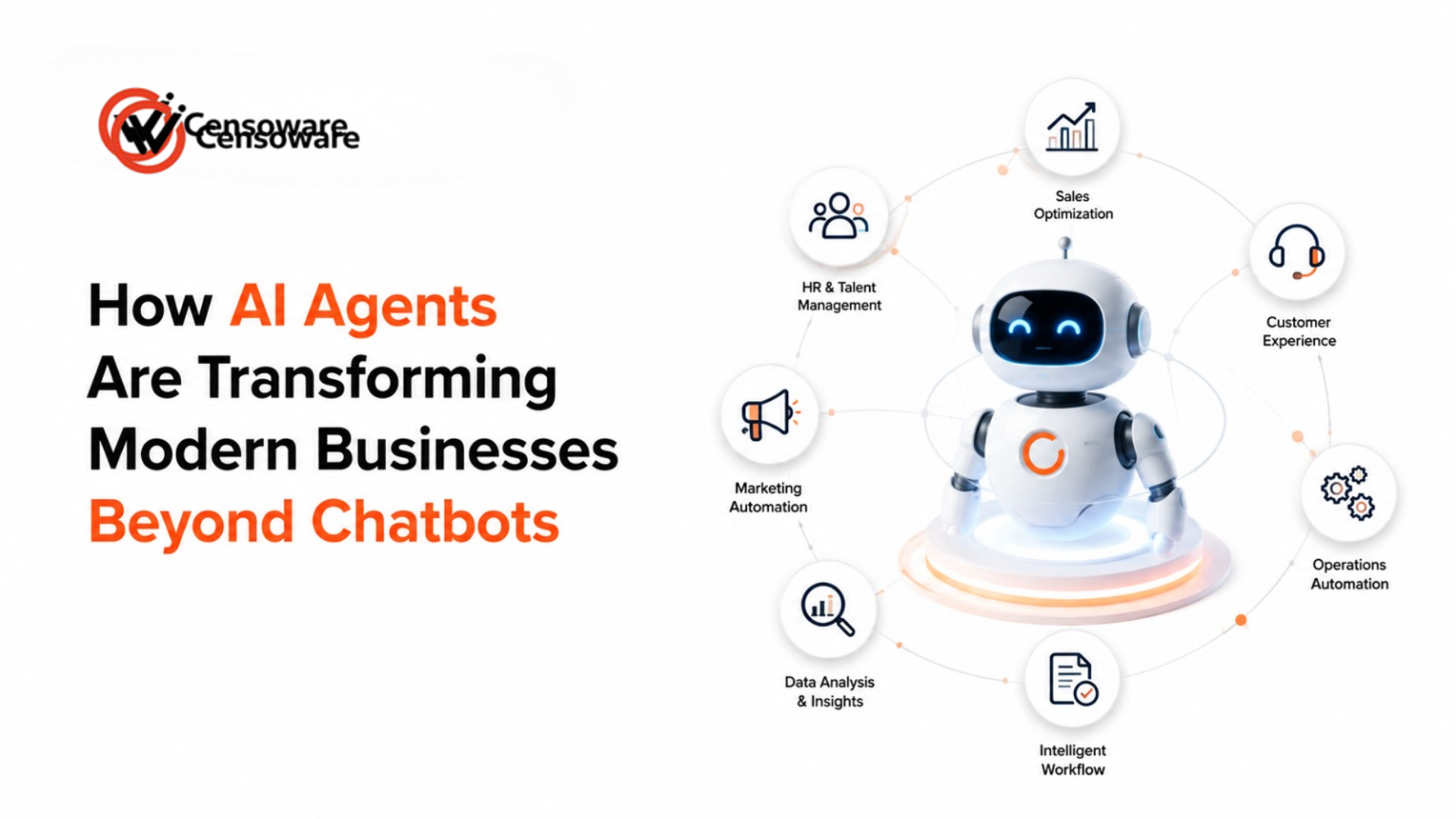
How AI Agents Are Transforming Modern Businesses Beyond Chatbots
A practical guide to understanding autonomous, goal-driven systems capable of reasoning and executing multi-step tasks.
- Introduction
- What Exactly Is an AI Agent?
- Where AI Agents Are Already Making an Impact
- Why Adoption Is Accelerating
- What to Consider Before Adopting AI Agents
- Frequently Asked Questions
For years, when people heard the phrase "artificial intelligence in business," the first image that came to mind was a chatbot answering customer queries on a website. That perception is rapidly becoming outdated. Businesses are now moving far beyond simple conversational bots into a new era defined by AI agents, autonomous, goal-driven systems capable of planning, reasoning, and executing multi-step tasks with minimal human intervention.
This guide explains what AI agents actually are, where they are already reshaping day-to-day operations, and what a business should think through before adopting one. Whether you run a sales team, a logistics operation, or a finance department, understanding this shift is becoming essential to staying competitive.
What This Guide Covers
- What AI agents are and how they differ from traditional chatbots.
- The core business functions where AI agents are already being used.
- Why businesses are adopting agentic AI faster than any previous wave of automation.
- Practical considerations before introducing AI agents into your own operations.
What Exactly Is an AI Agent?
An AI agent is a software system built on large language models and machine learning that can perceive its environment, make decisions, and carry out actions to reach a specific goal. Unlike static automation scripts that follow rigid, pre-programmed rules, AI agents adapt their approach based on context and can even coordinate with other agents to complete complex workflows.
These agents typically combine a reasoning engine that breaks goals into smaller tasks, a memory system that retains context across interactions, and tool integrations that let the agent act on external software such as CRMs, databases, or APIs. This combination allows AI agents to function almost like digital employees, capable of handling entire processes rather than isolated queries. A chatbot might tell you your order status; an AI agent can detect a shipping delay, reroute the shipment, notify the customer, and update inventory records, all without a human stepping in.
Where AI Agents Are Already Making an Impact
AI agents are transforming how departments function across organizations, taking over complex, multi-step workflows.
Sales and Supply Chain
Sales teams use AI agents to research prospects, personalize outreach, and qualify leads before handing off only the most promising opportunities to human staff, shortening sales cycles considerably. In supply chains, agents monitor inventory, predict demand shifts, and respond to disruptions in real time, rerouting shipments without waiting for manager approval.
Finance and HR
Finance departments deploy agents to reconcile accounts, flag anomalous expenses, and generate summaries automatically. In HR, agents screen resumes, schedule interviews, and guide new hires through onboarding.
IT and Security
IT teams use agents to monitor network traffic continuously and isolate compromised devices the moment unusual activity appears, well before a human analyst would typically notice.
Why Adoption Is Accelerating
Several forces are converging at once. Competitors adopting agentic AI operate faster and cheaper, putting pressure on everyone else to keep pace. The underlying technology has also matured; earlier systems struggled with context retention, but current models handle multi-step reasoning far more reliably.
Businesses are also drowning in repetitive, rules-based work that agents can absorb, freeing employees for strategic and relationship-driven tasks. Integration has become easier too, since agents now connect readily with tools like Salesforce, SAP, Slack, and Google Workspace.
What to Consider Before Adopting AI Agents
Data privacy and security deserve close attention whenever an agent is given access to sensitive systems. Clear governance, access controls, and audit trails are essential rather than optional. Businesses also need clarity on accountability, since determining responsibility when an autonomous decision goes wrong is not always straightforward.
Managing Change
Legacy infrastructure can complicate integration, and employee concerns about job security need honest, transparent communication rather than being brushed aside. Planning for both technical architecture and human impact makes adoptions significantly more successful.
Frequently Asked Questions
1. How is an AI agent different from a chatbot?
A chatbot mainly responds to questions with information. An AI agent goes further, taking real actions across systems, such as updating records, rerouting shipments, or scheduling meetings, without needing a human to execute each step.
2. Do AI agents replace employees?
In most deployments, agents take over repetitive, rules-based tasks rather than entire roles, freeing employees to focus on judgment-heavy or relationship-driven work that still requires human involvement.
3. Which departments benefit most from AI agents right now?
Sales, supply chain, finance, HR, and IT are currently seeing the most mature use cases, largely because these functions involve high volumes of structured, repeatable tasks.
4. Is it expensive to implement AI agents?
Costs vary widely depending on scope. Many businesses start with a narrow use case, such as automating lead qualification, before expanding into more complex, multi-step workflows.
5. What is the biggest risk businesses should plan for?
Governance is the biggest risk area. Without clear access controls and oversight for high-stakes decisions, an agent operating autonomously across sensitive systems can create real exposure.
Final Thoughts
AI agents represent a genuine leap beyond the chatbots that first introduced many businesses to artificial intelligence. By combining reasoning, memory, and the ability to take real-world action, these systems are changing how companies operate across sales, supply chain, finance, HR, and IT.
The businesses that approach adoption thoughtfully, with proper governance and clear human oversight, are the ones positioned to gain a lasting advantage from this shift.
Censoware helps businesses prepare for and safely integrate AI agents. Ready to design an autonomous strategy tailored for your daily workflows?
Consult our AI innovation team.