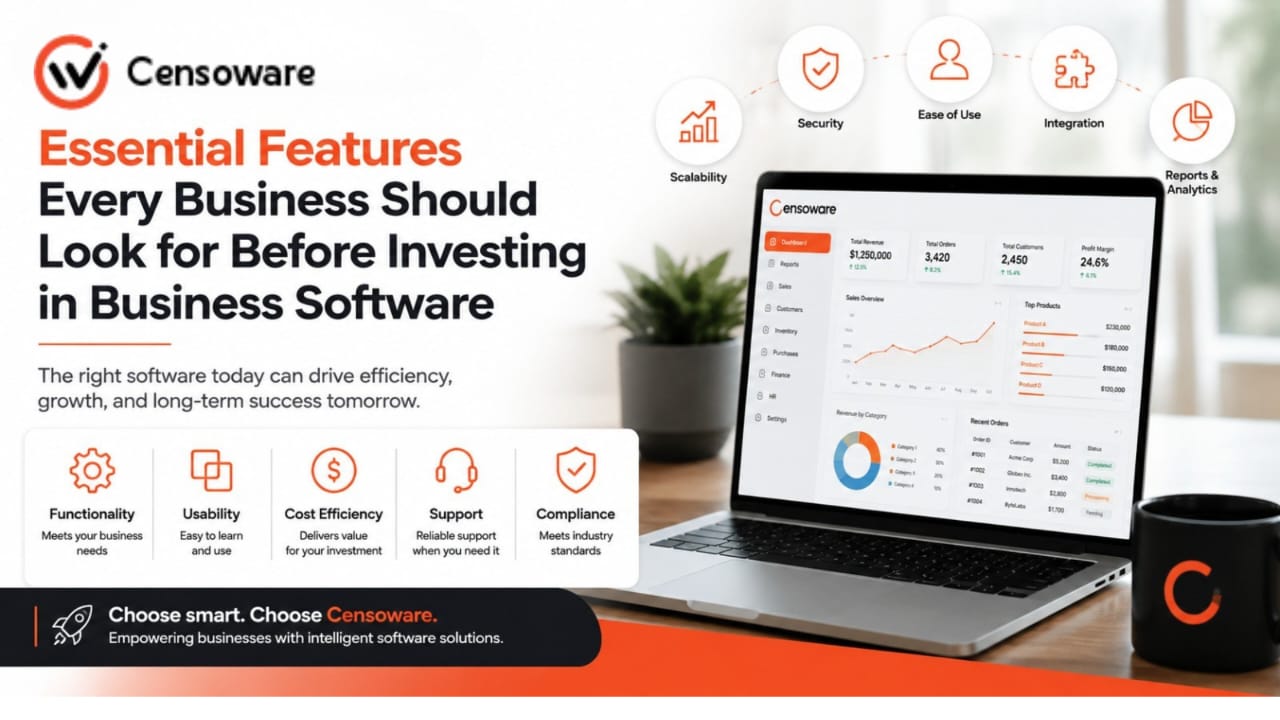
Essential Features Every Business Should Look for Before Investing in Business Software
A comprehensive evaluation guide on scalability, integration, security, usability, and vendor support before making a software investment.
- Introduction
- Scalability Should Come Before Day-One Convenience
- Integration With Existing Tools Is Non-Negotiable
- Security Features Deserve Serious Attention
- Usability Determines Whether Employees Will Actually Use It
- Reliable Support and Onboarding Matter More Than They Seem
- A Practical Checklist Before Investing
- Frequently Asked Questions
Investing in the wrong business software is an expensive mistake, not just in terms of cost, but in the time lost to poor implementation, employee frustration, and the eventual need to switch systems again. With so many options available, it can be difficult to know which features actually matter and which are simply attractive add-ons.
This guide outlines the essential features businesses should evaluate before investing in any business software, helping avoid the common pitfalls that lead companies to regret their choice within the first year.
What This Guide Covers
- The core features that separate reliable business software from a poor investment.
- Why scalability and integration matter as much as day-one functionality.
- Security and support considerations businesses often overlook.
- A practical checklist to use before committing to any business software.
Scalability Should Come Before Day-One Convenience
It is easy to choose software based on how well it fits current needs, but businesses change quickly, and software that cannot grow alongside the company often becomes a limitation within a year or two. Before committing to a platform, businesses should evaluate whether it can reasonably support increased users, transactions, or complexity as the company grows.
Scalable software typically offers tiered plans, flexible configuration options, and the ability to add functionality over time without requiring a complete system replacement. Choosing software purely based on its lowest-tier pricing, without considering what happens once the business outgrows that tier, is one of the most common mistakes businesses make.
Integration With Existing Tools Is Non-Negotiable
Very few businesses run on a single piece of software. Most rely on a combination of tools for accounting, communication, customer management, and operations. Software that cannot integrate with these existing systems creates exactly the kind of duplicated effort and disconnected data that businesses are trying to eliminate in the first place.
Before investing, businesses should confirm whether new software can connect directly with the tools they already depend on, either through built-in integrations or a reasonably accessible API. Software that operates as an isolated island, requiring manual data transfer to and from other systems, tends to create more inefficiency than it solves.
Security Features Deserve Serious Attention
Business software often handles sensitive information, including customer data, financial records, and internal communications. Despite this, security is frequently treated as an afterthought during the evaluation process, with businesses focusing primarily on functionality and price.
Before investing, businesses should confirm what security measures the software includes, such as data encryption, access controls, and regular security updates. It is also worth understanding how the vendor handles data backups and what happens to business data if the company ever needs to switch to a different platform.
Usability Determines Whether Employees Will Actually Use It
Even the most powerful software provides little value if employees find it too complicated or frustrating to use consistently. Poor usability often leads to partial adoption, where employees revert to spreadsheets or manual workarounds for tasks the software was meant to handle.
Businesses should evaluate how intuitive the software feels during a trial or demo, paying particular attention to how many steps common tasks require and how much training would realistically be needed to get the team fully comfortable with the system.
Reliable Support and Onboarding Matter More Than They Seem
The quality of a vendor's support and onboarding process often becomes apparent only after a business has already committed to the software, which is exactly why it should be evaluated beforehand. Businesses should look into how accessible support is, what onboarding resources are provided, and how quickly issues are typically resolved.
Software that seems ideal on paper can become a serious liability if problems arise and support is slow, difficult to reach, or unhelpful. Reviewing this aspect early can prevent significant frustration later, particularly during the critical early weeks after implementation.
A Practical Checklist Before Investing
Before committing to any business software, it is worth confirming that the platform can scale with the business, integrates with existing tools, includes strong security measures, is genuinely usable by the team, and is backed by reliable support. Software that checks all of these boxes tends to deliver long-term value, while software that is missing even one often leads to frustration or an eventual switch to a different platform.
Frequently Asked Questions
1. What is the most commonly overlooked feature when choosing business software?
Integration with existing tools is frequently overlooked, even though it often has the biggest impact on whether the software actually reduces manual work.
2. How important is scalability for a small business?
Very important. Businesses grow faster than expected, and software that cannot scale often needs to be replaced sooner than anticipated, creating unnecessary disruption.
3. Should price be the primary factor in choosing business software?
No. Price matters, but choosing software based solely on the lowest cost, without considering scalability, integration, and support, often leads to a more expensive replacement later.
4. How can a business evaluate software usability before committing?
Requesting a trial or demo and having actual team members test common tasks is one of the most reliable ways to evaluate real-world usability.
5. Why does vendor support matter if the software works well initially?
Problems and questions inevitably arise over time, and slow or unhelpful support can turn a minor issue into a significant operational disruption.
Final Thoughts
Choosing business software is not simply about finding a tool that works today. It is about finding a platform that can scale, integrate, and remain secure and usable as the business continues to grow and change.
Businesses that evaluate these essential features carefully before investing tend to avoid the costly cycle of switching software repeatedly, instead building a stable foundation that supports the business for years rather than months.
Censoware builds custom business software designed to seamlessly scale, integrate, and support your operations. Looking for software built for your business?