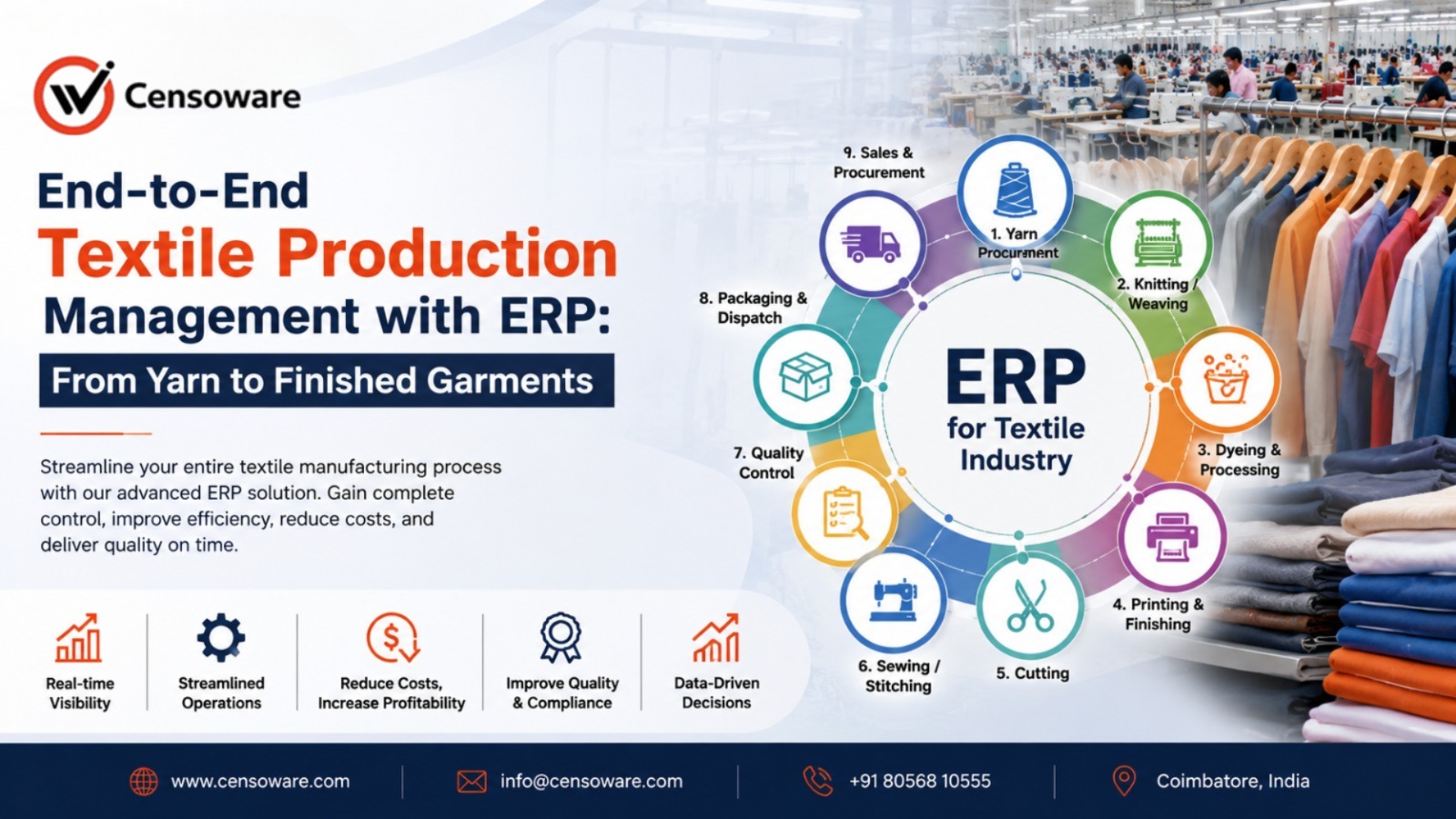
End-to-End Textile Production Management with ERP: From Yarn to Finished Garments
Discover how Textile Production ERP connects procurement, spinning, weaving, dyeing, quality control, and dispatch into one seamless lifecycle.
- Introduction
- Purchase Management as the Starting Point
- Production Planning Across Multiple Orders
- Dyeing, Weaving, and the Stages In Between
- Quality Control Built Into Every Stage
- Dispatch, Delivery, and Closing the Loop
- Traceability from Raw Material to Finished Garment
- Frequently Asked Questions
Turning raw yarn into a finished garment involves purchase, spinning or weaving, dyeing, quality checks, cutting and stitching, and finally packing and dispatch, with each stage depending on accurate information from the one before it. When these stages are managed separately, using different registers or disconnected spreadsheets for each department, small errors at one stage quietly become bigger problems by the time an order reaches dispatch.
This guide walks through the full production lifecycle and explains how Textile Production ERP connects every stage into a single, continuous process, giving manufacturers control from the first purchase order to the final delivery. It also highlights where Textile Automation makes the biggest practical difference, from recipe tracking in dyeing to traceability in finished garments.
What This Guide Covers
- How ERP connects purchase, production, and dispatch into one continuous process.
- Where dyeing, weaving, and quality control fit into the production lifecycle.
- Why production planning matters more as order volume and variety increase.
- What a fully connected production lifecycle looks like in practice.
Purchase Management as the Starting Point
Every production cycle begins with purchasing raw material, whether that is yarn, greige fabric, or dyes and chemicals. When purchase records are connected to the ERP system, the quantity, cost, and supplier of every input is tied directly to the production order it will be used for, which makes cost tracking accurate from day one instead of being estimated later.
This connection also helps procurement teams avoid both shortages and overstocking, since the system can compare upcoming production requirements against current stock and flag exactly what needs to be purchased and when, rather than relying on a purchase manager's general sense of what usually runs low.
Production Planning Across Multiple Orders
As a manufacturer takes on more orders with different fabric types, colors, and deadlines, planning which machine handles which job and in what sequence becomes genuinely difficult to do by memory or on paper. Garment Manufacturing ERP provides a planning view that shows machine availability, order priority, and material readiness together, helping planners sequence work in a way that keeps machines running and deadlines realistic.
This planning view also makes it easier to absorb an urgent order without disrupting everything else, since planners can see exactly where there is spare capacity instead of guessing which job could safely be delayed to make room for the new one.
Dyeing, Weaving, and the Stages In Between
Dyeing and weaving are two of the most variable stages in textile production, where shade matching, recipe accuracy, and timing all affect the final quality. Textile Automation within an ERP system records recipe details, batch timing, and shade approval status at each stage, so any deviation from the standard process is visible immediately rather than being discovered only when the finished fabric fails inspection.
Recording recipes and timing consistently also builds a searchable history that helps replicate a successful shade match on a future order, instead of relying on a dyeing master's personal notes or memory of how a particular color was achieved months earlier.
Quality Control Built Into Every Stage
Rather than treating quality control as a single check near the end of the process, an ERP-driven approach records inspection results at each relevant stage, from greige fabric inspection through to final garment checking. This makes it possible to catch a recurring defect early, before it repeats across an entire production run and turns into significant rework.
This staged approach to quality also makes it easier to hold specific processes accountable, since a defect traced back to the weaving stage can be addressed there directly, rather than being discovered at final inspection when the cost of correction is already much higher.
Dispatch, Delivery, and Closing the Loop
Once garments are packed and ready, dispatch records connect back to the original sales order, confirming that the right quantity, size mix, and quality standard have been met before the shipment leaves the warehouse. Because every earlier stage has already been recorded in the same system, generating delivery documents and invoices at this final step takes minutes rather than requiring someone to reconstruct the order history from scattered files.
This closed loop also gives management a complete, order-level view after delivery, showing exactly how long each stage took and where time was gained or lost, which becomes valuable data for improving the next production cycle.
Traceability from Raw Material to Finished Garment
One of the most valuable side effects of connecting every production stage in a single system is full traceability. If a customer raises a concern about a finished garment, the exact yarn lot, dyeing batch, and production line responsible for it can be identified within minutes, rather than requiring a lengthy manual investigation across multiple departments.
This traceability also supports certifications and buyer audits that many export-focused textile businesses are increasingly required to demonstrate, since the production history is already documented as part of routine operations rather than assembled specially for an inspection.
Frequently Asked Questions
1. Does ERP work for both weaving and garment manufacturing units?
Yes. Textile Production ERP is typically configurable to match different stages of the value chain, whether a business focuses on fabric production, garment manufacturing, or both, and can be adjusted as the business adds new processes.
2. How does connecting all stages actually help on a day-to-day basis?
It means a delay or shortage at one stage is visible to everyone downstream immediately, so adjustments can be made early instead of being discovered when it is too late to recover the deadline.
3. Can quality control data from ERP be used for supplier evaluation?
Yes. Recording inspection results against specific raw material batches makes it possible to identify whether recurring quality issues are linked to a particular supplier or lot, giving procurement a factual basis for future decisions.
4. Is production planning software difficult for shop floor staff to use?
Most Garment Manufacturing ERP systems are designed with simple, visual planning screens so shop floor supervisors can update progress without needing detailed technical training or long onboarding periods.
5. Does end-to-end tracking slow down the production process?
No. Recording data at each stage typically takes moments through simple entries or barcode scans, and the time saved later on reporting and dispute resolution far outweighs this small addition to daily routine.
Final Thoughts
The distance between raw yarn and a finished garment involves many hands, many machines, and many opportunities for small errors to compound. Textile Production ERP closes these gaps by keeping every stage, from purchase to dispatch, connected within a single continuous record.
For manufacturers managing increasing order complexity, this connected view of the entire production lifecycle is what makes it possible to grow order volume without losing control of quality, cost, or delivery timelines. Adopting Textile Production ERP is ultimately less about any single feature and more about making sure that no stage in the journey from yarn to finished garment operates in isolation from the rest.
Censoware builds custom end-to-end Textile Production ERP systems connecting yarn purchasing through garment dispatch. Ready to gain total control over your production lifecycle?