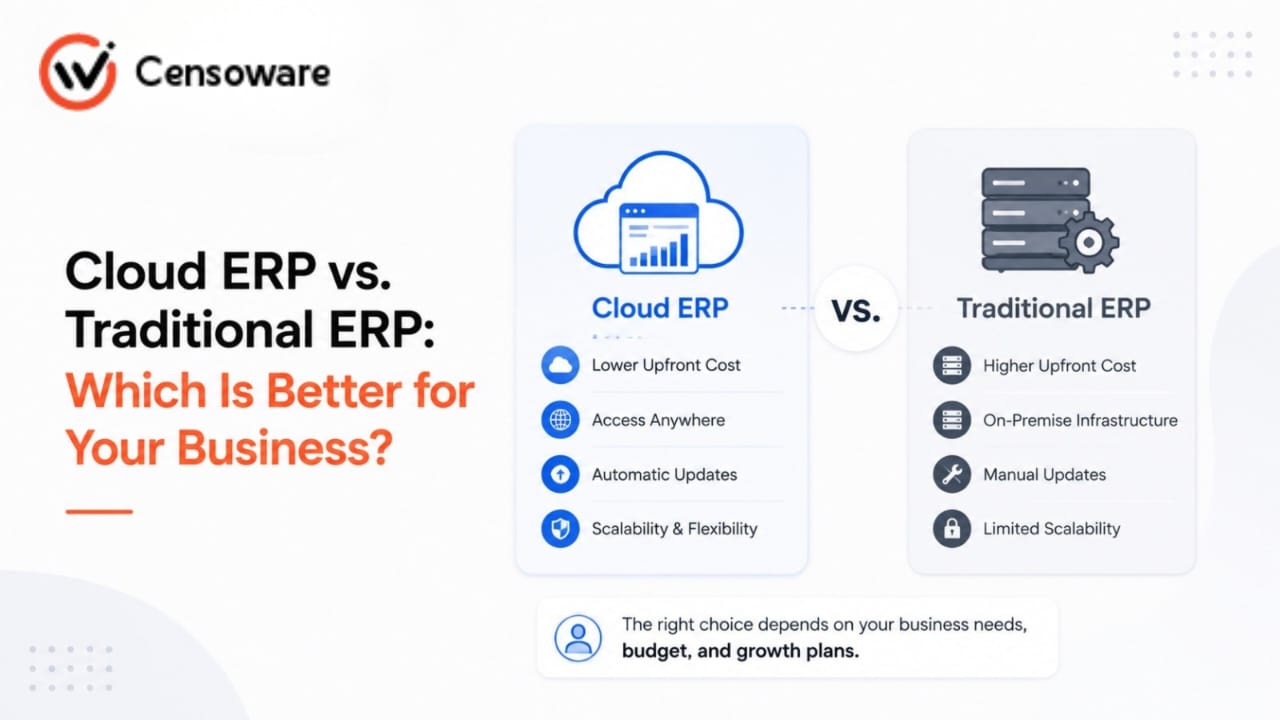
Cloud ERP vs. Traditional ERP: Which Is Better for Your Business?
A direct comparison of cloud-based and on-premise ERP systems covering cost structure, maintenance, accessibility, scalability, and practical guidance for choosing the right deployment.
- Introduction
- What Separates Cloud ERP From Traditional ERP?
- Comparing Cost, Maintenance, and Accessibility
- Trends Shaping the Cloud vs. Traditional ERP Decision
- Which Approach Fits Your Business?
- Questions to Ask Before Making a Decision
- The Role of Customization in the Decision
- Frequently Asked Questions
Choosing an ERP system involves more than comparing features on a spec sheet. One of the first, and most consequential, decisions a business makes is whether to adopt a cloud-based ERP system or a traditional, on-premise deployment. The two approaches solve the same basic problem, unifying finance, inventory, purchasing, and operations into a single system, but they differ significantly in cost structure, maintenance, and flexibility.
This guide compares cloud ERP and traditional ERP directly, explains the practical trade-offs of each, and offers guidance on which approach tends to suit different types of businesses.
What This Guide Covers
- The core differences between cloud ERP and traditional, on-premise ERP systems.
- How each approach compares on cost, maintenance, accessibility, and scalability.
- Current trends shaping how businesses choose between the two.
- Practical guidance on which approach fits different types of businesses.
What Separates Cloud ERP From Traditional ERP?
Traditional ERP systems are installed on servers that a business owns and maintains, typically on its own premises or in a data center it controls. The business is responsible for hardware, ongoing maintenance, security patches, and upgrades, usually with the help of an internal IT team or an external contractor.
Cloud ERP, by contrast, is hosted and maintained by the software provider and accessed over the internet, typically through a subscription. The provider handles servers, security updates, and infrastructure, while the business focuses on configuring and using the system rather than maintaining it.
Comparing Cost, Maintenance, and Accessibility
Traditional ERP typically requires a significant upfront investment in licenses, servers, and implementation, followed by smaller ongoing maintenance costs. Cloud ERP shifts this to a subscription model, with lower upfront costs but ongoing monthly or annual fees that continue for as long as the system is in use. Over a long enough period, the total cost can end up similar, but the cash flow pattern is very different, which matters more to some businesses than others.
Maintenance responsibility is one of the clearest differences. With traditional ERP, the business is responsible for keeping the system running, including hardware failures and security updates. With cloud ERP, the provider handles this, which reduces the burden on internal staff but also means the business has less direct control over when updates happen. Accessibility also differs meaningfully: cloud ERP is generally accessible from any location with an internet connection, which has become increasingly important as more businesses support remote or multi-location teams.
Trends Shaping the Cloud vs. Traditional ERP Decision
Over the past several years, most ERP vendors have shifted their primary development focus toward cloud versions of their products, with traditional on-premise versions receiving fewer new features over time. This has made cloud ERP the default recommendation for many new implementations, particularly among small and medium businesses that do not have large in-house IT teams.
At the same time, some businesses, particularly those in regulated industries or with strict data control requirements, continue to prefer on-premise systems for the direct control they offer over where data is stored and how it is secured. Hybrid approaches have also emerged, where certain functions run in the cloud while sensitive data or specialized processes remain on internal servers.
Which Approach Fits Your Business?
Businesses without a dedicated IT team, or those prioritizing lower upfront costs and remote accessibility, tend to be better served by cloud ERP. It removes the burden of infrastructure management and typically offers faster initial deployment, which matters for growing businesses that need a system running quickly.
Businesses with strict regulatory requirements, highly customized processes, or an existing in-house IT team capable of managing infrastructure may still find traditional ERP a better fit, particularly if they need direct control over data location and system configuration that some cloud providers do not offer.
Questions to Ask Before Making a Decision
Before committing to either approach, it helps to map out how the business expects to grow over the next several years, including new locations, additional staff, or expansion into new markets, since scaling a cloud ERP system generally requires less additional infrastructure investment than scaling an on-premise deployment. It is also worth reviewing any industry-specific regulations around data storage and security, as these requirements can materially narrow which providers and deployment types are actually viable.
Cost comparisons should account for more than the initial quote. Traditional ERP often carries hidden costs in hardware refreshes and internal IT staff time, while cloud ERP subscriptions can increase as user counts or data volume grow, so requesting a multi-year cost projection from vendors, rather than comparing only the first-year price, gives a more accurate basis for comparison.
The Role of Customization in the Decision
Businesses with highly specific or unusual workflows sometimes assume they need the deep customization traditional ERP systems allow, but many modern cloud ERP platforms now offer substantial configuration options, along with app marketplaces and integration tools, that cover a wide range of specialized needs without requiring custom development. It is worth evaluating how much of a business's process complexity is genuinely unique versus how much simply reflects habits built around an older system.
For businesses that do require deep, ongoing customization, whether due to a highly specialized industry or a proprietary process that provides real competitive advantage, traditional ERP or a hybrid deployment may still be justified. The key is distinguishing between customization that delivers real business value and customization that has simply become a habit, since the latter often adds cost and complexity without a corresponding benefit.
Frequently Asked Questions
1. Is cloud ERP less secure than traditional ERP?
Not inherently. Reputable cloud ERP providers invest heavily in security infrastructure that many individual businesses could not match on their own, though data control and compliance requirements should still be reviewed carefully.
2. Can a business switch from traditional ERP to cloud ERP later?
Yes, though migration involves transferring data, retraining staff, and reconfiguring processes, so it is generally treated as a significant project rather than a simple switch.
3. Is cloud ERP cheaper than traditional ERP overall?
It depends on the time horizon. Cloud ERP typically costs less upfront but involves ongoing subscription fees, while traditional ERP costs more initially with lower recurring costs afterward.
4. Do small businesses generally choose cloud or traditional ERP?
Most small and medium businesses choose cloud ERP, largely because it requires less internal IT infrastructure and offers faster, lower-cost initial deployment.
5. Which option offers better remote access?
Cloud ERP generally offers stronger remote access by default, since it is built to be accessed over the internet from any location, while traditional ERP often requires additional setup, such as a VPN, to support remote use.
6. Do cloud ERP providers offer the same level of support as traditional ERP vendors?
Support quality varies by provider rather than by deployment type, so it is worth reviewing support response times, available channels, and customer reviews for any vendor being considered, regardless of whether the system is cloud-based or on-premise.
Final Thoughts
Neither cloud ERP nor traditional ERP is universally better; the right choice depends on a business's budget structure, IT resources, regulatory requirements, and need for remote accessibility. Cloud ERP has become the default choice for many growing businesses due to its lower upfront cost and reduced maintenance burden.
Businesses evaluating this decision should weigh their long-term growth plans and internal technical capacity alongside cost, rather than treating the choice purely as a budget comparison.
Censoware builds custom ERP solutions engineered specifically around your unique business operations. Evaluating ERP deployment options for your business?