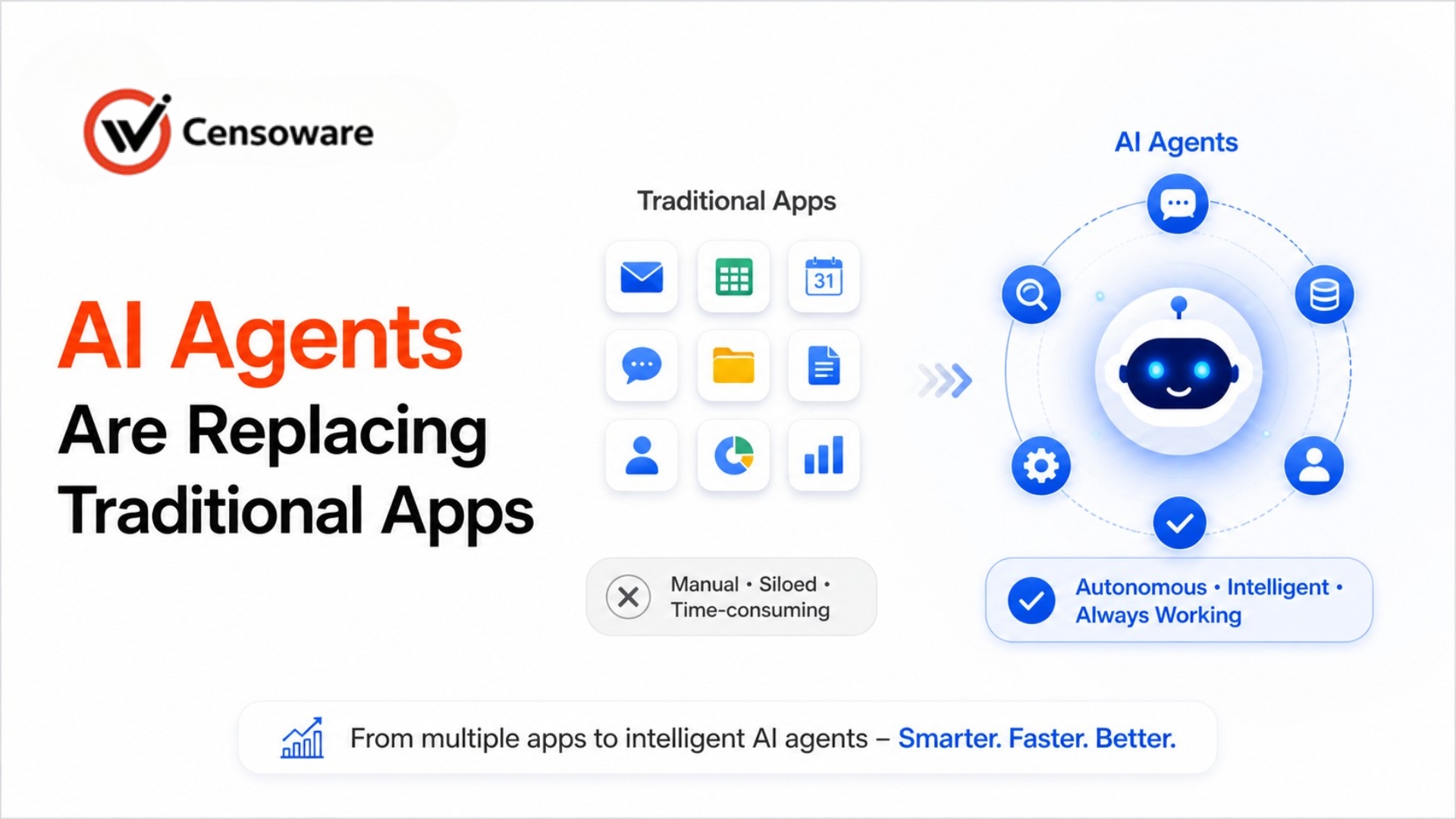
AI Agents Are Replacing Traditional Apps
A practical guide to understanding why AI agents are becoming the new interface for business software, automation, and digital workflows
- Introduction
- Why AI Agents Are Changing Software
- How AI Agents Differ from Traditional Apps
- Where AI Agents Are Already Replacing Apps
- Why Businesses Are Adopting Agent-Based Systems
- The Future of Apps in an Agent-First World
- Frequently Asked Questions
Software is entering a new phase. For years, businesses relied on traditional applications with dashboards, menus, forms, and manual workflows. That model is now being challenged by AI agents that can understand instructions, decide what steps to take, and complete tasks across tools with minimal human effort.
For many businesses, the real question is no longer whether AI will influence software. The question is whether traditional app-based workflows can keep up with the speed, flexibility, and automation that AI agents offer. In many cases, the answer is already becoming clear: agents are starting to replace the way users interact with apps entirely.
At a practical level, this shift is not only about technology. It is about productivity, operating efficiency, and user experience. Businesses do not just want software that stores data. They want systems that can act on data, respond to requests, and move work forward automatically.
Before investing in the next software platform, businesses should ask not just, "What features does this app include?" But "how much work can this system complete without constant manual input?"
Why AI Agents Are Changing Software
AI agents are changing software because they move the focus from interface-driven interaction to outcome-driven execution. Traditional software requires the user to open the application, understand the workflow, and complete every step manually. AI agents reduce that burden by allowing users to describe the goal while the system handles the process behind it.
This matters because modern work is fragmented across too many tools. A single business task may involve email, CRM software, spreadsheets, project management systems, customer support tools, and reporting dashboards. In a traditional model, employees switch between apps and manually transfer information. In an agent-based model, the AI can coordinate these steps through one conversational or task-based interface.
That is why AI agents are not simply another software feature. They represent a different software logic. The user no longer needs to manage every interaction with the system directly. Instead, the system becomes more capable of interpreting intent and carrying out work with less friction.
How AI Agents Differ from Traditional Apps
Traditional apps are structured around fixed navigation. Users must learn where features are located, what sequence to follow, and how to move from one task to the next. This design works, but it also creates dependency on training, repeated manual effort, and sometimes slow execution.
AI agents are structured around tasks and goals. Rather than asking the user to adapt to the software, the agent adapts to the user's request. It can gather information, call tools, produce outputs, and refine results based on context. That makes software interaction more natural and often more efficient.
The difference becomes especially clear when comparing routine business work. A traditional app may require a manager to log in, open several tabs, pull data, draft a message, update records, and assign follow-ups. An AI agent can perform much of that sequence in one flow, reducing time and cognitive load.
Traditional Apps vs AI Agents
| Model | How It Works | Limitation or Advantage |
|---|---|---|
| Traditional Apps | Users click through screens, forms, and dashboards manually | More training, more repetitive work, slower task completion |
| AI Chatbots | Respond to prompts and basic questions | Useful for conversation, but often limited in action-taking ability |
| AI Agents | Understand goals, connect tools, execute tasks, and adapt to context | Faster workflows, reduced friction, stronger automation potential |
This comparison shows why many companies are shifting attention from standalone apps to agent-enabled systems. The real value is no longer in software access alone. The value is in how quickly software can convert a request into a completed task.
Where AI Agents Are Already Replacing Apps
The replacement is already visible in many business functions. Customer support is one of the clearest examples. Instead of requiring a support team to manually search systems, draft responses, and escalate tickets, AI agents can retrieve account details, suggest answers, create tickets, and trigger follow-up actions automatically.
Sales and CRM workflows are also changing quickly. An agent can summarize a client call, update customer records, generate the next follow-up email, assign a reminder, and flag risks or opportunities. In the traditional app model, those actions might require multiple tools and several manual updates.
Marketing operations are following the same pattern. AI agents can generate campaign drafts, organize keyword ideas, summarize analytics, and coordinate content workflows. Rather than opening separate apps for writing, reporting, and scheduling, teams increasingly expect one intelligent system to manage connected actions.
Internal business operations are another major area of change. Scheduling, approvals, reporting, onboarding tasks, and document summaries can all be coordinated by agents. This makes software feel less like a collection of systems and more like an active assistant that supports execution.
Why Businesses Are Adopting Agent-Based Systems
Businesses are adopting AI agents because they solve a practical problem: software complexity. Many organizations are burdened by too many apps, too many interfaces, and too much repeated administrative work. AI agents reduce that complexity by creating a single action layer across systems.
This creates direct operational benefits. Teams save time because fewer steps are done manually. Training becomes easier because users do not need deep knowledge of every tool. Workflow consistency improves because the agent follows a structured process instead of relying on individual user habits.
There is also a strategic advantage. Businesses no longer want software that only records activity after work is done. They want software that helps perform the work itself. AI agents fit that expectation because they do not just organize information; they help move business processes forward.
For leadership teams, this changes software investment decisions. Instead of buying isolated tools for every department, businesses can think in terms of connected systems with an intelligent orchestration layer. That model can improve productivity while reducing software sprawl over time.
The Future of Apps in an Agent-First World
Traditional apps are unlikely to disappear completely, but their role is changing. Many applications will continue to exist as back-end systems, databases, dashboards, and control environments. However, users may interact with them less directly as agents become the preferred front-end experience.
This means the app becomes infrastructure rather than a destination. The user no longer needs to enter every system to complete work. The agent can interpret the request, connect to the right software, and carry out the task in the background. In that model, the visible interface becomes simpler while the execution layer becomes more intelligent.
Businesses that adapt to this shift early are likely to gain a major advantage in speed and usability. Those that continue to rely only on old app-first structures may find their workflows slower, less flexible, and harder to scale compared with agent-driven operations.
Frequently Asked Questions
Are AI agents completely replacing traditional apps?
Not entirely. In most cases, AI agents are replacing how users interact with software rather than eliminating software altogether. The underlying applications may still exist, but the user increasingly works through the agent instead of through multiple manual interfaces.
What is the difference between an AI agent and a chatbot?
A chatbot mainly answers questions or responds in conversation. An AI agent can go further by planning actions, using connected tools, retrieving information, updating systems, and completing tasks based on the user's goal.
Why are businesses interested in AI agents now?
Businesses want faster workflows, less repetition, better productivity, and simpler software use. AI agents help reduce software friction by connecting multiple systems and carrying out tasks with fewer manual steps.
Which business areas benefit most from AI agents?
Customer support, sales, CRM, marketing operations, reporting, scheduling, and internal workflow management are among the biggest areas where AI agents are already creating value. These are functions where repeated tasks and multi-tool workflows create delays in traditional app environments.
Will AI agents matter for small businesses too?
Yes. Small businesses often struggle with limited time, smaller teams, and too many disconnected tools. AI agents can help by automating repeated work, simplifying software use, and allowing teams to focus on higher-value business tasks.
Conclusion
AI agents are not just another software trend. They represent a major shift in how digital work gets done. As businesses look for faster operations, lower friction, and better automation, agent-based systems are becoming more practical than traditional app-only models.
For companies planning the next stage of digital transformation, the key question is no longer whether apps matter. The question is whether apps alone are enough. In many industries, AI agents are already proving that the future of software is not only interactive but also proactive.