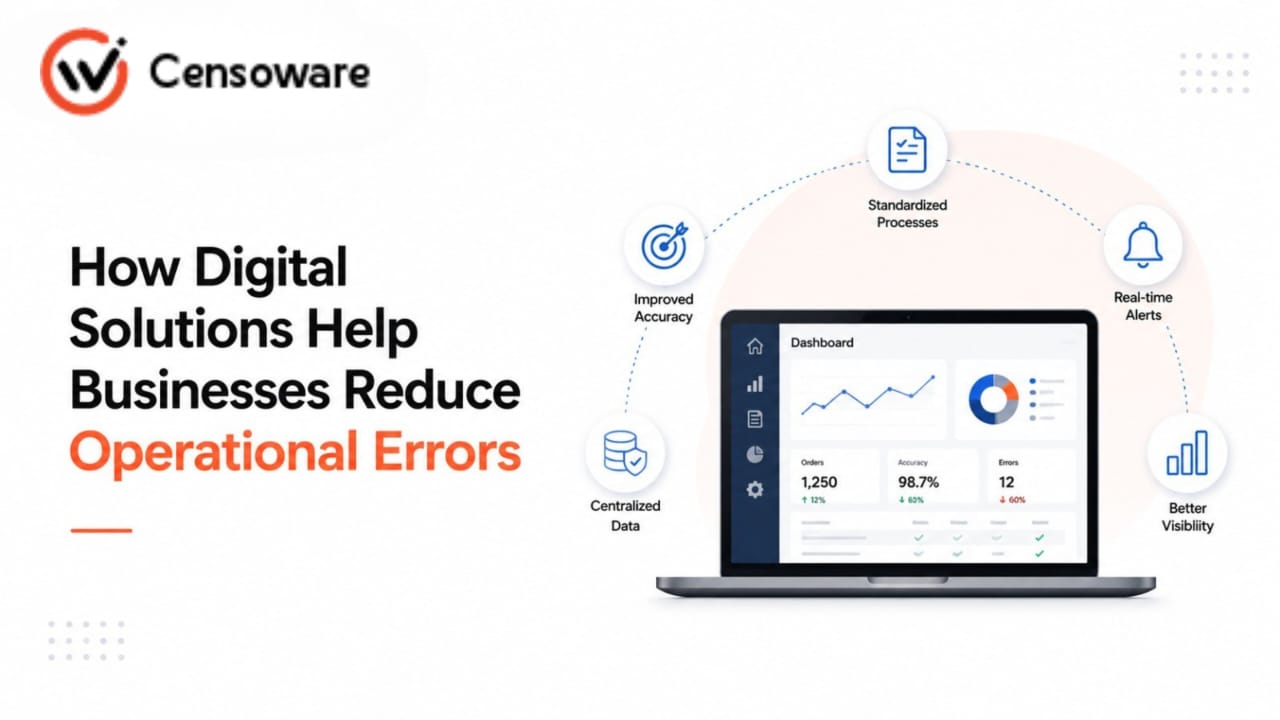
How Digital Solutions Help Businesses Reduce Operational Errors
A practical guide to identifying recurring manual failure points, implementing automated validation and handoffs, and creating sustainable error-reduction workflows.
- Introduction
- Where Operational Errors Most Commonly Start
- How Digital Solutions Address These Failure Points
- Trends in How Businesses Are Catching Errors Earlier
- Getting Started Without a Full System Overhaul
- Measuring the Impact of Reduced Errors
- Building a Culture That Sustains Fewer Errors
- Frequently Asked Questions
Operational errors rarely come from a single dramatic mistake. More often, they build up from small, repeated issues, a mistyped quantity, a missed handoff between departments, an outdated price carried over from an old spreadsheet. Individually minor, these errors add up to real costs in wasted time, unhappy customers, and lost revenue. Digital solutions address this problem not by eliminating human involvement entirely, but by removing the specific points where manual processes are most likely to fail.
This guide explains where operational errors most commonly originate, how digital tools address each of those points, and practical ways a business can begin reducing errors without undertaking a complete system overhaul.
What This Guide Covers
- Where operational errors most commonly originate in a growing business.
- How digital tools reduce errors at each stage of a process.
- Current trends in how businesses are using digital solutions to catch mistakes earlier.
- Practical ways to start reducing errors without a major overhaul.
Where Operational Errors Most Commonly Start
Most operational errors trace back to a small number of recurring situations: information being entered manually more than once, handoffs between departments or systems that are not directly connected, and a lack of a single source of truth that everyone can refer to. When a customer order is entered in one system and then manually re-entered into inventory and shipping systems, each re-entry is a fresh opportunity for a mistake.
Handoffs are particularly error-prone because responsibility for information often becomes unclear. If a sales team updates a customer's order but does not directly notify the fulfillment team, the shipment may go out based on outdated information, not because anyone did their job incorrectly, but because the process itself did not connect the two steps.
How Digital Solutions Address These Failure Points
Digital solutions reduce errors primarily by removing repeated manual entry and creating a single, shared record that every relevant team can access. When an order is entered once and automatically flows through inventory, fulfillment, and invoicing, there is no opportunity for the details to change or be mistyped between steps. Validation rules built into digital systems, such as flagging an order that exceeds available stock or a price that falls outside an expected range, catch mistakes at the moment they occur rather than after the fact.
Automated notifications also close the gap that causes many handoff errors. Rather than relying on someone remembering to inform another department, a digital system can trigger the next step automatically once a condition is met, an order marked ready for fulfillment, a shipment logged as delivered, or a low stock threshold reached.
Trends in How Businesses Are Catching Errors Earlier
Businesses are increasingly using real-time dashboards that surface anomalies as they happen rather than waiting for a monthly report to reveal a problem after the fact. This shift, from retrospective reporting to real-time monitoring, allows staff to correct a mistake within minutes rather than discovering it weeks later during a reconciliation process.
Integration between systems has also become a priority, with businesses moving away from standalone tools that require manual data transfer between them. When a customer relationship management system, an inventory platform, and an accounting system are connected, information entered once is trusted throughout the organization, significantly reducing the number of points where a manual error can be introduced.
Getting Started Without a Full System Overhaul
A business does not need to replace every system at once to see meaningful error reduction. The most effective starting point is identifying the single handoff or manual entry point currently causing the most repeated mistakes, whether that is order entry, inventory updates, or invoice generation, and addressing that specific step first.
Many existing software platforms already offer integration options or validation features that are simply not being used. Reviewing current tools for underused features can often reduce errors meaningfully before a business needs to invest in an entirely new system.
Measuring the Impact of Reduced Errors
Once a digital solution is in place, it is worth tracking a small number of specific error metrics, such as the rate of order corrections, the frequency of inventory discrepancies, or the number of invoices requiring revision, rather than relying on a general sense that things have improved. Comparing these figures before and after adoption gives a business a concrete way to confirm that a new tool or process change is actually working, rather than assuming it based on fewer complaints reaching management.
This kind of tracking also helps identify where errors are shifting rather than disappearing entirely. Occasionally, removing one source of manual entry reveals a second, previously hidden error point further down the process. Reviewing error metrics regularly, rather than only immediately after a new system is introduced, helps a business catch and address these secondary issues before they become significant.
Building a Culture That Sustains Fewer Errors
Technology alone does not fully solve operational errors if the surrounding habits and expectations do not change alongside it. Encouraging staff to report near-misses and small mistakes without fear of blame helps surface weak points in a process before they cause a larger problem, and this kind of open reporting works best when supported by systems that make it easy to log an issue in the moment rather than after the fact.
Regularly revisiting validation rules and automated checks as the business evolves also matters, since a rule that made sense when a business handled one product line may no longer fit once new products, suppliers, or order types are introduced. Treating digital solutions as something to be periodically reviewed and adjusted, rather than configured once and left alone, tends to keep error rates low even as the business continues to grow and change.
Frequently Asked Questions
1. Can digital solutions eliminate operational errors completely?
Not entirely, since human judgment remains part of most processes, but digital tools significantly reduce the most common and repetitive sources of error, particularly duplicate entry and miscommunication between departments.
2. What is usually the biggest source of operational errors in a growing business?
Manual re-entry of the same information across multiple disconnected systems is one of the most common sources, since each re-entry introduces a new opportunity for a mistake.
3. Do I need to replace all my current software to reduce errors?
Not necessarily. Many businesses can reduce errors significantly by better integrating or fully using the features already available in their current systems before investing in new ones.
4. How quickly can a business expect to see fewer errors after adopting digital tools?
Improvements in areas like order entry and data duplication are often visible within weeks, while broader gains from real-time monitoring tend to build over a longer period.
5. Where should a business start if it wants to reduce operational errors?
Start by identifying the specific step, whether order entry, inventory updates, or a handoff between departments, that generates the most repeated mistakes, and address that step first.
Final Thoughts
Operational errors are rarely the result of careless staff; they are usually the predictable outcome of processes that rely on repeated manual entry and unclear handoffs between teams. Digital solutions address this by creating a single, shared source of information and by automating the handoffs where mistakes are most likely to occur.
Businesses do not need a complete system overhaul to see results. Identifying and addressing the single most error-prone step in a process is often enough to produce a noticeable, measurable improvement.
Censoware builds custom digital solutions and workflow automations designed to eliminate manual errors and streamline business operations. Ready to optimize your operational processes?